Here is the complaint in Nanticoke Lenni-Lenape Tribal Nation v. Hoffman (D. N.J.):
Author: Matthew L.M. Fletcher
WaPo: “As salmon vanish in the dry Pacific Northwest, so does Native heritage”
Here.
Federal Court Dismisses Claim against Utah Police for Shooting Indian Man
Here are the materials in Jones v. United States (Fed. Cl.):
NYTs: “Native Alaskans Study and Clean Up a Legacy of Pollution”
Here.
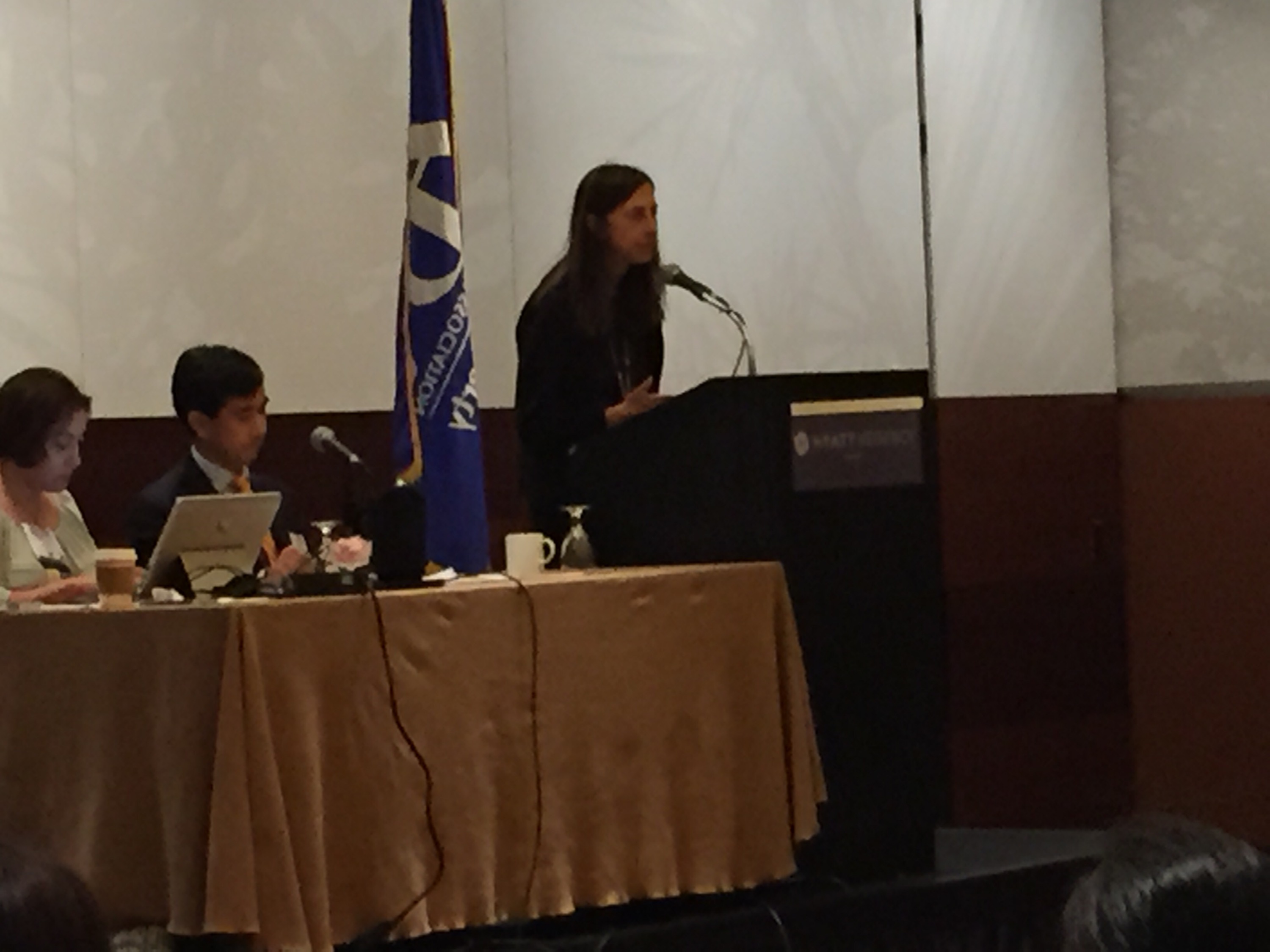
Mary Smith Speaking before the ABA House of Delegates

Michael Blumm on Federal Reserved Water Rights
Michael C. Blumm has posted “Reserved Water Rights as a Rule of Law” on SSRN. Here is the abstract:
The reserved water rights doctrine is — and always has been — a controversial doctrine in Western water law circles because it provides a federal trump over state systems of water allocation. First articulated by the U.S. Supreme Court over a century ago, states and their water rights holders have always resisted implementation of federal water rights because the federal government and its trustee Indian tribes often have different water priorities than the states, long committed to diversionary rights largely for irrigated agriculture.
In Idaho, opposition to federal water rights largely succeeded in defeating water for wilderness, national forests, national recreational areas, and other federal conservation lands in the decisions by state courts in the massive Snake River Basin Adjudication (SRBA). Now, in an Idaho Law Review article, two advocates for state water rights who helped defeat federal water rights in the SRBA proffer a theory that, if accepted by other Western states, would export their Idaho victories.
This response to their effort explains why their theory is flawed and should be rejected by Western state courts. Their argument was in fact not adopted by the Idaho Supreme Court, which employed other reasoning for rejecting federal reserved water rights. This essay maintains that, although Congress certainly has the power either to affirm or reject water rights for federal lands, the idea that water rights may be lost by mere congressional discussion of the doctrine followed by a decision not to take action cannot be interpreted as a rejection of a legal doctrine over a century old. There is no support for interpreting congressional inaction to reverse a long settled legal doctrine like federal reserved water rights — and the costs imposed on federal interests, especially in terms of instream flows, would be significant.
Navajo Nation DOJ Job Posting
ASSISTANT ATTORNEY GENERAL POSITION
TAX AND FINANCE UNIT
NAVAJO NATION DEPARTMENT OF JUSTICE
The Navajo Nation Department of Justice is seeking an energetic and motivated Assistant Attorney General to manages a component “Tax and Finance Unit” The qualified applicant will provide legal advice and representation to various programs, departments and divisions of the Navajo Nation government, regarding a wide range of legal issues, including statutory and regulatory grounds for local authority, contract disputes and procurement issues, and intergovernmental relations. Emphasis will be in the area of Tax, Retirement, Insurance, Finance and Office of Management and Budget.
Current active state bar licensure in any state is required, with the expectation that within a year of hire, the applicant will obtain licensure in the Navajo Nation as well as one of the following states: Arizona, New Mexico or Utah. Preferred qualifications are current membership in good standing in the Arizona, New Mexico, or Utah State Bar Association and the Navajo Nation Bar Association.
Please direct applicant packets consisting of (1) Letter of Interest with current address, telephone numbers, and e-mail address; (2) Navajo Nation employment application; (3) resume; (4) recent legal writing sample; (5) copy of bar membership certificates; and (6) law school graduation documents to Navajo Nation Department of Justice, Attention: Kandis Martine, Acting Assistant Attorney General, Human Services and Government Unit, P.O. Box 2010, Window Rock, AZ 86515, and to the Navajo Nation Department of Personnel Management, P.O. Box 7080, Window Rock, Arizona, 86515.
Please visit http://www.dpm.navajo-nsn.gov/jobs.html to obtain a copy of the Navajo Nation employment application. This position number #202237 will soon be listed on the Navajo Nation’s Job Vacancy Announcement document. Applications are currently being accepted. For any questions, please contact Ethel B. Branch, Attorney General at 928/871-6345.
ABA Young Lawyers Division Panel “YLD Forty Years Later: What is the State of Young Native American Lawyers in the Legal Profession?”

Keepseagle Settlement Modification Materials
Here are selected materials from Keepseagle v. Vilsack (D. D.C.):
779-1 Keepseagle Motion to Modify
782 Plaintiffs Opposition to Motion to Modify
784 Great Plaints Plaintiffs Amicus Brief
787 Intertribal Ag Council Amicus Brief
Here is Judge Sullivan’s opening commentary:
This case places the Court in the unenviable position of enforcing a five-year-old bargain that nobody likes. The bargain at issue is not any old contract; rather, it is a settlement agreement that resolved a major civil-rights class action, was approved by the Court in accordance with the Federal Rules of Civil Procedure, and was made final by that approval and the lack of appeal therefrom. The story that led this case to its current posture is as unique as it is disappointing. In brief, the $680,000,000 in damages that were awarded under the settlement agreement was intended to compensate Native American farmers who alleged that the United States Department of Agriculture discriminated against them personally. The agreement created a claims process for distributing this money, but the claims process failed and $380,000,000 remains undistributed. The scope of this failure is monumental; the reasons for it remain unclear.
The agreement was finalized before the claims process began, so no one anticipated such a large amount of excess funds. But the parties did anticipate that some money might be leftover, so they included in their settlement agreement a cy presprovision, which directs that all leftover funds be distributed in equal shares to a group of charities that serve Native American farmers and ranchers that were to be chosen by Class Counsel. Now, faced with the prospect of over half of the plaintiffs’ damages being distributed in equal shares to charities nominated by Class Counsel, many class members regret that part of their agreement and want to change it. Principal among those class members is Marilyn Keepseagle, who has asked the Court to modify the agreement to create a renewed claims process to distribute more of the money to individual class members. Others, including Class Counsel, ask to modify only the charitable-distribution procedures to accommodate the large amount of money to be distributed by: (1) allowing it to be distributed in unequal shares scaled to an organization’s capacity; (2) spreading the distribution over twenty years; and (3) placing distribution decisions in the hands of a trust run by Native American leaders.Unless there is a legal basis for this Court to modify the agreement, the Court must enforce the agreement reached in 2011. Doing so would frustrate all parties’ goals. Contrary to the Keepseagles’s wishes, the funds would remain entirely for charitable distribution. Contrary to the goals of Class Counsel and the government, that charitable distribution would be pursuant to the arguably inefficient procedures that were designed to handle a much smaller amount of money. This result could be viewed as both unjust and inefficient. Over half of the class’s damages would be distributed to third parties, despite the relative ease with which class members could be identified, the claims process reopened, and previously successful claimants permitted to prove that they suffered damages in excess of the compensation they have obtained.The Court’s role is not to craft a new compromise based upon the Court’s own views about the appropriate amount of compensation due to class members who alleged decades-long, and, in many cases, life-altering discrimination at the hands of their federal government. Nor is it to create a preferred process for distributing the funds to charity. Before the Court is a simple question: Are any of the narrow circumstances in which a court’s final judgment may be modified present in this case?
The avenues proposed by the parties for unilateral modification—Class Counsel’s attempt to realign the charitable-distribution procedures pursuant to Federal Rule of Civil Procedure 60(b)(5), and the Keepseagles’s attempt to reopen the claims process pursuant to the legal doctrine governing unclaimed funds as well as Rules 60(b)(5) and 60(b)(6)—are simply inapplicable, as the Court discusses in detail in Parts II.A and II.B of this Opinion. Absent a way to modify the agreement unilaterally, the parties must come to a consensus themselves, which their settlement agreement defines as “the written agreement of the Parties.” As the Court finds in Part II.C, this language requires more than the agreement of Class Counsel and the government, over the objection of at least one class representative and many class members, which is what is presented by Class Counsel’s proposed modification. It also requires more than an alignment between Class Counsel, the class representatives, and members of the class, who would all prefer that the money be distributed directly to class members. Because there is no consensus within the meaning of the agreement, and because the parties’ proposals for unilateral modification are legally insufficient, the Court DENIES both pending motions for modification of the settlement agreement. The Court expects that there will be review of the legal conclusions reached in this Opinion by appellate courts. Upon resolution of appellate proceedings, if this Court’s legal conclusions are undisturbed, the Court will grant the Parties a period of time to negotiate an agreement that they may jointly present to the Court.


You must be logged in to post a comment.