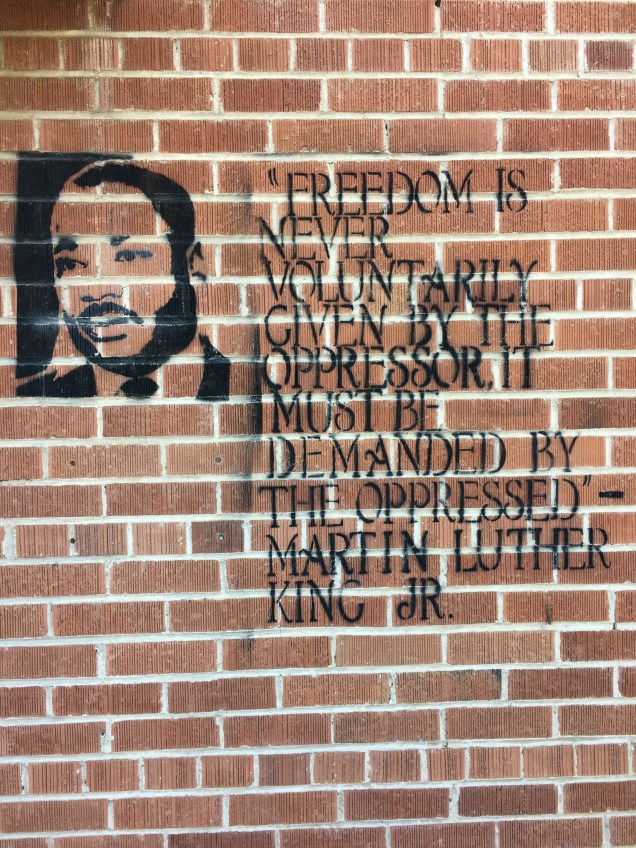
MLK


Dean Kevin K. Washburn has posted “Agency Pragmatism in Addressing Law’s Failure: The Curious Case of Federal ‘Deemed Approvals’ of Tribal-State Gaming Compacts,” forthcoming in the Michigan Journal of Law Reform.
Here is the abstract:
In the Indian Gaming Regulatory Act of 1988 (IGRA), Congress imposed a decision-forcing mechanism on the Secretary of the Interior related to tribal-state compacts for Indian gaming. Congress authorized the Secretary to review such compacts and approve or disapprove each compact within forty-five days of submission. Under an unusual provision of law, however, if the Secretary fails to act within forty-five days, the compact is “deemed approved” by operation of law but only to the extent that it is lawful. In a curious development, this regime has been used in a different manner than Congress intended. Since the United States Supreme Court held part of IGRA unconstitutional in 1996, the Secretary declined to issue an affirmative approval or disapproval on more than seventy-five occasions—thus, allowing a compact to become approved by operation of law—but has simultaneously issued a letter setting forth legal objections to aspects of the compact. The Secretary’s creative response to a broken regulatory scheme appears to be unique, and it raises interesting questions about how the executive branch should behave in the face of legal uncertainty. It raises questions of administrative law, such as whether the Secretary’s non-action is reviewable as agency action under the Administrative Procedure Act (APA), whether the Secretary’s letter is entitled to deference, and if so, what level of deference. It also raises important questions about whether such action constitutes good policy. This Article examines some of those questions.
Here, now titled “American Indians: Law, Politics, Culture — A Bibliography.”
Here, by Prof. Darcy Lindberg.
Multiple parties and amici filed strong briefs in the Brackeen v. Zinke case in the Fifth Circuit yesterday. Twenty-one state attorneys general filed an amicus brief in support of the law, as did 325 tribal nations and 57 tribal organizations. 30 child welfare organizations also signed on to the Casey Family Programs “gold standard” brief. Law professors from more than 20 law schools signed on to the three law professor amicus briefs.
Appellee states and individual plaintiffs will file theirs by February 6. Oral arguments are expected the week of March 11.
Merits
Amicus Briefs
Constitutional Law Professors Amicus Brief
Casey Family Programs and Thirty Child Welfare Organizations
325 Tribal Governments and 57 Tribal Organizations Amicus Brief
Here is the petition in Miccosukee Tribe of Indians of Florida v. United States:
Question presented:
The 2014 Tribal General Welfare Exclusion Act states that, for income tax purposes, “[g]ross income does not include the value of any Indian general welfare benefit.”
The question presented is whether contrary to that plain command, gross income includes “Indian general welfare benefits” when those benefits are derived from gaming revenue pursuant to the 1988 Indian Gaming Regulatory Act.
Here is the petition in Jim v. United States:
Questions presented:
Whether treaties with Indian tribes must be construed consistent with that tribe’s present-sense understanding of the treaty.
Whether the Miccosukee Tribe’s long-standing method of compensation for use of Tribal member lands and distributing revenue from land to its members can be considered a “mere formalism” to avoid inclusion and taxation as income to the members when the Tribe’s chosen method of compensation is soundly in line with federal law and policy.
Whether the Assistant Secretary of the Interior through its designated representative can interpret, waive, modify or exempt payments made to tribal members from inclusion as income.
Lower court materials here.
UPDATE:
Here:
Question presented:
Whether the Tenth Circuit panel violated the current jurisprudence of this Court and the Congressional policy underlying IGRA by precluding the Nation from exercising its sovereign authority to permit a patron’s tort claim against the Nation and its gaming facility to be brought in state court without express congressional permission.
Lower court materials here.
UPDATE (3/14/19):
Here are the materials in Alaska Logistics LLC v. Newtok Village Council (D. Alaska):
25 answer to counterclaims and counterclaims to counterclaims
 Turtle Talk
You must be logged in to post a comment.