Fourth Circuit’s Decision in Moses v. CashCall

Here are the materials:

CashCall Opening Brief

Moses Brief

CashCall Reply

Amicus Brief — Bankruptcy Attys

Amicus Brief — Chapter 13 Trustees

CA4 Opinion

An excerpt:

This bankruptcy appeal presents the issue of whether two claims, one for declaratory relief and one for money damages, asserted by debtor Oteria Moses in an adversary proceeding, are subject to arbitration. The bankruptcy court retained jurisdiction over the first claim and denied the motion of CashCall, Inc. to compel arbitration. With respect to the second claim, it made recommended findings of fact and conclusions of law, likewise to retain jurisdiction over the claim and deny the motion to compel arbitration. On appeal from the bankruptcy court, the district court affirmed the bankruptcy court’s denial of the motion to compel arbitration as to the first claim and, itself, denied the motion to compel arbitration with respect to the second claim.
On appeal, we hold, for the reasons given by Judge Niemeyer in Parts I, II.A, and III of his opinion, in which Judge Gregory joined, that the district court did not err in affirming the bankruptcy court’s exercise of discretion to retain in bankruptcy Moses’ first claim for declaratory relief. We also hold, however, that the district court erred in retaining in bankruptcy Moses’ claim for damages under the North Carolina Debt Collection Act and denying CashCall’s motion to compel arbitration of that claim. Judge Gregory and Judge Davis wrote separate opinions concurring in that judgment. Judge Niemeyer wrote a separate opinion on that issue, dissenting.
Accordingly, the judgment of the district court is affirmed in part and reversed in part, and this matter is remanded to the district court with instructions to grant CashCall’s motion to compel arbitration on Moses’ second claim for damages.
William Mitchell Law Review: “Environmental Justice and Tribal Environmental Regulation”

Here:

Environmental Justice and Tribal Environmental Regulation
Stephen V. Quesenberry, Timothy C. Seward, and Adam P. Bailey, Tribal Strategies for Protecting and Preserving Groundwater

Richard Duncan and Christiana Martenson, I Can See Clearly Now: The EPA’s Authority to Regulate Indian Country Under the Clean Air Act

Jamie Kay Ford and Erick Giles, Climate Change Adaptation in Indian Country: Tribal Regulation of Reservation Lands and Natural Resources

Philomena Kebec, REDD+: Climate Justice or a New Face of Manifest Destiny? Lessons Drawn from the Indigenous Struggle to Resist Colonization of Ojibwe Forests in the Nineteenth and Twentieth Centuries

Liza Guerra Garcia, “Free the Land”: A Call for Local Governments to Address Climate-Induced Food Insecurity in Environmental Justice Communities 

Paula Goodman Maccabee, Tribal Authority to Protect Water Resources and Reserved Rights Under Clean Water Act Section 401

Deadspin: “Paiute Tribal Leader Faces Impeachment For Taking Redskins Gifts”

Here.

Federal Court Rejects Gaming Bid of MOWA Band of Choctaw Indians

Here are the materials in State of Alabama v. 50 Serialized JLM Games (S.D. Ala.):

8 Alabama Motion to Remand

10 MOWA Motion to Dismiss

23 Alabama Response to Motion to Dismiss

31 MOWA Amended Notice of Removal to Federal Court

32 Alabama Surreply re Motion to Remand

36 Magistrate Report

39 DCT Order

Federal Court Rejects Mackinac Tribe’s Bid for Federal Recognition

Here is the order in Mackinac Tribe v. Jewell (D. D.C.):

19 DCT Order

Briefs are here.

NIGC Prevails in Dispute with City of Duluth over the Fond du Luth Casino

The D.C. District Court granted the NIGC’s motion for summary judgment and dismissed the City’s APA challenge to the Fond-du-Luth NOV. Here is the order in City of Duluth v. National Indian Gaming Commission (D. D.C.):

APA case — District Court Op. (March 31 2015)

An excerpt:

Plaintiff City of Duluth, Minnesota, brings this action challenging a Notice of Violation (“NOV”) that the National Indian Gaming Commission (the “Commission”) issued to the Fond du Lac Band of Lake Superior Chippewa (the “Band”) with respect to Band’s gaming establishment in the City of Duluth. This action is the latest step in a long saga pertaining to the relationship of the Band and the City of Duluth with respect to gaming, including proceedings in federal court in Minnesota, before the National Indian Gaming Commission, and, now, before this Court as well. In a nutshell, in the NOV, issued July 12, 2011, the National Indian Gaming Commission informed the Band that the 1994 Agreement between the Band and the City of Duluth violated the requirement that the Band have the “sole proprietary interest” in the gaming activity pursuant to the Indian Gaming Regulatory Act of 1988. The City of Duluth filed this action pursuant to the Administrative Procedure Act, claiming that the NOV, first, was arbitrary, capricious or otherwise not in accordance with law, and, second, exceeded Defendants’ authority under the Indian Gaming Regulatory Act. The City of Duluth requests that the NOV be set aside and requests related declaratory and injunctive relief. The Federal Defendants—the Commission and Jonodev Chaudhuri, in his official capacity as Acting Chairman of the National Indian Gaming Commission—argue that the NOV neither was arbitrary or capricious nor exceeded the scope of the Commission’s authority. Before the Court are Plaintiff’s [24] Motion for Summary Judgment and the Federal Defendants’ [26] Cross-Motion for Summary Judgment. Upon consideration of the pleadings, the relevant legal authorities, and the record as a whole, the Court DENIES Plaintiff’s [24] Motion for Summary Judgment and GRANTS the Federal Defendants’ [26] Cross-Motion for Summary Judgment. The Court concludes that the NOV was not arbitrary or capricious; that it did not exceed the scope of the Commission’s authority; and that none of the other legal infirmities that Plaintiff identifies are grounds for setting aside the NOV. Accordingly, this case is dismissed in its entirety.

Briefs are here.

ABA Journal Article on the Implementation of VAWA’s Tribal Jurisdictional Provisions

Here is “Indian tribes are retaking jurisdiction over domestic violence on their own land.”


Livestreaming Sliver of a Full Moon—A Play About Justice for Native Women—Yale Law School—Tues, March 31

Here.

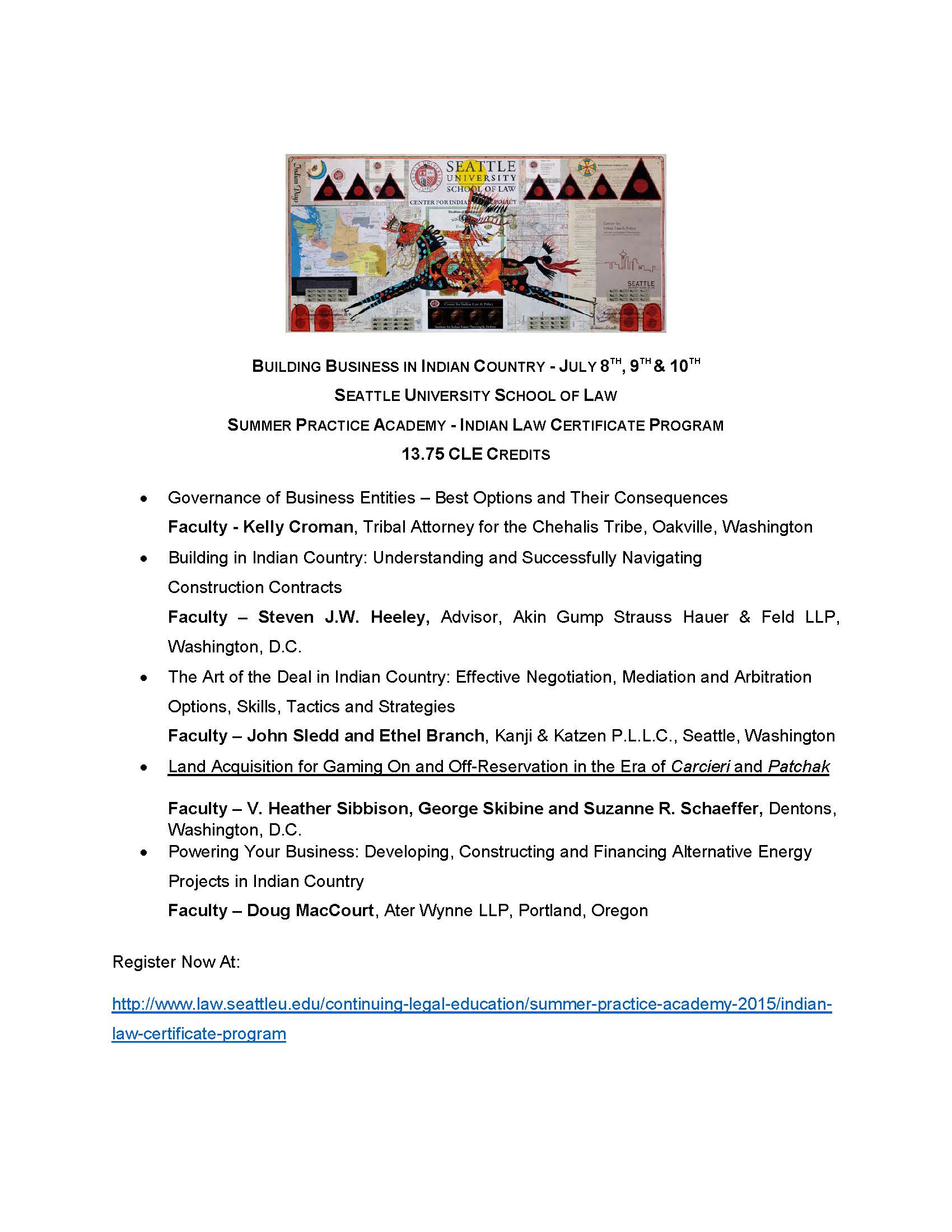
“Building Business in Indian Country” — July 8-10, 2015 — Seattle U. School of Law

Here (PDF):

Building Business in Indian Country.One Page 03.25.2015

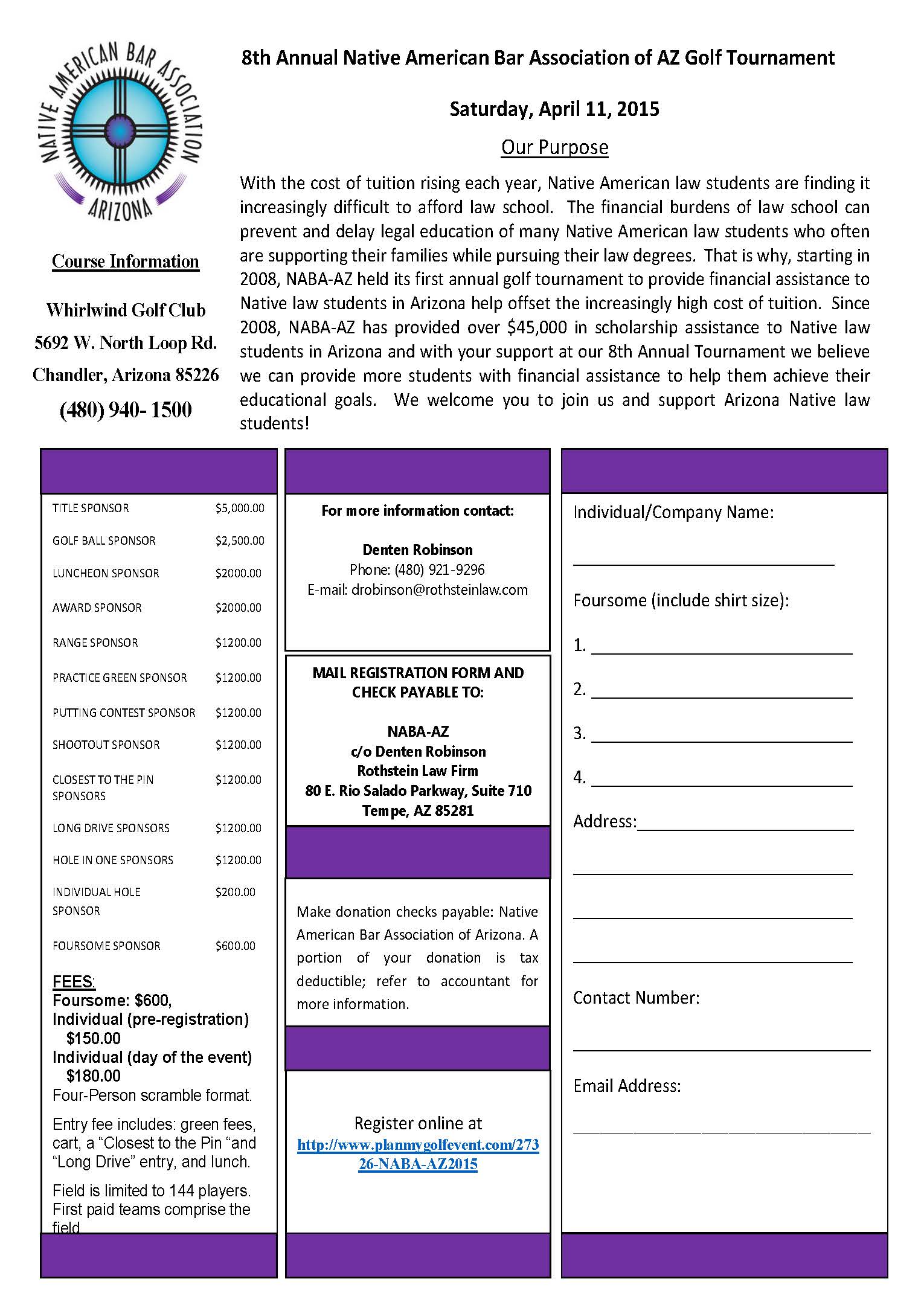
8th Annual Native American Bar Association of AZ Golf Tournament

Here:

NABA AZ Golf Tournament April 11