Author: Matthew L.M. Fletcher
Michigan Journal of Race & Law Reunion This FRIDAY
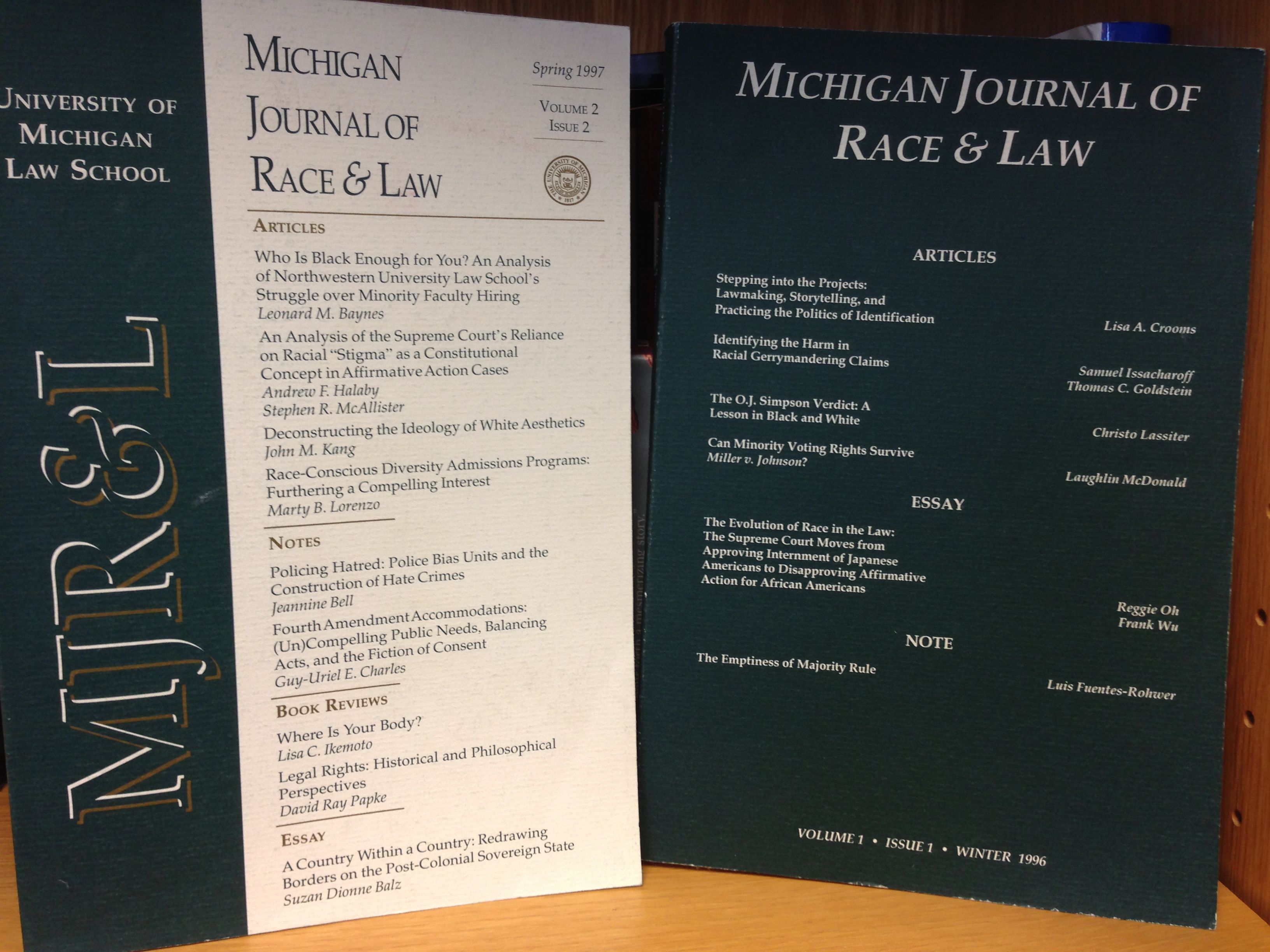
I hope to have more pics to include later in the week but here’s a taste — copies of two of the first four issues of the Journal:
Agenda here. My panel:
Panel I: Beginnings
9:00-10:15 A.M.
Moderator: Matthew Fletcher, ’97, Professor of Law and Director if the Indigenous Law & Policy Center, Michigan State University College of Law
Todd Aagaard, ’97, Associate Professor of Law, Villanova University School of Law
Emily M.S. Houh, ’96, Gustavus Henry Wald Professor of the Law of Contracts, University of Cincinnati College of Law
Travis Richardson, ’96, Richardson & Mackoff
Hardy Vieux, ’97, Martin & Gitner PLLC
New Scholarship on “the Unparalleled Rights Enjoyed by American Indians Born in Canada to Freely Access the United States”
The Seattle Journal of Environmental Law has published “Canadian Indians, Inuit, Métis, and Métis: An Exploration of the Unparalleled Rights Enjoyed by American Indians Born in Canada to Freely Access the United States.”
Here is the abstract:
This article expands on an earlier work published in October 2013, jointly by Bender’s Immigration Bulletin and Western Washington University’s Border Policy Research Institute.
Certain American Indians born in Canada enjoy access to the United States unrestricted by the Immigration and Nationality Act, a right stemming from the Jay Treaty of 1794. An examination of this right, reflected by codification as § 289 of the INA, reveals qualifying ABCs are entitled to privileges unparalleled by all but United States citizens to enter and remain in the U.S. “for the purpose of employment, study, retirement, investing, and/or immigration” or any other reason.
Elizabeth Kronk Warner on Lessons from the Tribal Environmental Laboratory
Elizabeth Kronk Warner has posted “Justice Brandeis and Indian Country: Lessons from the Tribal Environmental Laboratory” on SSRN. Here is the abstract:
Justice Brandeis first famously wrote of a system of federalism where states would serve as laboratories of regulatory experimentation, allowing other states and the federal government to benefit from successful regulatory experiments. Although likely beyond the contemplation of Brandeis, tribes, as separate sovereigns existing within the United States, are well-placed to experiment in new and interesting ways. In particular, given their unique connection to the land and the intensified threat of some modern environmental challenges, many tribes are already engaged in regulatory innovation related to environmental law. This is the first scholarly work to fully develop the idea of tribes as “laboratories” for examining environmental law, demonstrating that tribal experimentation can generate the same benefits typically ascribed to the system of federalism. This is also the first article to examine how tribes are already innovating in areas of environmental law outside of tribal codes. The article begins with an examination of federalism and the benefits, such as states as laboratories, typically attributed to the system of federalism. Having provided an introduction, the article then explains how federalism itself is not required to achieve the benefits associated with it, arguing that tribal regulatory experimentation can yield similar results. Next, the article establishes the modern-day need for environmental regulatory experimentation given the lack of innovation occurring at the federal level. And, finally, the article takes a deep look into forms of tribal environmental law related to the regulation of environmental pollution and climate change other than code provisions. Such an examination is particularly helpful given the potential for governments to use such legal tools to fill existing regulatory gaps and the ease with which innovations in this field can be diffused amongst other governments. Having considered these other forms of tribal environmental laws, the article then develops some initial thoughts of how tribes, the states and the federal government may benefit from innovations occurring within the tribal environmental laboratory. Tribal environmental law is particularly exciting given its ability to transcend federal and state environmental law. This section of the article then ends with a call for additional tribal environmental innovation within this area. Ultimately, the article concludes that, by enacting environmental laws to meet their unique tribal needs, many tribes are creating and innovating in the field under their unique powers as separate sovereigns within the United States.
Carrie Menkel-Meadow on the Canadian Indian Residential Schools Settlement
Carrie Menkel-Meadow has posted “Unsettling the Lawyers: Other Forms of Justice in Indigenous Claims of Expropriation, Abuse, and Injustice” on SSRN. It is published in the University of Toronto Law Journal in a symposium on the Indian Residential Schools Settlement. When we have the other papers, we will post.
Here is her abstract:
This article considers, from the experience of the Indian Residential Schools Settlement, the limitations of the current formal justice system and the common ways that lawyers and parties act within it. Looking at the combinations of lawsuits, settlement negotiations, structured compensation schemes, truth and reconciliation processes, and memorial and education programs now provided for in the IRSS, the article suggests that we may need ‘process pluralism’ and different orientations to deal with modern mass harms: now recognized harms (like loss of culture, family, language, as well as physical, mental, and social injury) that the formal legal system has not yet developed the capacity to address. Placing the IRSS in a larger international context, the article suggests that some legal and social recognition of ‘new’ human harms and injuries has necessitated the development of different legal and quasi-legal processes. Whether called ‘restorative,’ ‘transitional,’ or ‘alternative’ justice, new forms of dealing with wrongs, harms, and conflicts will require redesigning legal processes and institutions; legal professional education; and social, cultural, and philosophical orientations to human injuries and ‘redress.’ Not all who are injured (both individually and in groups) want or require the same ‘remedies,’ and our conventional and historical common law and adversarial system must be adapted to the diverse needs of those who are injured by past and unconscionable wrongs, especially when inflicted by major governmental, religious, and civil society institutions and practices.
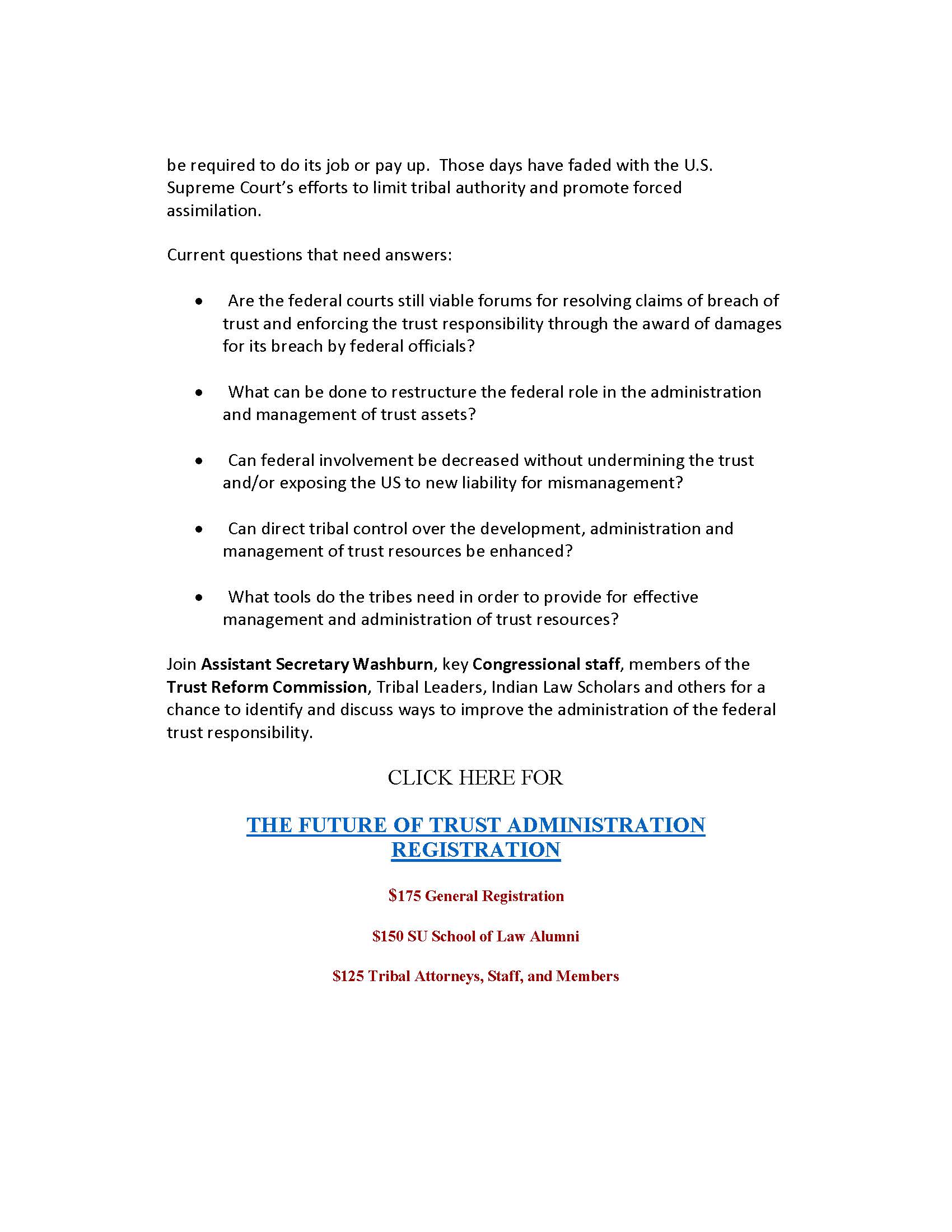
Seattle Law: “The Future of Trust Administration”
Here:
Internships in the Office of the General Counsel of the Smithsonian Institution
Here:
Interested applicants should apply through the Smithsonian‘s online application system, https://solaa.si.edu/solaa/SOLAAHome.html, and include a cover letter, resume, law school transcript, and writing sample (transcripts need not be official, unofficial transcripts may be submitted electronically). The Smithsonian will accept applications for: the fall internship between January 15 and May 15; the spring internship between May 15 and October 1; and the summer internship between September 1 and January 15. Positions will be open until filled, that is, the Smithsonian may review applications as received and encourages interested students should submit applications early within the relevant application window.
Eleventh Circuit Briefs in Alabama v. PCI Gaming
Justice Mike Cavanagh and Judge Mike Petoskey at the Wisconsin, Minnesota and Michigan State and Tribal Judges Forum
Here:

State ex rel Attorney General v. Grand River Enterprises — New Mexico
From April:
An excerpt:
Defendant Grand River Enterprises Six Nations, Ltd., a tobacco company, appeals the district court’s denial of its motion to set aside a default judgment entered against it in an action brought by the State to force Grand River to contribute money into New Mexico’s tobacco escrow fund. On appeal, Grand River argues that the default judgment must be set aside because (1) the State failed to comply with the rules governing the service of process on foreign corporations; and (2) the district court did not have personal jurisdiction over Grand River when it entered the default judgment. Because we agree with Grand River that the district court lacked personal jurisdiction, we conclude that the district court’s default judgment is void and must be set aside.


You must be logged in to post a comment.