Federal Court Enjoins Seneca Member-Owned “All Of Our Butts” from Selling Smokes in New York City

Here are the materials in City of New York v. Gordon (S.D. N.Y.):

DCT Order Granting Injunction

City Motion for PI

Gordon Motion to Dismiss

An excerpt:

Plaintiff, the City of New York (“the City”), brought this action seeking injunctive relief, penalties, and damages for violations of the Prevent All Cigarette Trafficking Act (“PACT Act”), 15 U.S.C. § 375 et seq.; the Contraband Cigarette Trafficking Act (“CCTA”), 18 U.S.C. § 2341 et seq.; the Cigarette Marketing Standards Act (“CMSA”), N.Y. Tax L. § 483 et seq.; and the Racketeer Influenced and Corrupt Organizations Act (“RICO”), 18 U.S.C. § 1961 et seq. The City has moved for a preliminary injunction pursuant to Rule 65(a) of the Federal Rules of Civil Procedure, enjoining Defendants Robert and Marcia Gordon (together “the Gordon Defendants”) from violating the PACT Act and the CMSA; and Defendants Marcia Gordon and Regional Integrated Logistics, Inc. d/b/a Regional Parcel Services (“RPS”) from violating the CCTA. Defendants have moved to dismiss the case for failure to state a claim under Rule 12(b)(6) of the Federal Rules of Civil Procedure. For the reasons that follow, the City’s motion for a preliminary injunction is GRANTED, and the Defendants’ motions to dismiss are DENIED.
Two Papers from Elizabeth Kronk

Indian Claims and the Court of Federal Claims: A Legal Overview, Historical Accounting and Examination of the Court of Federal Claims’ and Federal Circuit’s Impact on Federal Indian Law
6 Journal of the Federal Circuit Historical Society 59 (2012)
Elizabeth Ann Kronk
Abstract:

Many would argue that the history of the federal government’s relationship with Indian tribes is replete with examples of atrocities and shameful actions on the part of the federal government (which is not to say that Indian tribes have been historical angels). Through the Court of Federal Claims, and its predecessor the Indian Claims Commission, Indian tribes have been able to pursue monetary claims against the federal government for these historic and modern injustices. The history of Indian claims in the United States Court of Federal Claims is an interesting and multifaceted one. Although many Indian tribes regularly bring claims to the Court of Federal Claims today, this was not always the case. This article seeks to trace the history of Indian claims in the Court of Federal Claims and also discusses how decisions of the Court of Federal Claims and United States Court of Appeals for the Federal Circuit have significantly impacted the development of federal Indian law. To accomplish this goal, the article begins with a general examination of federal Indian law and of the history of Indian claims in the Court of Federal Claims. The article then examines some key decisions of the Court of Federal Claims and Court of Appeals for the Federal Circuit that have significantly impacted the development of federal Indian law.


One Statute for Two Spirits: Same-Sex Marriage in Indian Country
JURIST Forum, April 2013
Elizabeth Ann Kronk

Abstract:

On March 15, 2013, the Little Traverse Bay Bands of Odawa Indians (LTBB) became the third tribal nation to recognize same sex unions. The LTBB statute, Waganakising Odawak Statute 2013-003, defines marriage as “the legal and voluntary union of two persons to the exclusion of all others.” The Coquille Tribe, in 2009, and Suquamish Tribe, in 2011, both previously recognized same sex unions. Unlike the Coquille Tribe, located within Oregon, and the Suquamish Tribe, located within Washington, LTBB’s tribal territory is located within Michigan, a state that does not currently recognize same sex marriages. Accordingly, some may question the authority of LTBB and similarly situated tribal nations to enact provisions, such as the Waganakising Odawak Statute 2013-003, that conflict with state policy. This article addresses issues surrounding the authority of tribal nations to enact provisions allowing for same-sex marriage or unions.

Univ. of Montana Law Dean Posting

Dean of the School of Law
Tracking Code
705-254
Job Description

The University of Montana seeks a Dean to lead its School of Law as it begins the second century of its distinguished history.

Founded in 1912, the School of Law is an established leader in legal education, preparing students for serving people in the practice of law through effective integration of theory and practice. Our curriculum begins with an innovative skills-based law-firm program in the first year, continues with intensive trial and transactional simulation courses in the second year, and finishes with a required third-year clinical program offering professional placements at both in-house law clinics and government and public-interest law offices.Beyond preparing students for practice, our curriculum emphasizes areas of law significant to the Rocky Mountain West including natural resource law, environmental law, and Indian law.

At a challenging time for legal education, the success of Montana’s model in training and placing lawyers has earned it recognition as one of the best-value law schools in the nation. Our strengths allow us to attract a small, diverse, talented, and tightly knit student body, and have made us one of a handful of law schools to attract significantly more applicants this year than last. As Montana’s only law school, we enjoy a close connection to the Montana bench and bar.

Continue reading →

Washington COA Decision Involving Tribal Immunity from State Criminal Subpoenas

Here is the opinion in State v. Youde:

Washington COA Opinion

An excerpt:

This case involves a prosecution for delivery of marijuana. The investigating agency was the police department of the Tulalip Tribes. The Tribes asserted sovereign immunity in response to a defense subpoena for information the Tribes deemed immaterial. Recognizing that a sovereign entity is not subject to compulsory process, the superior court quashed the subpoena. The court then granted the defendant’s motion to dismiss the prosecution under CrR 8.3(b). The State appeals the dismissal. We hold the court abused its discretion by dismissing the case without first determining whether the subpoenaed information was material. Because the record does not support a finding of materiality, we reverse the order of dismissal.

Briefs are here:

Tribal Court Denies Injunction in Nooksack Disenrollee Challenge

Here are the materials available in Lomeli v. Kelly (Nooksack Tribal Court):

Order Denying Motion for Preliminary Injunction

Defendants Response Brief in Opposition to Plaintiffs Emergency Motion for T

Reply in Support of Plaintiffs Emergency Motion for TRO

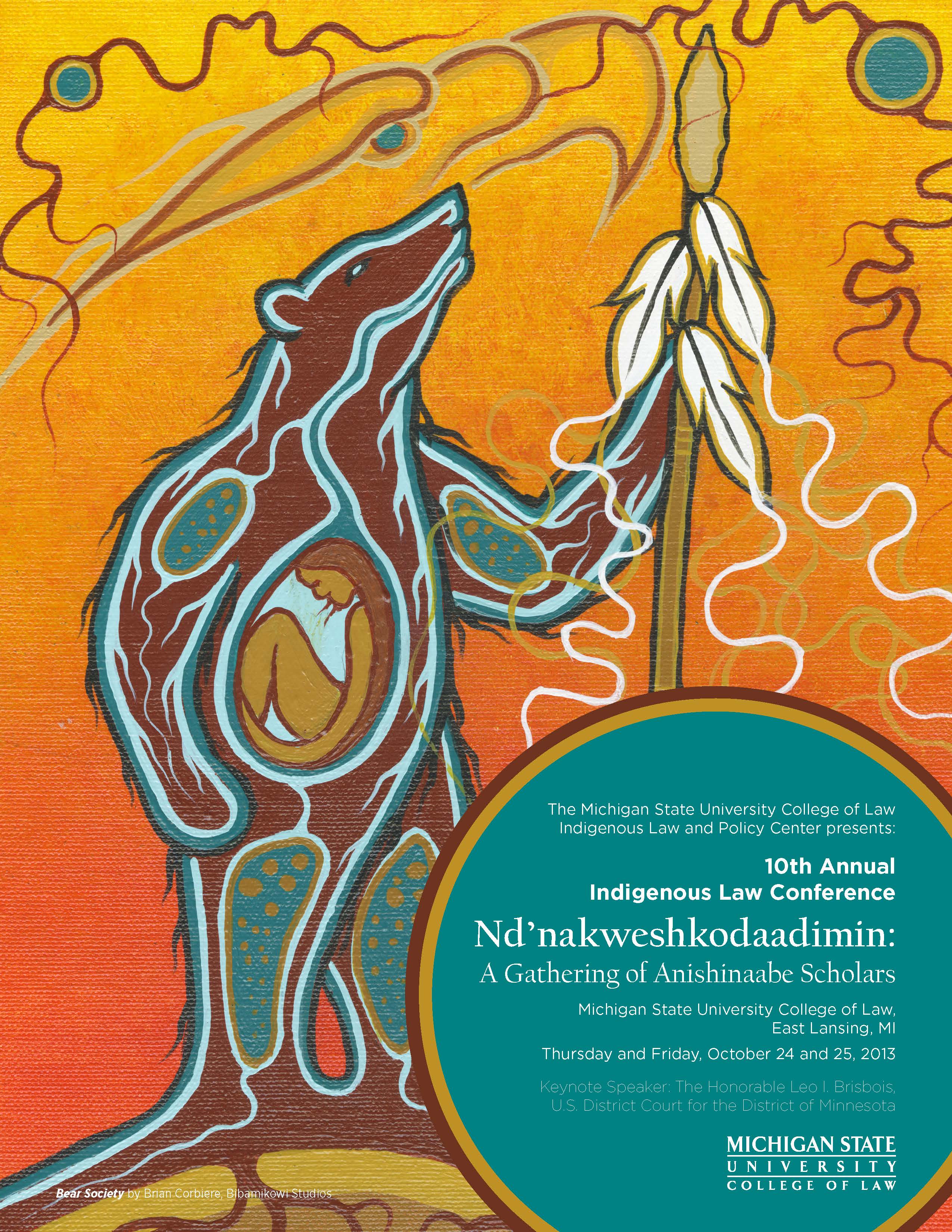
2013 MSU Indigenous Law and Policy Center Annual Conference Announcement

Here (PDF):

13-I&P-34 Indigenous Conference 2013

2013 Minnesota American Indian Bar Association CLE

Friday, June 07, 2013 at Grand Casino Hinckley

Registration details are available at http://www.minncle.org/seminardetail.aspx?ID=102111301.

Speakers include:

  • § Robert Tim Coulter, Executive Director, Indian Law Resource Center, Helena, Montana
  • § Chief Judge Paul W. Day, Leech Lake Band of Ojibwe, Cass Lake
  • § Judge John E. Jacobson, Shakopee Mdewakanton Sioux (Dakota) Community, Prior Lake
  • § Chrissi Nimmo, Assistant Attorney General, Cherokee Nation, Tahlequah, Oklahoma
  • § Judge John P. Smith, Minnesota Court of Appeals, Saint Paul
  • § Megan E. Treuer, Executive Director, Regional Native Public Defense, Cass Lake
  • § Mike Wiggins, Jr., Chairman, Bad River Band of the Lake Superior Tribe of Chippewa Indians, Odanah, Wisconsin

Plus, you won’t want to miss the complimentary reception sponsored by the Minnesota American Indian Bar Association in honor of Margaret (Peggy) S. Treuer, Member of the Leech Lake Band of Ojibwe and Chief Judge of the Bois Forte Band of Chippewa Tribal Court.

Seattle U. Law School/Bristol Bay Native Assn. Fellowship Posting

Exciting Fellowship Opportunity in Alaska!

The Center for Indian Law & Policy at Seattle University School of Law and the Bristol Bay Native Association (BBNA) has developed a project to provide estate planning services to BBNA members. The members reside in 36 villages in a remote area around Bristol Bay, Alaska. We are seeking a full-time Fellow to reside in Dillingham, Alaska, where BBNA is headquartered, for 9 months, from September 2013 through May 2014. The Fellow will travel to villages with BBNA staff to meet with clients and provide estate planning services. The Fellow will be supervised by Center personnel and will have on-site contact with an Alaska Legal Services attorney. This is a unique opportunity for a recent law school graduate to gain hands-on legal experience in a unique location! BBNA members have special estate planning needs, and the Fellow will undergo training on those special needs, as well as estate planning for native Alaskans. Pay: expense stipend of $34,000.

We will begin accepting applications for this Fellowship on May 1, 2013, with the deadline for applications on August 25, 2013.

If you are interested, please submit a cover letter, resume, transcript, and list of 3 references to Erica Wolf, Managing Attorney at wolfer@seattleu.edu.

Minnesota Legislature Passes Bill to “Fix” the Minnesota SCT Decision In re R.S.

Minnesota Legislature Passes Bill to “Fix” the Minn. SCT Decision In re R.S.

HF 252, which was introduced by Rep. Susan Allen, overcame its final hurdle in the Minnesota Legislature by passing the House by a wide margin on May 10th. It passed the Senate with an equally wide margin the previous week and was signed into law on May 16th.

HF 252 reverses the affects of the Minn. SCT’s decision In the Matter of the Welfare of the Child of R.S. and L.S., wherein the Court denied a transfer of jurisdiction to a tribal court in a proceeding at the pre-adoptive stage. HF 252 amends Minnesota Statute 260.771, Subd. 3 to allow for transfers of jurisdiction at all four stages of a child custody proceeding: involuntary foster care placements; termination of parental rights; pre-adoptive; and adoption proceedings. HF 252 is a tremendous accomplishment for the 11 tribes and bands in Minnesota as well as a brave and courageous action by Rep. Allen.

Our prior post on this legislation is here.

Which Supreme Court Justice Are You?

Here.

I choked down my bile and said I “liked” the Mets best out of the four godawful choices they give us (Yankees, Mets, and Bosox also make the list). Go Tigs!