Here is the opinion in United States v. Redlightning. No Indian law issues apparent.
Criminal
Special Prosecutor Files Criminal Complaints against Multiple Navajo Council Members
Here:
A special prosecutor has filed criminal complaints in an investigation of the Navajo Nation Council’s discretionary funds.
The tribe’s Department of Justice said Wednesday that criminal complaints allege conspiracy, fraud, theft, forgery and abuse of office related to management of the funds.
Tribal justice officials didn’t immediately say how many complaints had been issued. Navajo lawmakers were told to call the prosecutor’s office to determine if they are the subject of a criminal complaint.
But lawmakers curious to find out were told they would have to wait until Thursday to see if they’re on the list. Defendants have until the close of business Friday to pick up the complaints and summons or they will be served by police, justice officials said.
“This is probably one list you really don’t want to be on,” said council Delegate LoRenzo Bates.
Tribal Council spokesman Alastair Bitsoi said the position of lawmakers has been that the funds are available to give out to those in need and as they see fit. He said the 88-member council bases its decisions on respect and upholding the public interest.
“They’re innocent until proven guilty,” he said. “They still have to go through the process, and if this is the process, we’ll continue.”
The complaints were announced during the Tribal Council’s weeklong fall session in Window Rock and just ahead of the Nov. 2 election in which nearly three dozen lawmakers are on the ballot.
The council receives millions of dollars a year though supplemental budget appropriations to dole out to elderly Navajos on fixed income, college students, organizations in need or Navajos looking for emergency funding.
Any Navajo can seek financial assistance from a single lawmaker every six months, according to the policy, which has been amended over the years to exclude a limit on how much an individual could receive.
LVD Shooting Indictment — U.S. v. Richard McGeshick
Federal Court Dismisses Indian Country Indictment for Reliance Upon Uncounseled Tribal Court Convictions
Here are the materials in United States v. Shavanaux (D. Utah):
DCT Order Dismissing Shavanaux Indictment
Washington SCT Materials on Off-Reservation Hot Pursuit Case
As Indianz reported, the Washington Supreme Court has decided State v. Eriksen — opinion here and dissent here.
Here are links to the briefs:
80653-5 – State v. Eriksen
Hearing Date – 05/12/2009
- Reply of Petitioner
- Amicus Lummi Nation Brief
- Statement of Additional Auth
- Answer to Petition for Review
- Appellant Brief
- Petition for Review
- Respondents Brief
Minnesota Public Radio: White Earth Pushes for More Law Enforcement
From Minn. Public Radio:
White Earth Indian Reservation, Minn. — Unhappy with the way criminal cases are handled on the White Earth Indian Reservation, tribal officials are seeking more control over law enforcement and the courts.
Tribal officials say local counties don’t prosecute crimes on the reservation aggressively enough.
AN UNEASY RELATIONSHIP
Rape cases particularly are going unpunished on the White Earth reservation, Tribal Attorney Joe Plummer said. Tribal officials want those cases prosecuted to help break the cycle of teen pregnancy and poverty on the reservation.
“These are young girls, 14, 15, 16 years old being impregnated by older men, 21 and older,” Plummer said. “And these are not being prosecuted. I can’t remember when one was prosecuted.”
But county officials strongly disagree. They contend tribal members don’t cooperate with investigators.
The tribe’s dissatisfaction over how criminal cases are handled on the reservation is just one example of the tension between White Earth and Mahnomen County over land, taxes and crime.
“I can’t remember when [a rape case] was prosecuted.”
– Tribal Attorney Joe Plummer
A review of Mahnomen County court records from 2008 to 2009 appears to confirm Plummer’s complaint about the lack of prosecution for criminal sexual conduct cases. But it’s unclear if all of the records from those years are entered in the public database.
When it comes to fighting crime on the White Earth Reservation, counties control the system. The tribe can investigate crimes, but county prosecutors decide who gets charged with a crime.
The two sides often disagree on how cases are handled. It’s one of many areas where the tribe and the county don’t see eye to eye.
COUNTY ATTORNEY: VICTIMS DON’T COOPERATE
Mahnomen County Attorney Julie Bruggeman said she’s not the problem. She said crime victims don’t cooperate with her office.
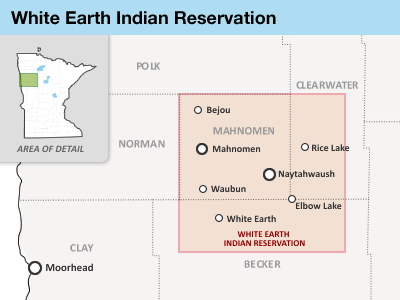
She also questions whether tribal officials really want justice for all the people accused of a crime. Bruggeman accused tribal officials of wanting to pick and choose who is prosecuted based on tribal connections.
Tenth Circuit Affirms Conviction for Theft from Tribal Organization
Here is the unpublished opinion in United States v. Saupitty.
An excerpt:
While serving as the Tax Commissioner of the Apache Tribe of Oklahoma (the “Tribe”), Ms. Saupitty diverted tribal tax revenues to a bank account she established without the Tribe’s knowledge and that she solely controlled. Over a two-year period, she withdrew all of the Tribe’s funds from that account–more than $100,000–which she used to pay for her personal expenses, among other things. She was sentenced to twenty-seven months’ imprisonment, followed by two years of supervised release, restitution of $107,627.65, and 104 hours ofcommunity service.
Prostitution Made Legal in Canada – Aboriginal Women’s Groups Clash
A divisive debate is currently underway among women’s advocate groups after an Ontario court recently struck down some of the laws restricting prostitution in Canada. Even Aboriginal women’s groups are clashing on the matter.
On Sept. 28, in Bedford v. Canada, Justice Himel of the Ontario Superior Court declared three sections of the Canadian Criminal Code pertaining to prostitution as unconstitutional. Here’s the (146 page!) decision. Bedford v. Canada (Attorney General)
Technically, prostitution was never illegal in Canada, in and of itself. Rather, the three sections of the Criminal Code which were struck down, indirectly made it so. They were:
(1) communication for the purposes of prostitution – Section 213(1)(c)
(2) living off of the sex trade – Section 212(1)(j)
(3) the keeping of a “common bawdy house.” – Section 201
In a joint statement by the Aboriginal Women’s Action Network (AWAN) together with Asian Women Coalition Ending Prostitution and South Asian Women Against Male Violence, the authors claimed that the Ontario Court “abandons Aboriginal women and women of colour to pimps.”
Federal Court Denies Habeas Relief to Navajo Man Sentenced to Death (over Navajo Nation’s Wishes)
Some of you might remember this case — the Ninth Circuit’s opinion affirming the death sentence was a big part of the discussion at the FBA Indian Law Conference three years back — US v Mitchell CA9 Opinion.
Here is the district court order on habeas review: Order Denying Mitchell Habeas Relief
The Federal Death Penalty Act, 18 USC 3598, requires federal prosecutors to seek tribal concurrence on the death penalty before seeking the sentence for Indian country crime committed by tribal members. So the Ashcroft Dept. of Justice sought the death penalty under a different jurisdictional statute, and successfully avoided the tribal concurrence provision.
Federal Court Declines to Dismiss Major Crimes Act Indictment on Indian Status Question
The case is United States v. Delacruz-Slavik (E.D. Mich.), and the court held that whether the defendant is an “Indian” is an element of the crime to be decided by a jury. An excerpt:
Defendant notes that he is not an enrolled tribal member and thus does not satisfy the first, and most important, of the Bruce factors. As noted above, this is not an absolute requirement. The government alleges that Defendant has received government recognition through receipt of assistance reserved only to Indians and has enjoyed benefits of tribal affiliation. Namely, Defendant took seven parenting classes at the Nimkee Memorial Wellness Center in 2008, and has had many Nimkee dental, medical and behavior health/mental health and substance abuse appointments between 1996 and 2009. Gov’t’s Response & Brief to Def.’s Mot. to Dismiss Indictment 5. These services allegedly are not available to non-Indians. Id. The government estimates that Defendant has had 100 or more tribal-related organization appointments. The government alleges that Defendants records identify Defendant as an “Indian” and “Native American,” as well as Defendant identifying himself as an “Indian” and “Native American.” Id. Defendant states that he only received some tribal services allowed to him as an immediate family member of a Tribal Member, but that he himself has never qualified for membership and is not a recognized member. Def.’s Mem. in Supp. of Mot. to Dismiss Indictment 2. There is also evidence that Defendant has social recognition as an Indian through residence on a reservation and participation in Indian social life.
Still seems to be an interesting constitutional question whether a jury empaneled in Detroit is really competent to decide beyond a reasonable doubt that a person with the above factors, and who is not an enrolled tribal member, is an “Indian.” Without much doubt, that Detroit jury will consist entirely of non-Indians (and any Detroit Indians will be excluded from the jury, to be sure).
Here are the materials:
 Turtle Talk
You must be logged in to post a comment.