Northwestern Pritzker School of Law: Law School Admissions Conference

Here are details:

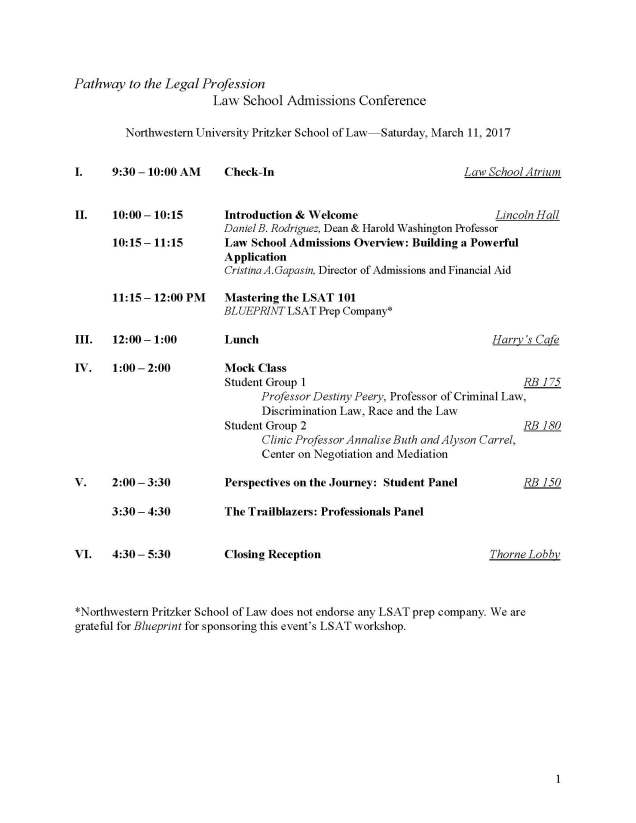
Pathway to the Legal Profession Law School Admissions Conference

Saturday, March 11, 2017 10:00 a.m. – 5:30 p.m. 

Check-in starts at 9:30am

We cordially invite you to attend the Pathway to the Legal Profession Conference. This conference will give prospective law school applicants a comprehensive overview of the law school application process and advice on how to successfully navigate it from applicant to law student. Current law students from diverse, non-traditional backgrounds, including first generation students and students with limited financial means, want to help attendees from similar backgrounds journey from law school applicant, to law school student, to lawyer.

The all-day conference consists of:

  • A workshop on mastering the LSAT
  • A law school admissions presentation
  • Mock law class taught by a real law school professor
  • Various panels made up of diverse lawyers and current law students sharing their wisdom and insight as well as answering your questions
  • Mentorship opportunities
  • Lunch will be provided

The conference will take place at: Northwestern Pritzker School of Law

375 East Chicago Avenue, Chicago, Illinois 60611

Please RSVP at https://goo.gl/forms/THk4Msx1vIjjHuos1. Registration closes March 6th at 5:00 p.m. Space is limited.

Agenda (PDF):

2017-pathway-conference-agenda

Ahniwake Rose: “Why Aren’t We Talking About Native American Students?”

From Education Week, here.

An excerpt:

It’s more than a little upsetting that in more than three hours of testimony before Congress on her nomination to be the new U.S. secretary of education, neither Betsy DeVos nor the members of Congress grilling her said anything—not a single word—about a cohort of more than a half-million American students who will fall under the Department of Education’s remit.

That group? Native American students.

Justice Sotomayor on Diversity at Michigan Law School (and all law schools)

Here is “Justice Sotomayor says lack of black students at UM ‘a real problem.'” HT How Appealing.

An excerpt:

“We are making large improvement towards that kind of equality, but we’re still far from it when you look at the number of African Americans at the University of Michigan, there’s a real problem there,” Sotomayor said.


NYTs on Suit against Havasupai Elementary/United States

Here.

Complaint here.

Law Students: Enter the LSAC 2017 Diversity Writing Competition to win $5000

This year’s LSAC Diversity Writing Competition topic is “Why Pipeline Programs Targeting Students from Underrepresented Racial and Ethnic Backgrounds are Essential to the Future of the Legal Profession.”  Current JD candidates are invited to submit papers addressing this topic.  The deadline for submissions is Friday, March 31, 2017, and LSAC will award three $5000 prizes to the best paper submitted by a 1L, 2L, and 3L/4L.  In addition, one winner will have a chance to publish their entry in the Journal of Legal Education.

We know there are law students following Turtle Talk who could write excellent papers on this topic. LSAC’s rules for submissions are here.

EdWeek: Commentary on Indigenous Ed in Alaska

Here is “Alaska Is Failing Its Indigenous Students” by Evon Parker.

Roxanne Dunbar Ortiz: “The Miseducation of Native American Students”

In Education Week, here.

An excerpt:

While distortions and myths of Native American culture plague many schools, textbooks often fail to mention Native history after the 19th century. In a 2015 study, scholars Antonio Castro, Ryan Knowles, Sarah Shear, and Gregory Soden examined the state standards for teaching Native American history and culture in all 50 states and found that 87 percent of references to American Indians are in a pre-1900s context.

Director of Student Services and Skills Posting for Lakehead University

One contract position (three-year term), Thunder Bay Campus

Highly organized and possessing excellent interpersonal skills, you will play a key role in the administration of our legal program. Working closely with the Dean, you will be responsible for providing the coordination of services for student recruitment and retention, delivering the Integrated Practice Curriculum (IPC), assisting course instructors with developing skills-exercise content for their courses, coordinating the third-year Practice Placement program with legal supervisors, and offering career support for upper level students.

You have a JD or LL.B. degree and three years of legal practice experience. Ideally, you possess membership in the Law Society of Upper Canada, have knowledge of Indigenous communities, and have previous experience with post-secondary administration, program development, and/or post-secondary instructional delivery. Collaborative and able to work with individuals of various backgrounds, you have outreach experience with law firms, legal departments in government organizations, and other community legal entities. Some travel is required.

This position is an initial three-year full-time contract with potential for renewal and is subject to budgetary approval. Salary is commensurate with experience. If you are interested in applying, please submit your curriculum vitae and cover letter outlining your experience to:

Lakehead University – Office of Human Resources
University Centre
Room UC-0003
fax: 807-346-7701
e-mail: careers@lakeheadu.ca

The deadline for applications is December 9, 2016. If you have questions about this position, please feel free to contact, Dean EagleWoman at lawfaculty@lakeheadu.ca.

Lakehead University is committed to creating a diverse and inclusive environment and welcomes applications from all qualified individuals including women, members of visible minorities, Aboriginal persons, and persons with disabilities. If you require accommodations for interviews or other meetings, please contact Human Resources at (807) 343-8334. We appreciate your interest; however, only those selected for an interview will be notified.

Aboriginal & Indigenous Law Faculty Posting for Lakehead University

Tenure Track Position – Aboriginal and Indigenous Law Curriculum

Lakehead University’s Bora Laskin Faculty of Law invites applications for a tenure track position to teach within the Aboriginal and Indigenous Law curriculum. Rank of appointment is commensurate with qualifications, teaching, and research. The appointment will commence on July 1, 2017. Review of applications will begin on November 15, 2016 and continue until the position is filled. Aboriginal and Indigenous candidates are encouraged to apply.

The ideal candidate will have teaching and research expertise in Indigenous legal traditions. Given the Faculty’s presence in Anishinaabe and Métis territory, preference will be given to qualified candidates with research and teaching expertise in either Anishinaabe law or Métis law or both. The Faculty invites candidates to discuss their experience engaging with the language, worldview, traditions, and protocols of an Indigenous people, and the ways in which their teaching and research address the relationship between Indigenous laws and Indigenous languages, worldviews, traditions, and protocols, where such is the case. The Faculty encourages applications from candidates who employ Indigenous pedagogy in their teaching, including land-based pedagogy.

The Bora Laskin Faculty of Law has a tripartite mandate, which includes a focus on Aboriginal and Indigenous law, natural resources and environmental law, and rural and small firm practice. The Faculty’s Integrated Practice Curriculum incorporates the requirement of articling into the Faculty’s three-year program. The Law Society of Upper Canada has approved the Integrated Practice Curriculum; as a result, successful graduates may be called to the bar in Ontario without completing a separate period of articles. Our faculty have experience practicing law, and many of our courses include skills-based exercises. The Faculty encourages applications from those who have experience in the practice of Indigenous law, and who can incorporate Indigenous skills exercise into their courses.

Applicants must have a law degree, and preference will be given to those who also have a graduate degree in law. Complete applications will consist of the following:

  • a cover letter that includes a teaching and research statement;
  • a curriculum vitae,
  • Law transcripts;
  • up to two samples of published research; and,
  • the names and email addresses of three referees.

Complete applications should be sent to:
Dean Angelique EagleWoman
Bora Laskin Faculty of Law
Lakehead University, 955 Oliver Road, Thunder Bay, ON  P7B 5E1
e-mail: lawfaculty@lakeheadu.ca

If you have questions about this position, please feel free to contact Dean EagleWoman, at lawfaculty@lakeheadu.ca. Review of the applications will begin November 15, 2016 and continue until the positions are filled.

A completed Confirmation of Eligibility to Work in Canada form should be submitted with the application.

Lakehead University is committed to creating a diverse and inclusive environment and welcomes applications from all qualified individuals including women, members of visible minorities, Aboriginal persons, and persons with disabilities. We appreciate your interest; however, only those selected for an interview will be notified. Lakehead University is committed to supporting an accessible environment. Please ask us how we may help you by contacting the Office of Human Resources, Lakehead University, 955 Oliver Road, Room UC0003, Thunder Bay, ON  P7B 5E1 (807) 343-8334 or e-mail human.resources@lakeheadu.ca.
“Perils of Indigenous People’s Day”

From the San Francisco Chronicle.

An excerpt:

So when Penn State social studies Professor Sarah Shear examined state history standards around the country in 2014, she found that 87 percent of references to Native Americans in the standards addressed their history before 1900. And not a single state included content about present-day native peoples.

When Shear asked her undergraduate students what they knew about Native Americans, unsurprisingly, they referred only to the woes that native peoples had endured. “They were coming to college believing that all Indians are dead,” Shear noted.