Guest Post — Kevin Washburn: The LSAT’s Key Role in Native Legal Education

THE LSAT’S KEY ROLE IN NATIVE LEGAL EDUCATION

By Kevin Washburn

In this morning’s post on Turtle talk, Mr. Jay Rosner asks what would it mean for Native Americans and law schools that seek to increase their numbers of Native students if the LSAT lost its leading role in legal education.

The answer: it could be bad. Very bad.

Indeed, it could kill the PreLaw Summer Institute (PLSI) at the American Indian Law Center located the University of New Mexico School of Law, which helps Native law students succeed in law school — and helps law schools recruit Native students.

The PLSI program, which is about to celebrate its 50th anniversary, began out of a desire to meet the federal trust responsibility to tribal nations in part by developing more Native lawyers.  It was supported originally with federal funding. It takes a couple of hundred thousand dollars each year provide travel and living stipends to the 25 to 35 students who attend the two-month PLSI program each summer and to pay the professors and staff who run the program. The professors are excellent and it can be a life changing experience for the students. Professors Matthew Fletcher and Wenona Singel have taught in the program, as have many of the other leading law professors in the field.

For years, the program existed at the whim of federal officials, some of whom were supportive, and some who were not. Its funding has tended to vacillate over the years and, indeed, for a couple of years in the 1980s, the program did not exist at all.

At least twice in the PLSI’s history, the Law School Admission Council (LSAC) has come to the rescue when the PLSI program lost federal funding. For decades, the LSAC has annually directed modest revenues from its reserves toward various pipeline programs for law schools, to help poor and minority students gain access to a legal education.

In times of crisis for the PLSI, funding from the LSAC has literally saved the program. In total, during the last three decades, the LSAC has provided more than $3 million in funding at various times to keep the PLSI program alive.

Most of us are ambivalent in legal education about standardized tests, especially the most important one of all, the bar exam. It is true that standardized tests can produce disparate outcomes in scores. No one who sees inequities in society will be surprised by these disparities. Psychometricians who design the LSAT work very hard to identify raw analytical ability and to minimize the advantages that “wealth” might contribute to test scores. But inequality in education surely exists in our society, and none of us are terribly surprised that it cannot be entirely eradicated from tests.

We should keep working on the perfect test that can find a way to eradicate any influence, even indirectly, that socioeconomic factors play. In the meantime, in light of the fact that the bar exam will always be an obstacle to be overcome for anyone seeking to become a lawyer, I am grateful for the pipeline programs supported by the LSAT, and I do not want to see them disappear.  Because of my own personal interest in pipeline programs, I have served within the volunteer board structure of the LSAC and am currently a member of the board. I also recently joined the board of the American Indian Law Center, which runs the PLSI. I am writing today not on behalf of either of these two organizations, but only myself.  From my perspective, the collaboration between the LSAC and the PLSI program has dramatically improved the number of Native American lawyers in the United States. Indeed, the PLSI program is sometimes called the single most successful program in Native American education. That program changed many lives, including my own.

I am glad that Mr. Rosner has asked what it might mean for Native American law school applicants and law schools seeking more Native Americans to lose the support of the LSAC as a leader in legal education. It is important that we all understand the answer: a program that has helped more than a thousand Native Americans succeed in law school in the last 50 years might be at risk. In sum, the answer is that it could be devastating for Native Americans seeking a legal education.
Guest Post — Jay Rosner: The LSAT vs. the GRE: May They Both Lose

The LSAT vs. the GRE:  May They Both Lose

The monopoly that the LSAT has enjoyed for decades in law school admissions appears to be eroding.  What does that mean for Native American law school aspirants, and for the law schools that desire to increase their number of Native students?

Up until yesterday, the fight to be able to use the GRE in law admissions instead of the LSAT had been led by the University of Arizona Law School, which had accepted a small number of students with GRE scores.  A few other law schools had been studying the possibility, but no other law school joined Arizona until yesterday, when Harvard Law announced that they too would consider the GRE from applicants.

For the foreseeable future, the impact on law admissions will be symbolic only.  Arizona and Harvard will each only accept a small number of applicants based upon their GRE scores, and until a few dozen more law schools join them, the total number of applicants affected may be a few hundred out of tens of thousands.  So, while the current discussion may have substantial implications years down the road, today’s applicants will find this a niche play at best.

The LSAT vs. GRE discussion will likely generate more heat than light.   Folks will look at their differences, which are worth noting:

  • The LSAT is a pencil and paper test, while the GRE is delivered on computer;
  • The LSAT is offered only 4 times per year, while the GRE is offered almost continuously throughout the year;
  • ¾ of the LSAT’s bubble sections, generating its score, are verbal, and only ¼ (one section, informally called “Games”) involves some math-related sensibilities, while fully ½ of the GRE bubble sections are straightforward math, and 1/2 are verbal; and,
  • Under the current rules, a student must report an LSAT score to a law school if he/she has taken it, so only students who have taken the GRE and not the LSAT will have their GRE solely considered.

What most LSAT vs. GRE comparisons will miss are the profound and important ways that these two tests are similar, and both deeply problematic.  Both are created by psychometricians using the same methods, so they share these significant characteristics:

  • They both generate significantly disparate results by gender, race and ethnicity, with Native Americans, Latinos and African Americans scoring much lower on both, on average, than whites and Asian Americans, and females scoring lower than males;
  • The foundation for these disparities could be revealed by item level data, which are statistics on individual test questions that test developers routinely refuse to release because they would expose the way that tests are designed to solidify and maintain those disparities;
  • Scores for both are affected by inequitable access to high-quality, often expensive, test prep, with groups like Native Americans penalized because Native students often can’t afford to pay for test prep courses; and,
  • What equity activists need to do is try to reduce, and even eliminate, the weight that any bubble test is given in any competitive admissions (or financial aid, etc.) decision.

While the last concept may seem fanciful in the law school admissions world, we now have many highly selective undergraduate schools, like Wake Forest, Wesleyan, Mount Holyoke, etc., that have years of successful experience with test-optional admissions policies that serve to reduce the bubble-test burden faced by URM students.

Any Native educators supporting either the LSAT or the GRE are, I contend, missing the forest for the trees.   Bubble tests are designed in a way that Native students are placed at yet another disadvantage in admissions, and these tests should be made optional until they are eliminated entirely.

It should be noted that multistate bar scores will tend to correlate with LSAT (or GRE) scores, since all bubble tests have high correlations with other bubble tests.  That’s not a reason to keep the LSAT; that’s a reason to make sure that all Native bar takers have the benefit of high-quality bar-prep courses to leverage their ability to get their best score on the multistate.


Northwestern Pritzker School of Law: Law School Admissions Conference

Here are details:

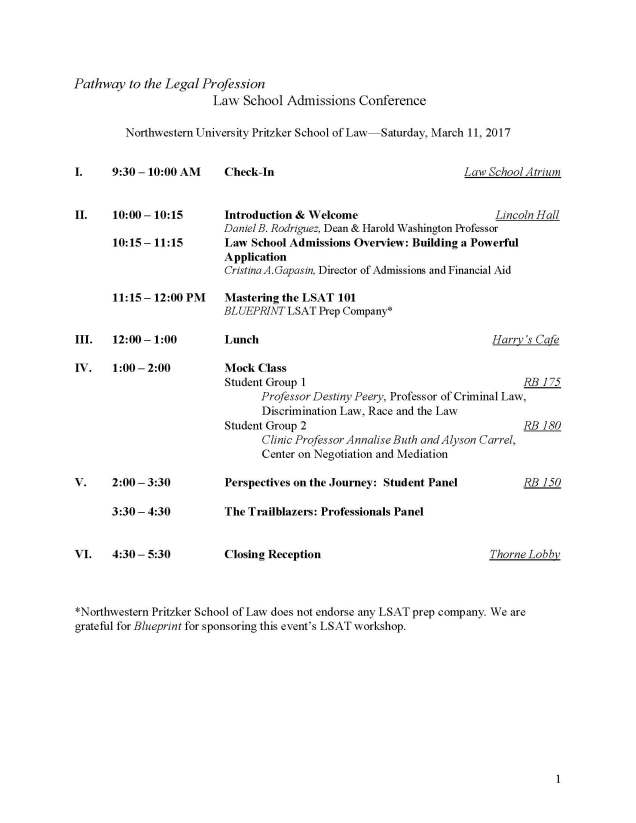
Pathway to the Legal Profession Law School Admissions Conference

Saturday, March 11, 2017 10:00 a.m. – 5:30 p.m. 

Check-in starts at 9:30am

We cordially invite you to attend the Pathway to the Legal Profession Conference. This conference will give prospective law school applicants a comprehensive overview of the law school application process and advice on how to successfully navigate it from applicant to law student. Current law students from diverse, non-traditional backgrounds, including first generation students and students with limited financial means, want to help attendees from similar backgrounds journey from law school applicant, to law school student, to lawyer.

The all-day conference consists of:

  • A workshop on mastering the LSAT
  • A law school admissions presentation
  • Mock law class taught by a real law school professor
  • Various panels made up of diverse lawyers and current law students sharing their wisdom and insight as well as answering your questions
  • Mentorship opportunities
  • Lunch will be provided

The conference will take place at: Northwestern Pritzker School of Law

375 East Chicago Avenue, Chicago, Illinois 60611

Please RSVP at https://goo.gl/forms/THk4Msx1vIjjHuos1. Registration closes March 6th at 5:00 p.m. Space is limited.

Agenda (PDF):

2017-pathway-conference-agenda

Ahniwake Rose: “Why Aren’t We Talking About Native American Students?”

From Education Week, here.

An excerpt:

It’s more than a little upsetting that in more than three hours of testimony before Congress on her nomination to be the new U.S. secretary of education, neither Betsy DeVos nor the members of Congress grilling her said anything—not a single word—about a cohort of more than a half-million American students who will fall under the Department of Education’s remit.

That group? Native American students.

Justice Sotomayor on Diversity at Michigan Law School (and all law schools)

Here is “Justice Sotomayor says lack of black students at UM ‘a real problem.'” HT How Appealing.

An excerpt:

“We are making large improvement towards that kind of equality, but we’re still far from it when you look at the number of African Americans at the University of Michigan, there’s a real problem there,” Sotomayor said.


NYTs on Suit against Havasupai Elementary/United States

Here.

Complaint here.

Law Students: Enter the LSAC 2017 Diversity Writing Competition to win $5000

This year’s LSAC Diversity Writing Competition topic is “Why Pipeline Programs Targeting Students from Underrepresented Racial and Ethnic Backgrounds are Essential to the Future of the Legal Profession.”  Current JD candidates are invited to submit papers addressing this topic.  The deadline for submissions is Friday, March 31, 2017, and LSAC will award three $5000 prizes to the best paper submitted by a 1L, 2L, and 3L/4L.  In addition, one winner will have a chance to publish their entry in the Journal of Legal Education.

We know there are law students following Turtle Talk who could write excellent papers on this topic. LSAC’s rules for submissions are here.

EdWeek: Commentary on Indigenous Ed in Alaska

Here is “Alaska Is Failing Its Indigenous Students” by Evon Parker.

Roxanne Dunbar Ortiz: “The Miseducation of Native American Students”

In Education Week, here.

An excerpt:

While distortions and myths of Native American culture plague many schools, textbooks often fail to mention Native history after the 19th century. In a 2015 study, scholars Antonio Castro, Ryan Knowles, Sarah Shear, and Gregory Soden examined the state standards for teaching Native American history and culture in all 50 states and found that 87 percent of references to American Indians are in a pre-1900s context.

Director of Student Services and Skills Posting for Lakehead University

One contract position (three-year term), Thunder Bay Campus

Highly organized and possessing excellent interpersonal skills, you will play a key role in the administration of our legal program. Working closely with the Dean, you will be responsible for providing the coordination of services for student recruitment and retention, delivering the Integrated Practice Curriculum (IPC), assisting course instructors with developing skills-exercise content for their courses, coordinating the third-year Practice Placement program with legal supervisors, and offering career support for upper level students.

You have a JD or LL.B. degree and three years of legal practice experience. Ideally, you possess membership in the Law Society of Upper Canada, have knowledge of Indigenous communities, and have previous experience with post-secondary administration, program development, and/or post-secondary instructional delivery. Collaborative and able to work with individuals of various backgrounds, you have outreach experience with law firms, legal departments in government organizations, and other community legal entities. Some travel is required.

This position is an initial three-year full-time contract with potential for renewal and is subject to budgetary approval. Salary is commensurate with experience. If you are interested in applying, please submit your curriculum vitae and cover letter outlining your experience to:

Lakehead University – Office of Human Resources
University Centre
Room UC-0003
fax: 807-346-7701
e-mail: careers@lakeheadu.ca

The deadline for applications is December 9, 2016. If you have questions about this position, please feel free to contact, Dean EagleWoman at lawfaculty@lakeheadu.ca.

Lakehead University is committed to creating a diverse and inclusive environment and welcomes applications from all qualified individuals including women, members of visible minorities, Aboriginal persons, and persons with disabilities. If you require accommodations for interviews or other meetings, please contact Human Resources at (807) 343-8334. We appreciate your interest; however, only those selected for an interview will be notified.