Hicks v. Fort Wingate School — Indian School Allegedly Outed and Humiliated Pregnant Student

An excerpt from the ACLU site:

The American Civil Liberties Union and the ACLU of New Mexico filed a lawsuit today on behalf of Shantelle Hicks, 15, who was initially kicked out of middle school and then publicly humiliated at an assembly by the school director and another staff member because she was pregnant.

The complaint alleges that school administrators violated Hicks’ constitutional right to equal protection under the law, Title IX’s prohibitions against sex and pregnancy discrimination and violations of her right to privacy.

“It was so embarrassing to have all the other kids staring at me as I walked into the gymnasium,” said Hicks. “I didn’t want the whole school to know I was pregnant because it’s not their business, and it wasn’t right for my teachers to single me out.”

***

Lawyers on this case include Klopfer, Alexandra Freedman Smith, Laura Schauer Ives and Maureen Sanders of the ACLU of New Mexico; and Sherwin and Lenora Lapidus of the ACLU Women’s Rights Project.

Read the full legal complaint: Hicks Complaint.


GTB Helping Suttons Bay Schools (They’re in Acute Financial Stress)

Here, from IPR.

Here is the GTB’s 2 percent press release:

Grand Traverse Band 2% Press Release 2nd half 2011

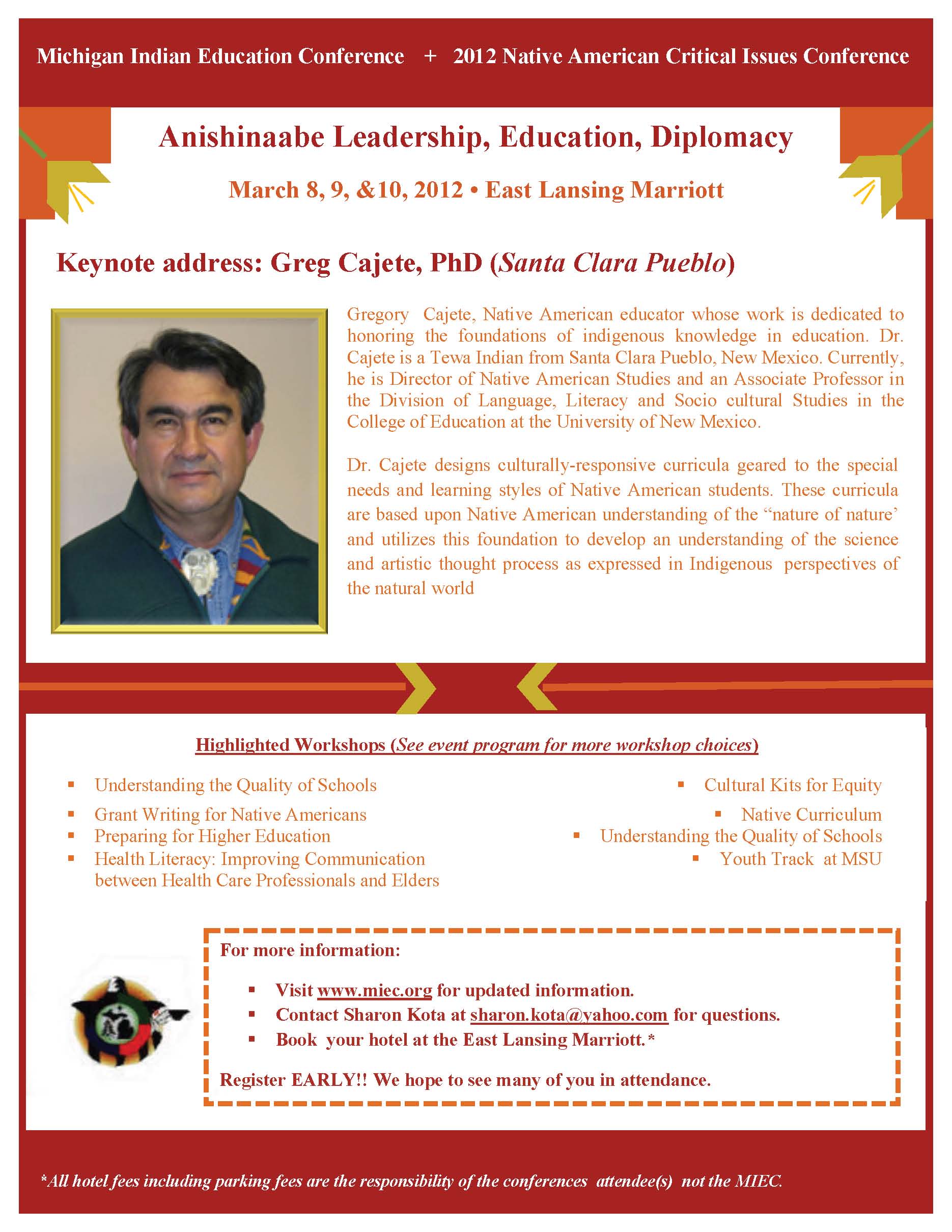
2012 Native American Critical Issues Conference Flyer

Here is a PDF: MIEC2012

Racial Tensions Rise in New Mexico School District as law suit filed.

An excerpt from an article on the issue:

Mormons and Indians

A deadlock between the two cultures is at least partly to blame for the political climate in the district since May, when the board and administrators began making drastic changes in personnel, policies and facilities.

At the root of much of that clash is a belief that Anglo Mormons long have dominated the district and held onto the purse strings.

“The allegation is that the Mormons have run the district for years,” said Byron Manning, the former director of finance and operations who resigned in 2011 after working in the district for 10 years.

The article in full can be found here.

American Indian Law Center’s “Pre-Law Summer Institute for American Indians and Alaskan Natives” Recognized by the American Bar Association

Outstanding news! And well-deserved!

Here is the press release: PLSI ABA Award PressRel_FINAL

An excerpt:

Albuquerque, NM – December 13, 2011 – The Pre-Law Summer Institute for American Indians and Alaskan Natives (PLSI) today announced that it will be recognized by the American Bar Association (ABA) Council for Racial and Ethnic Diversity in the Education Pipeline for exemplary leadership in pipeline programming. PLSI is a program of the American Indian Law Center, Inc., that has been attended by many of the nation’s preeminent Native attorneys, judges, law school professors and deans, and tribal chairs since its inception in 1967.

The ABA 2012 Raymond Pace and Sadie Tanner Mossell Alexander Award for Excellence in Pipeline Diversity recognized PLSI for their exemplary leadership in pipeline work. The ABA Council on Racial and Ethnic Diversity commended PLSI for its “outstanding accomplishments and significant contributions to diversifying” the law profession. The ABA will formally honor PLSI at the ABA Midyear Meeting in New Orleans, LA on February 3, 2012.

Ontario Superior Court of Justice Adds Two Schools To Residential Schools Settlement Agreement

Stirland Lake and Cristal Lake have been added to the already 130+ number of schools that have been identified and listed under Schedules “E” or “F” of Canada’s Residential Schools Settlement Agreement.  Here’s the decision, Fontaine v. Canada (Attorney General)

Continue reading

Suffolk Law Announces New Indian Law Clinic

This text is from a mass email sent to law clinicians, and isn’t (I suspect) the official announcement:

Suffolk Law is excited to announce the creation and launch of our Indian Law and Indigenous Peoples Clinic. This is a project I have long been trying to get off the ground…. Now, with the concerted efforts and amazing contacts of Professor Lorie Graham here at Suffolk and those pesky budget matters solved by the support of Dean Camille Nelson, we are starting our clinic. I was deeply impressed and influenced by my visit (eleven years ago?!) at the University of New Mexico where, through Professor Christine Zuni Cruz and SILC, I came to understand the potential and purposes of Indian Law work in the law school setting. It was that inspiration, the continued work of my friend Aliza Organick (now at Washburn), and the amazing passion of Prof. Graham that allowed this continuing scratchy idea at the back of our collective heads to become a reality.

Our program’s first work has been with the recently federally-recognized Mashpee Wampanoag Tribe for whom we drafted their first set of tribal court rules of civil procedure. We will continue to work with the Mashpee and other New England tribes in tribal court technical support, lawyer training, land use issues and other matters and we will soon begin direct representation of tribal members in the Boston area in a number of cases, including ICWA matters, J-Treaty work and partnering with the North American Indian Center of Boston (NAICOB). I believe we may be the only such full-time in-house, Indian Law Clinic east of the Mississippi….

The clinic will be taught this year by Practitioner in Residence Nicole Friederichs, who has extensive practice background in Indian Law matters, indigenous population work and international tribunal representation. I am sure you will all be meeting her soon at conferences, etc. Very gratifying….

Jeff Pokorak

PS We at Suffolk will also be hiring this year for an IP clinic faculty position — announcement will follow soon.

Journal Article Evaluates Treaty Provisions and their Import for Michigan Indian Education

From the Indigenous Policy Journal’s Winter 2010 issue (link to article here).

The article, titled “The Treaty Basis of Michigan Indian Education,” was authored by Martin Reinhardt and John Tippeconnic, III.

Here’s the abstract:

A socio-historical content analysis of 16 treaties and 3 contemporary American Indian education laws at the federal level revealed that a certain amount of the treaty obligation may yet be unfulfilled regarding tribes currently located within the State of Michigan. Both monetary and non-monetary provisions were analyzed using the United States Supreme Court’s Canons of Treaty Construction. The treaty provisions were further categorized according to certain criteria based on the trust doctrine. The outcomes of the treaty analysis were then compared to the provisions of the Indian Education Act, the Indian Self-Determination & Education Assistance Act, and the Individuals with Disabilities Education Act. Responsibilities of each level of government, implications for school policy and procedures, and recommendations for further study are included.

Law Schools and Indian Law Students

There is an enormous amount of discussion lately about the future of law schools (for a representative thread of discussion, see here). No doubt there appears to be a major glut in lawyers in the overall market, and many law students are beginning to see law school like trade school. They want to pass the bar and get a job. The liberal arts-style of legal education, along with the major development in the past decades of law clinics, is under attack, at least passive-aggressively.

I see a good chance that many law schools, possibly because they’ve lost a major lawsuit, will start streamlining their legal education palates. Subject areas not on the bar exam will fall by the wayside, or become even more marginalized (along with their instructors). When I was in law school, I skipped securities regulation and corporations in favor of legal history and immigration law, and an awesome death penalty seminar. Law schools that have robust curriculum in race studies, feminist legal studies, and Indian law will feel pressure to drop those classes.

I’m here to tell you that Indian law will be one of those classes that becomes marginalized or disregarded altogether. It’s already pretty marginalized in half of law schools, and disregarded altogether in another quarter.

Those law schools that still emphasize it (probably the same ones that do now) will become the holder and protected of a big secret — there is a market for lawyers in Indian country and in Indian law. American Indians are incredibly underrepresented in the field, Indian tribes are always looking for good lawyers, and tribal economies generate work for lawyers all over. State and federal judges are beginning to look for clerks with Indian law on the transcript — it’s a small number, but it’ll grow over time. If a student can master Indian law, then they can master anything (plus, more and more Indian law cases are coming).

I’m tired of people being warned out of Indian law, that there’s no money in it. I hear it all the time from teenagers to college kids. People out there telling American Indian students not to bother with law school and not to bother with Indian law are just plain idiots.
Friends of Turtle Talk Participate in NYTs Debate on the Future of Law School

Here for a full roster of debaters. Here for Kevin Noble Maillard, and here for Rose Cuison Villazor.

And also here: