Gregory Ablavsky on the Origins of Dual Federalism

Gregory Ablavsky has published “Empire States: The Coming of Dual Federalism” in the Yale Law Journal (PDF).

Here is the abstract:

This Article offers an alternate account of federalism’s late eighteenth-century origins. In place of scholarly and doctrinal accounts that portray federalism as a repudiation of models of unitary sovereignty, it emphasizes the federalist ideology of dual sovereignty as a form of centralization—a shift from a world of diffuse sovereignty to one where authority was increasingly imagined as concentrated in the hands of only two legitimate sovereigns.

In making this claim, the Article focuses on two sequential late eighteenth-century transformations. The first concerned sovereignty. Pre-Revolutionary ideas about sovereignty reflected early modern corporatist understandings of authority as well as imperial realities of uneven jurisdiction. But the Revolution elevated a new understanding of sovereignty in which power derived from the consent of a uniform people. This conception empowered state legislatures, which, throughout the 1780s, sought to use their status under new state constitutions as the sole repositories of popular authority to subordinate competing claims to authority made by corporations, local institutions, Native nations, and separatist movements.

The second shift came with the drafting and ratification of the U.S. Constitution, which bolstered federal authority partly in order to protect state authority against internal competitors—an aim reflected in the Guarantee and New State Clauses. Ultimately, the Constitution both limited and enhanced state authority; it entrenched a framework of dual sovereignty. After ratification, competitors to state sovereignty were increasingly constrained to appeal to some federal right or power. What had previously been contests among supposedly coequal sovereigns—what modern scholars would call horizontal federalism—became questions of vertical federalism, issues of whether federal authority would vindicate states or their opponents.

Although the Article concludes with some implications of this history for present-day federalism doctrine and theory, its primary contribution is descriptive. Judges and lawyers routinely and almost unthinkingly invoke localism and power diffusion as the historical values of federalism. Yet the history explored here challenges whether these near-universal assumptions about federalism’s aims actually reflect what federalism was designed to accomplish.
Fletcher: “Indian Children and the Fifth Amendment”

Forthcoming in the Montana Law Review’s Browning Symposium issue, available at SSRN here.

An excerpt:

Many of my first memories revolve around my grandmother Laura Mamagona’s apartment in Grand Rapids, Michigan. She shared the apartment with my uncle Crockett, who was a college student. Her apartment was the upstairs room of an old house on the side of a hill on College Street. My memories are mostly of domestic activities. Cooking. Sweeping. Sitting around. Playing with trains. Leafing through Crockett’s Sports Illustrated magazine collection. Laura worked the night shift at the veteran’s hospital across from Riverside Park. Early on weekday mornings, June, my mother, would drop me off at Laura’s place in her VW bug, the first car I remember. I had my own crib at Laura’s, one I can remember escaping pretty easily. Often, Laura would sleep most of the morning while I puttered around the house. Sometimes, Crockett would be there. Family lore tells that once, June dropped me off earlier than usual and Laura had worked a little late, so I was probably there alone for a short while. I heard the story so often growing up that I can seemingly remember that day, too. This was in the mid-1970s, before Congress enacted the Indian Child Welfare Act.

Recently, my wife Wenona Singel discovered documents about Laura’s childhood home life in the National Archives in Chicago. Wenona was there to research family boarding school histories. Laura’s name as a young woman, Laura Stevens, was listed alongside several of her brothers and sisters as former students at Mount Pleasant Indian Industrial Boarding School. They were all born with the Pokagon surname, but Laura’s dad, Peter Stevens, changed their names, thinking it would help the family blend in with white America. Laura never attended the boarding school, and instead spent those years in quarantine in a hospital in Kalamazoo. We think she tested positive for tuberculosis at the boarding school intake and was diverted to quarantine. While Laura was there in the hospital during several of her early teen years, her biological mother walked on. Laura had younger brothers and sisters in her family home in Allegan County, Michigan. So, Peter—who was single then—drove to Kalamazoo and took Laura home. As a young woman, but the oldest sibling left in the house, Laura was forced to replace her mom. The archive documents contain reports by social workers who visited the house, we think, on somewhat random occasions. They were spot checks, of sorts, by the State of Michigan, to see how this Indian family with no mother in the home was coming along. The social workers detailed every aspect of the Stevens’ home in the reports. They noted how many Bibles were in the house and where they were placed. They noted how many portraits of Jesus Christ there were and the location each was hung. They reported Laura’s younger siblings were all dressed for company and quietly studying. They focused especially on teenaged Laura. There she was, sweeping the kitchen. There she was, cooking dinner. There she was, folding clothes. The social workers were impressed. Well, they were barely impressed. Laura was, after all, still an Indian. Reading the reports, one can’t help but think that young Laura Stevens was the only thing stopping the State from taking Peter Stevens’s kids away from him. Imagine if she had been out shopping on the day of the spot visit. The little Stevens kids would have been home alone, dishes in the sink and dirty clothes on the floor. Laura might have come home from shopping, and then later Peter from work, to find a home stripped of its children. However, this never came to be. Perhaps out of sheer luck, Laura was always home when the social workers showed up.

And:

The Fifth Amendment of the United States Constitution is a truly fateful provision for Indian people. On occasion, Wenona and I teach at the Pre-Law Summer Institute (PLSI) for American Indians. It’s an eight week program that serves a little bit like a summer boot camp for Indian people who are planning to matriculate to law schools in the fall. Wenona teaches Property and I teach Indian Law. Compared with the regular law school survey-the-field course in Federal Indian Law, the short class I teach at PLSI is even more truncated. I can only assign a cross-section of the “greatest hits” of Indian law Supreme Court decisions because I don’t have time to conduct a full survey. I also try to assign cases where tribal interests prevailed. It turns out tribal interests and Indian people prevail more than not when the Fifth Amendment is in play. However, there are cases where tribal interests painfully and dramatically suffer under the Supreme Court’s interpretation of the Fifth Amendment.

NYTs: “Overlooked No More: Elizabeth Peratrovich, Rights Advocate for Alaskan Natives”

Here.

Reviews of Nick Estes’ “Our History Is the Future: Standing Rock Versus the Dakota Access Pipeline, and the Long Tradition of Indigenous Resistance”

NPR

The Intercept

HNN

The book webpage from Verso is here.

The Atlantic [Family Weekly Newsletter]: “America’s Dark History of Native American Assimilation Schools”

Here.

HCN: “Adoption didn’t solve the ‘Indian Problem’”

By Susan Harness, here.

Michigan Radio: “‘We’ve never had justice’: How the Supreme Court rigged land deals against native people”

Here.

An excerpt:

“In many ways, it’s almost like gaslighting,” Wenona Singel says of the Johnson v. M’Intosh case. “You’re learning about … certain rights that are associated with property rights … knowing all along that these rights have not been respected, and were not enforced for your own ancestors.”

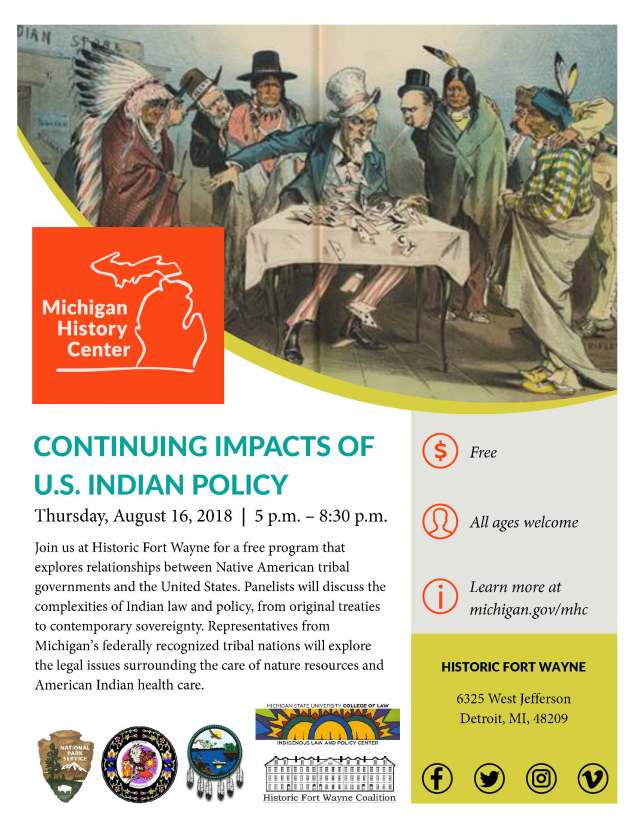
Rock Your Mocs — August 16, 2018 — Historic Fort Wayne (Detroit)

Here (pdf):

RYMAugust_Flyer2018

New Scholarship on Felix Cohen

Here is “‘Felix Cohen Was the Blackstone of Federal Indian Law’: Taking the Comparison Seriously,” by Adrien Habermacher, forthcoming in the British Journal of American Legal Studies.

Here is the abstract:

This paper explores thoroughly the many facets of Rennard Strickland’s comparison between Sir William Blackstone, author of the 1765-69 COMMENTARIES ON THE LAWS OF ENGLAND, and Felix Cohen, architect of the 1942 HANDBOOK OF FEDERAL INDIAN LAW. It consists in a side by side analysis of both authors’ master works, political and educational projects, as well as general contribution to jurisprudence. It reveals that despite the stark differences between Blackstone’s work on the English common law from his professorship at Oxford in the late 18th century, and Cohen’s endeavors on the US federal law concerning Native Americans as a civil servant at the turn of the 1940’s, there are remarkable similarities in the enterprises of legal scholarship the two jurists took on, the larger political projects they promoted, and their role in the development of legal thought. The idea that “Felix Cohen was the Blackstone of Federal Indian Law” has stylistic appeal and could have been little more than a gracious way to celebrate Cohen. An in-depth comparative examination of legal history and jurisprudence however corroborates and amplifies the soundness of the comparison.

Greg Ablavsky Commentary on Upper Skagit Decision

Gregory Ablavsky has posted “Upper Skagit v. Lundgren: Deceptively Straightforward Case Raises Fundamental Questions about Native Nations, History, and Sovereignty” on Stanford Law School’s blog.

Here are excerpts:

This decision provoked the ire of Justice Thomas, who, in a lengthy dissent, insisted that the immovable property exception did apply to tribes.  Thomas’s rationale involved a deep dive into the history of international law, citing the principle’s enunciation not just in such well-known staples as Vattel’s 1758 Law of Nations but also in deep cuts like the works of Cornelius van Bynkershoek and Bartolus of Sassaferatto. (Sadly for connoisseurs of elaborately named international-law treatise writers, Samuel von Pufendorf failed to make the cut). Columbia’s Ronald Mann, writing in ScotusBlog, called this dissent a “tour de force of historical arguments.”

I’m not so convinced.  Although I’m on record sharply questioning Justice Thomas’s constitutional history in Indian law more generally, I agree with Thomas that the immovable property exception has deep roots in international law.  But I question his blithe assumption that the same principle did, or should, apply to tribes.

***

One consequence of Marshall’s ruling that tribes were “domestic dependent nations” was that Native nations were deprived the benefits of international law—including the immovable property exception.  The history of U.S. westward expansion is largely the history of one sovereign—the United States—purchasing land within the territory of other sovereigns—Native nations.  Yet, notwithstanding Thomas’s “six centuries of consensus” on the issue, the United States did not believe these purchases subjected these lands to tribal courts and law; it assumed that it now had jurisdiction as well as ownership over the land.  And this was an assumption: unlike the transfers from France in the Louisiana Purchase or Mexico in the Treaty of Guadalupe Hidalgo, for instance, which explicitly stated that they conveyed sovereignty as well as title, most Indian treaties spoke only of the boundaries of the land sold.  There is, then, a bitter irony in Thomas’s invocation of Bushrod Washington’s 1824 statement that “the title to, and the disposition of real property, must be exclusively subject to the laws of the country where it is situated”—an irony only heightened when we recall that Marshall had decided Johnson v. M’Intosh, which unambiguously rejected that principle with respect to Native peoples, a year before.