Stupak Throws Indian Law Monkey Wrench Into Greektown Bankruptcy

Potentially, though perhaps not likely, this is a huge issue. Assuming that the Greektown parcel is owned by the Secretary of Interior on behalf of the Sault Tribe, then an Act of Congress may be required. And if one is not forthcoming, there may be some very interesting litigation involving the interaction of federal bankrupcty laws and maybe the Quiet Title Act. If the land is not in trust, then we may still have a Non-Intercourse Act problem, but likely not. Apparently, according to the letter, the land is in trust.

Update: Via Indianz, here is Stupak’s letter.

From the Freep, via Pechanga:

WASHINGTON — U.S. Rep Bart Stupak wants to halt the bankruptcy reorganization of Greektown Casino at least until the federal government determines whether an act of Congress is needed to transfer the land the Detroit gaming hall sits on.

Earlier this year, a federal bankruptcy judge approved a reorganization plan allowing Greektown Casino’s bondholders — including several private equity and hedge funds — to take ownership. The Sault Ste. Marie Tribe of Chippewa Indians, based on Michigan’s Upper Peninsula, has a majority ownership stake in the casino.

The process needs the approval of the Michigan Gaming Control Board, with a court deadline of June 30 approaching.

But Stupak, D-Menominee, has asked U.S. Attorney General Eric Holder and Interior Secretary Ken Salazar to delay any change in ownership while they investigate whether land held by the federal government on behalf of the tribe — about three-fourths of an acre on Beaubien Street in Detroit — can be transferred without an act of Congress.

“The tribe stands to lose its entire investment in the business, including a portion of the real property underlying the casino,” Stupak said in the letter written Wednesday.

According to Stupak, 400 Monroe Associates — controlled by Greektown businessman Ted Gatzaros — deeded the land to the U.S. Department of Interior on behalf of the tribe in 1992.

Tribally owned lands cannot be sold without the consent of the federal government, and the Interior Department is not allowed to approve the sale of such land without direct congressional authorization, Stupak said.

Continue reading

Saginaw Chippewa Briefs Struck in Reservation Boundary Case as Not Being Timely

Here is the order: DCT Order Striking Sag Chip Briefs

The remaining materials are here.

EPA Visits Eagle Rock

From ICT, via Pechanga:

BIG BAY, Mich. – As the top government official who oversees Great Lakes water quality stood on the edge of sacred Eagle Rock, overlooking a pristine expanse of the Yellow Dog Plains, she gained a better understanding about why the state-owned land is sacred to Michigan’s Ojibwa.

“I very much understand what their concerns are – and that is one of the things we are considering as we moved forward on this,” said Tinka Hyde, Water Division director for Environmental Protection Region 5. “We realize that Eagle Rock is of cultural and religious importance to the tribe.”

Hyde was one of three EPA regional bosses from Chicago and the agency’s tribal liaison for Michigan who were given a tour of the area May 13 by officials from the Keweenaw Bay Indian Community during a two-day visit to Michigan’s Upper Peninsula.

Members of numerous tribes including Ojibwa, Cherokee and Lakota had been camping at the base of Eagle Rock since April 23 in hopes of preventing Kennecott Eagle Minerals from building a nickel and copper sulfide mine – named the Eagle Project. At the company’s request, state and local police officers raided the encampment May 27 arresting two campers.

Under federal treaties, Ojibwa have rights to hunt, fish and gather on the state of Michigan owned land. The state leased the land to Kennecott with the understanding that all permits must be approved.

Hyde said any ruling the EPA makes about the withdrawal of state and federal permit applications by Kennecott subsidiaries will be based solely on environmental protection laws, primarily the 1974 Safe Drinking Water Act.

Continue reading

IPR on Eagle Rock Controversy

From IPR:

Photo courtesy of Yellow Dog Summer

By Bob Allen

Protestors of Michigan’s decision to permit underground mining at Eagle Rock near Marquette took petitions to the state capitol Thursday. Members of the Keweenaw Bay Indian Community say Eagle Rock is a sacred site to them, and a mine dug into the face of the rock will destroy it.

Eagle Rock is located on state land leased to Kennecott Minerals.

State law says mining operations have to take into consideration impacts to places of worship. But state officials ruled that places of worship means those located in a building such as a church.

Matthew Fletcher is an American Indian and professor of law at Michigan State University. He says any appeal of the state’s ruling about sacred places may not be a sure winner.

Listen to Bob Allen’s chat with Fletcher by playing the audio above.

Michigan Indian Casino Money May Fund College Scholarships

From Native American Times, via Pechanga:

LANSING, Mich. (AP) – Legislation headed for Gov. Jennifer Granholm’s desk would allow Michigan school districts to use money received through agreements with tribal-run casinos to fund college scholarship programs.

The Senate unanimously approved the bill on Wednesday.

Michigan has more than 20 casinos run by American Indian tribes. The tribes have agreements with the state that typically provides 2 percent of certain gaming revenue to local governments, including schools.

The bill would allow school districts covered by those agreements to use their proceeds for scholarships for their graduates.

The legislation sponsored by Republican Sen. Ron Jelinek of Three Oaks was sparked by a plan from New Buffalo schools to fund a scholarship program.

–––

The legislation is Senate Bill 1097.

Fletcher on “Race and American Indian Tribal Nationhood” — UPDATED

“Race and American Indian Tribal Nationhood” is available for download here. [The paper is there now, sorry.]

Here is the abstract:

Modern American Indian nations face a racial paradox. On one hand, the citizenry of Indian nations is almost exclusively based in race, ethnicity, and ancestry. Indian nations would not be “Indian” without this basis. But American constitutional principles dictate that laws based on racial, ethnic, or ancestral classifications are highly disfavored. For Indian nations, this means that Indian governments have virtually no authority to regulate the activities of the non-Indian citizens that live amongst Indian communities. This paper offers a long-term solution to this conundrum, a solution that requires Indian nations and American courts and policymakers to modernize understandings about American Indian tribal nationhood. American Indian law and policy forced Indian nations into a legal status akin to “domestic racial nations.” By tweaking Indian citizenship requirements, and recognizing the national character of modern Indian nations, modern Indian nations should more properly be understood as simply “domestic nations,” much like Monaco and The Vatican.

Constructive feedback welcome.

CIC-AIS Graduate Conference Prize Winners

Dear Colleagues:

Please spread the news that all three of the submitted prize winners at the recent graduate conference were women!!!   FIRST PRIZE went to Nicole Marie Keway for her remarkable paper on Emerson:  “The Piquancy of Particularity: Emersonian Savages and Speaking Beyond the Woods.”  The SECOND PRIZE winner was Sandra Garner for “Rhetorics of Traditions: Troubling Tradition in the Lakota Declaration of War Against Exploiters of Lakota Spirituality” –  Sandra is completing her degree at Ohio State University and will be at Miami University as a post-doc this fall.  Finally, a law student, Adrea Korthase, received THIRD PRIZE for her work on the “Kennecott Eagle Mineral Project and the Need for a Michigan Religious Protection Act.”

To see these outstanding women, please go to our website —  http://www.msu.edu/~cicaisc/ –  you can see their pictures as well as many of the other participants.  Conference planning, spearheaded by Susan Krouse, the director of the MSU AISP and her able assistant, Sakina Hughes, made this another memorable event.  The University of Wisconsin, University of Chicago, Ohio State, and the University of Michigan added a tremendous variety of  new scholarly approaches to the program – be sure to look at the program, which is on-line at our website.

Susan Sleeper-Smith

Director, CIC-AIS Consortium

Interlochen Public Radio Points North Rebroadcast on Eagle Mine–Friday at 7Pm Eastern

Here.

We’ll post it here as well when it is archived.

Michigan Indian Day SAVE THE DATE — Sept. 24, 2010

The Ingham County Health Department and Michigan State University ask you to SAVE THE DATE (flyer here: save the date michigan indian day) and invite you to attend the 2010 Michigan Indian Day event. The event will be taking place Friday September 24, 2010 at the Hannah Community Center in East Lansing, Michigan. The conference theme this year is Strengthening Health, Strengthening Families: Empowering Indigenous Communities.
The Michigan Indian Day Committee is currently taking requests for workshop proposals (application here: MID Workshop Proposal Request Letter). The workshop proposals are due Monday June 21 by 5p.m. and notification of accepted workshops will be announced on Monday July 12 by 5 p.m.
The SAVE THE DATE flier and Workshop Proposal Application are attached with this email. More information will be added to the Native American Outreach Program website. Please go to the this website for more current  information and materials as the Michigan Indian Day Event approaches.

30th Anniversary of Grand Traverse Band Federal Recognition!!!!

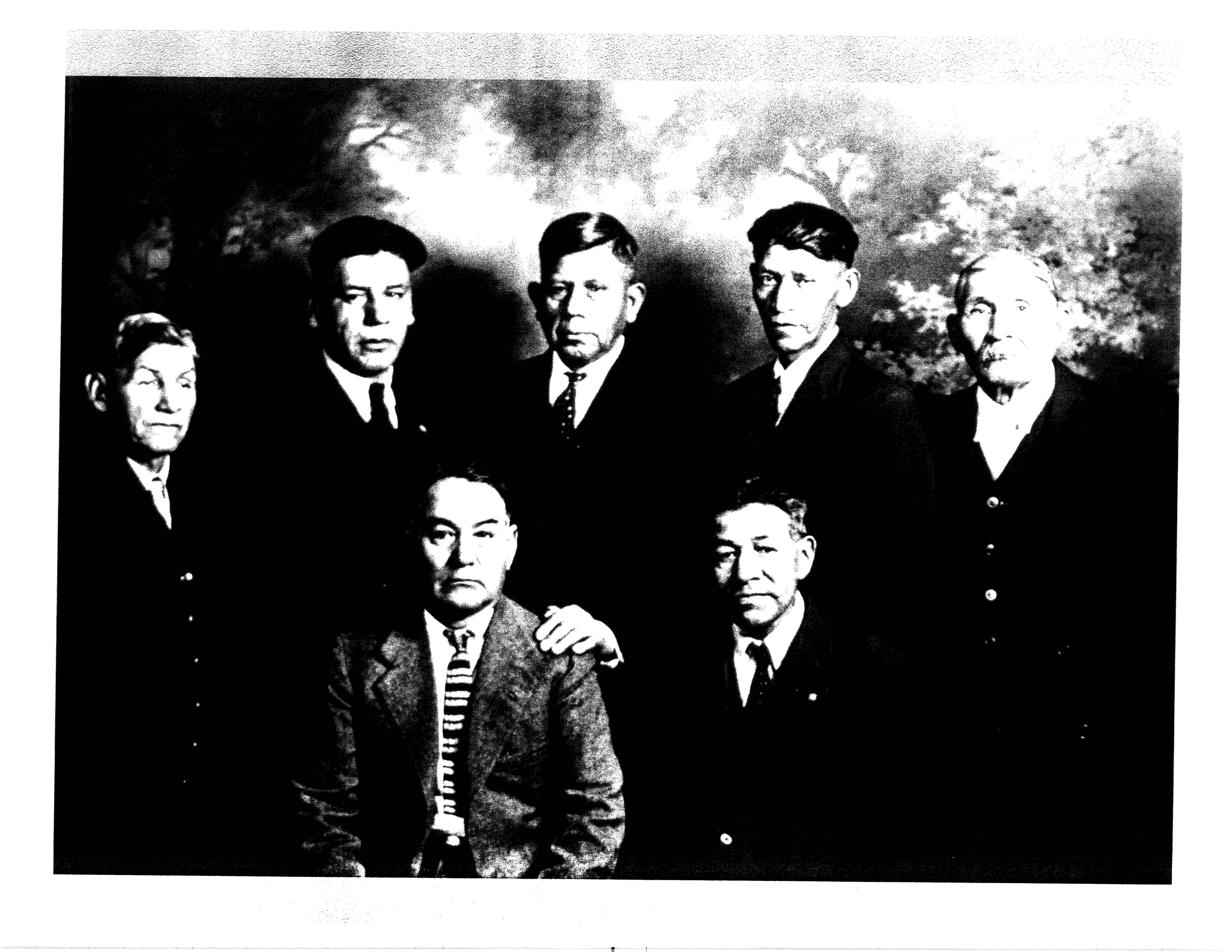
Here’s a pic of the Michigan Indian Defense Association headed by Ben Peshawbe:

And the government offices in Peshawbestown: