Asian Carp Op/Ed from GTB Chair Derek Bailey

From the Traverse City Record-Eagle:

Three decades ago many thought that the Great Lakes fisheries resources would be ruined by American Indian tribes exercising “treaty-fishing” rights. After the federal courts confirmed these treaty-reserved rights, the tribes demonstrated their primary concern is protection of the Great Lakes fisheries.

Ironically, these “treaty-fishing” rights now might prove crucial in protecting fisheries resources for all of Michigan’s citizens against the Asian carp invasion.

The United States Supreme Court has denied Michigan’s request for an injunction closing the shipping locks outside of Chicago to prevent any further migration of Asian carp into the Great Lakes. In the midst of the competing claims debating the economic losses of closing shipping to the Mississippi River system compared to potential harm to Great Lakes fisheries, all parties — Attorney General Cox, Gov. Granholm, the Army Corps of Engineers and other federal agencies — agree that the damage to the Great Lakes fisheries will be profound.

It has been almost six years since the U.S. Fish and Wildlife Service estimated that “Asian carp could have a devastating effect on the Great Lakes ecosystem and a significant impact on the $7 billion fishery.” During this time the Army Corps of Engineers failed to act promptly, in effect fiddling while Rome burned. To the extent the Army Corps is responsible for the impending disaster, the tribes may be better situated than the state to challenge the federal government.

Continue reading

Laura Spurr Obituary

From the Battle Creek Inquirer:

Laura Spurr wore many hats in her 64 years of life: nurse, health official, fundraiser and tribal chairwoman for the Nottawaseppi Huron Band of Potawatomi.

Spurr died Friday from a heart attack suffered while she was in Temecula, Calif., according to a statement released by her family. She was there to speak at the Pechanga Resort & Casino about what she is probably best known for publicly in the Battle Creek area: the FireKeepers Casino, a project Spurr and the tribe pursued for nearly a decade.

The casino was one of Spurr’s many projects she pursued throughout her life. After graduating from the University of Michigan in 1967 with a degree in nursing, she found herself working in the health field in Washington, D.C., New York, Chicago and Grosse Pointe.

Spurr also obtained a master’s degree from Chicago’s DePaul University with a double major in nursing administration and education.

In Washington, she was active in several organizations, such as the Personnel Committee for Planned Parenthood of Metropolitan Washington and the Committee of the League of Women Voters.

Health continued to be an issue for Spurr, who served as the Chair of the Education Committee and the Health Committee at the tribe’s Pine Creek reservation. Continue reading

Laura Spurr Walks On

News article here.

Michigan Supreme Court Denies Leave for Sault Tribe to Appeal Bouschor Case

The appeal focused on the Michigan court of appeal’s decision to drop Miller Canfield from the suit. It sounds like the suit against Bouschor and some of the other co-defendants will go to trial next.

The materials are here:

Sault Tribe Motion for Leave to Appeal

Leave Denied

Lower court materials are here.

Continue reading

WSJ Article on Asian Carp Issue

From the WSJ via How Appealing:

[SEPARATE]

More than a century ago, this city reversed the flow of its eponymous river, connecting the Great Lakes with the Gulf of Mexico and defining itself as the can-do capital of the American heartland.

Today, that engineering feat is coming under growing scrutiny, as scientists and politicians intensify their battle against a voracious flying fish that has been traveling up the Mississippi for 20 years. Amid signs that Asian carp have breached the last defensive barrier, calls are mounting for a massive do-over.

“We know these barriers aren’t working,” said Joel Brammeier, president of the Alliance for the Great Lakes and the lead author of a 2008 report that laid out how this project might look. “An ecological separation is the only permanent solution.”

Continue reading

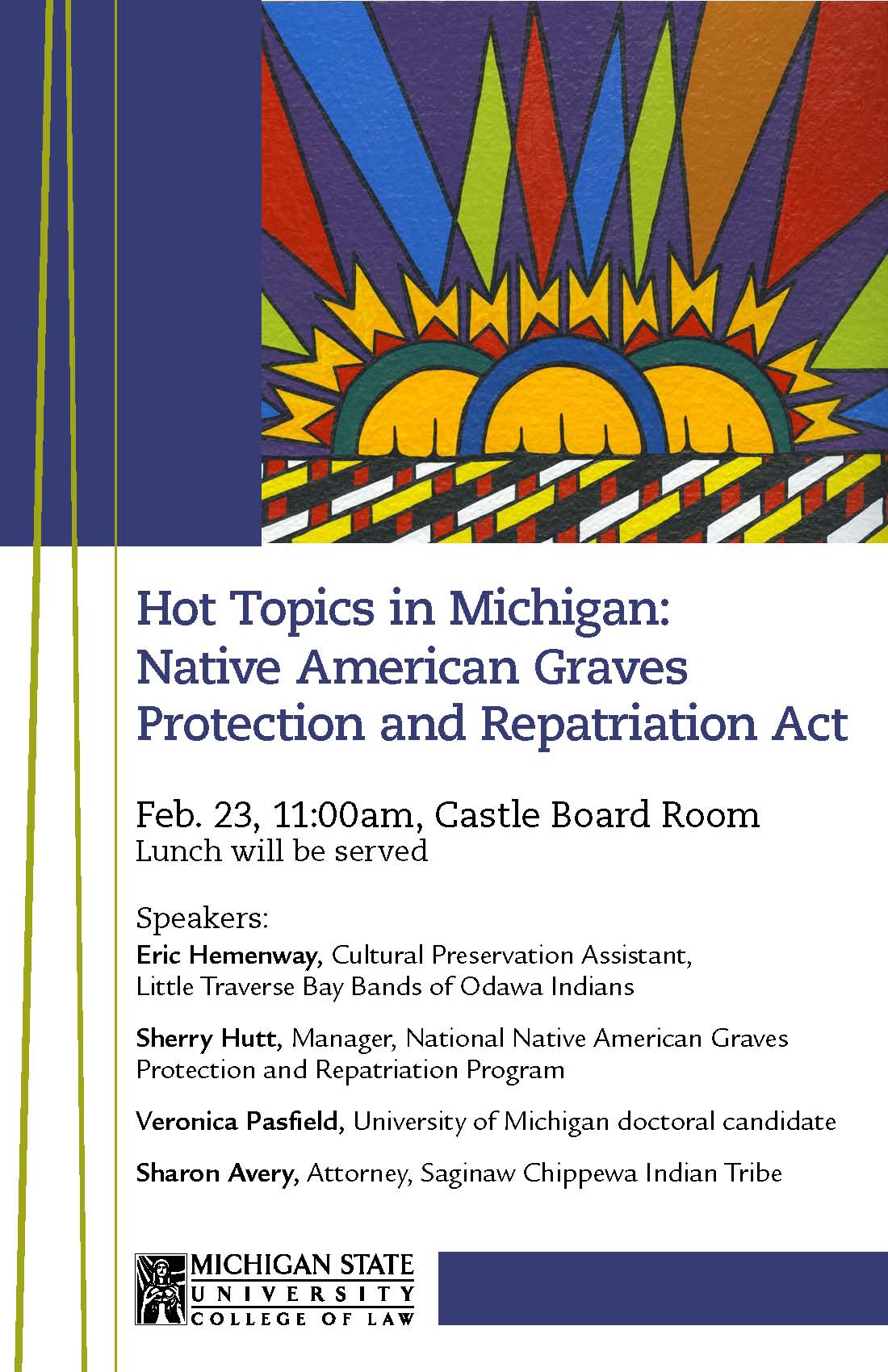
ILPC Event: Hot Topics in Michigan — NAGPRA (Feb. 23)

Fletcher, Fort, and Singel on Michigan Indian Country Cross-Deps

Indian Country Law Enforcement and Cooperative Public Safety Agreements
Michigan Bar Journal, Vol. 89, p. 42, February 2010, MSU Legal Studies Research Paper No. 08-02
Matthew L. M. Fletcher , Kathryn Fort and Wenona Singel

NHBPI Pays Nearly $2M in Revenue Sharing to Local Governments

Wow.

From the B.C. Enquirer (via Pechanga):

Besides its Aug. 5 opening, Friday was arguably the most important date in FireKeepers Casino’s short history, because the community got its share of the profits.

The Tribal Council of the Nottawaseppi Huron Band of Potawatomi, FireKeepers’ owners, on Friday morning presented a check for $1,933,683.41 to the FireKeepers Local Revenue Sharing Board. That money will reimburse local governments for increased costs attributable to the Emmett Township casino or the tribe’s Pine Creek Reservation in Athens Township, and also for revenue lost because tribal land is untaxable.

The money represents 2 percent of the casino’s slot revenue from its Aug. 5 opening to the Dec. 31 close of its fiscal year. The tribe is required to pay that money to local governments through a compact with the state.

The money is more than double what the tribe expected to pay the LRSB.

“We thought for a year we would be presenting $2 million,” said Laura Spurr, Tribal Council chairwoman. “This is for five months.”

“This money is to help us better the entire community,” said Mike Rae, the Calhoun County board chairman who on Friday was elected chairman of the LRSB. He spoke to the board via speakerphone from Florida. Continue reading

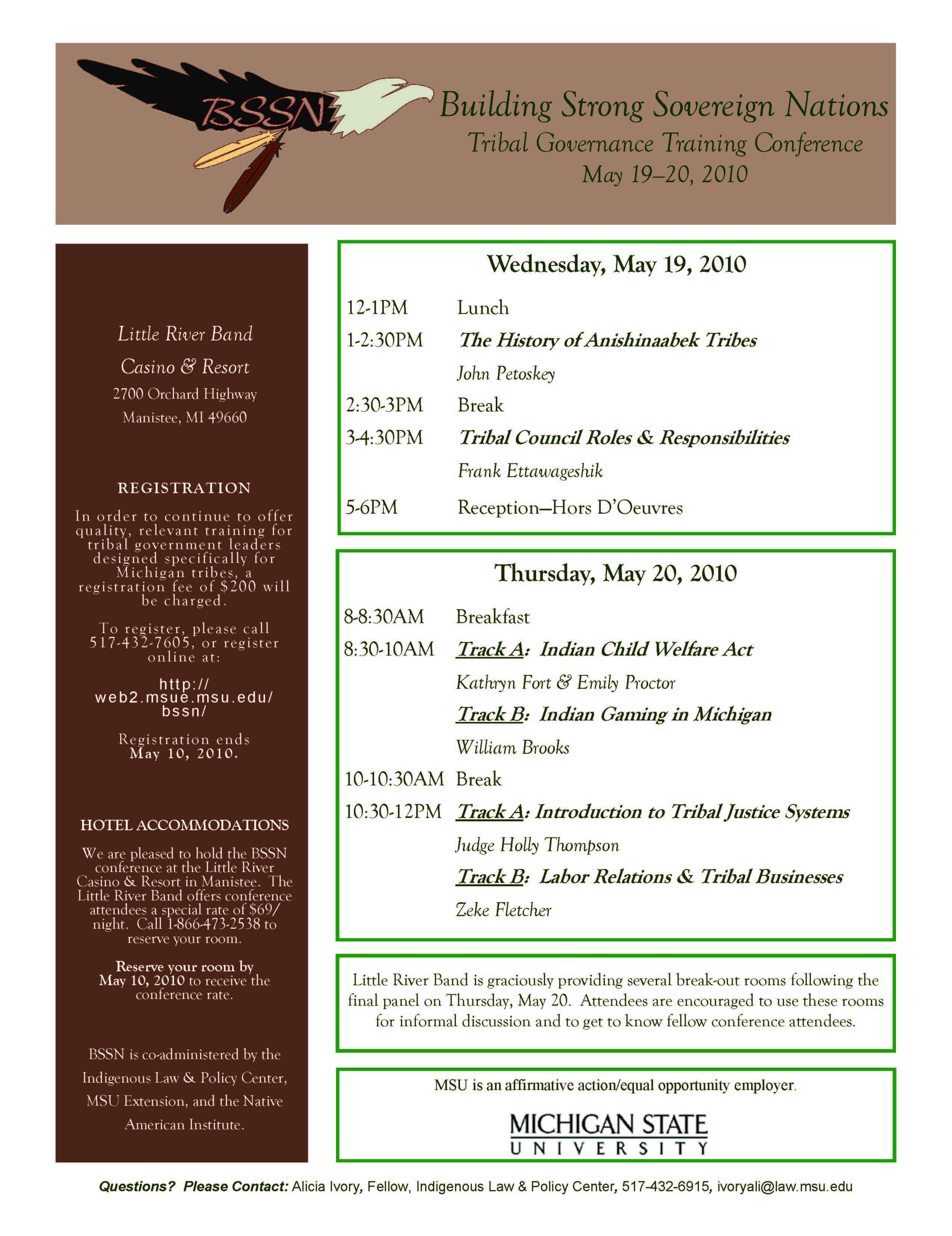
Building Strong Sovereign Nations SAVE THE DATE May 19-20, 2010

Registration here — now open.

Mackinac Bands Constitution Developed

From Indianz:

The Mackinac Bands of Chippewa and Ottawa Indians of Michigan are asking the Bureau of Indian Affairs to be treated as a federally recognized tribe.

The Mackinac Bands are considered a part of the federally recognized Sault Ste. Marie Tribe of Chippewa Indians. But the bands say they are a distinct and self-governing tribe.

The bands wrote a new constitution to reflect their status.

Get the Story:

New Anishinabe Constitution presented (The Cheboygan Daily Tribune 2/12)