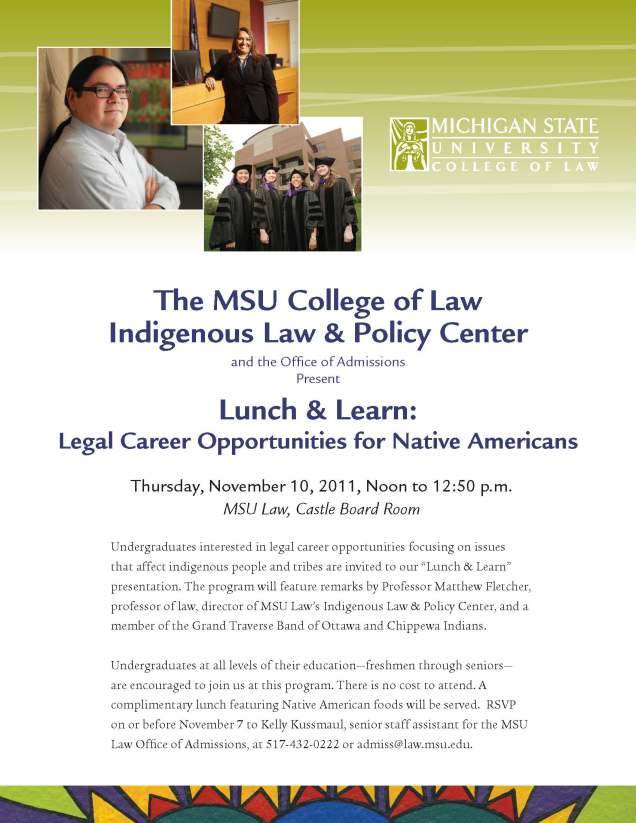
If you are interested in this event, and we hope you are, please RSVP here:
Michigan Indian
ICT Article on Local Support for Gun Lake Casino
Here is the article (h/t Pechanga). And an excerpt:
More than 15 entities, including Wayland Township, Allegan County, the Allegan Area Education Service Agency, the cities of Wayland and Allegan, the Barry County Chamber of Commerce, the Barry County Economic Development Alliance, the Gun Lake Business Association, and the Deputy Sheriff’s Association of Michigan have filed a collective amici curiae – friend of the court – brief in the petition for certiorari filed with the high court by the Interior Department and the Match-E-Nash-E-Wish Band of Pottawatomi (the Gun Lake Tribe) Indians versus David Patchak. The high court has been asked to review a ruling issued by the D.C. Circuit Court of Appeals last January that said Patchak, a former trustee in Wayland County, Michigan, has standing to bring a lawsuit against the Interior Department for taking into trust 147 acres in Bradley, Michigan, near Grand Rapids where the tribe operates its casino. The casino, which opened in February, created 900 new jobs and has brought a new wave of prosperity to local hotels, restaurants, vendors and other businesses in an area that had a reported 11.9 percent unemployment rate.
“Collectively, the amici curiae represent numerous individuals and businesses that support and have been positively affected by the Band’s economic development activities on the trust land. They submit this brief to explain the substantial local benefits that arise from the cooperative and mutually reinforcing economic development efforts of the Band, the regional governments, and local businesses,” the amici wrote. “The amici curiae urge this Court to grant the petitions for certiorari to resolve the debilitating uncertainty and economic instability created by the court of appeals’ decision, which threatens to stifle economic development in a state and region that has endured a disproportionate amount of economic suffering in recent years.”
Newberry Library Opens Site on Indian Peoples of the Midwest
The Newberry Library has developed a very nice website, “Indians of the Midwest, Past and Present.”
Here is a description:
The Newberry Library announces the launch of a multimedia educational website supported by National Endowment for the Humanities, titled “Indians of the Midwest, Past and Present”. The website focuses on Native people of Minnesota, Wisconsin, Michigan, Illinois, Indiana, and Ohio to explore several contemporary issues with roots in the history of the region: tribal sovereignty, hunting and fishing rights, casinos, treaties, identity, repatriation, and stereotypes.
Dr. Scott Manning Stevens (Mohawk) is the director of the Indians of the Midwest project and Dr. Loretta Fowler is the editor. Stevens also directs the D’Arcy McNickle Center for American Indian and Indigenous Studies and Fowler is an anthropologist and Professor Emerita at Indiana University. The site was developed in consultation with an advisory committee consisting of members of tribal colleges and university scholars. The site features Newberry-produced, videotaped interviews with several scholars, including Raymond J. DeMallie, Larry Nesper, Dave Edmunds, Nancy Lurie, and John Low.
Tigers Rally Video — Friends of Turtle Talk
To the tune of the White Stripes’ “Hardest Button to Button”:
Here.
Thanks to Angie Spickard and Nick Reo for putting this together.
NCAI Cert Stage Amicus Brief in Patchak Case
Here:
GTB Chairman Bailey to Run for Congress
Here.
An excerpt:
Peshawbestown, Mich.— The campaign to represent northern Michigan’s 1st Congressional District is expected to gain a new candidate this weekend.
Derek Bailey, tribal chairman of the Grand Traverse Band of Ottawa and Chippewa Indians, will announce his intention Saturday to run for Congress. He would face ex-state Rep. Gary McDowell of Rudyard in the Democratic August primary. McDowell lost in November to Republican Dr. Dan Benishek of Crystal Falls in a heated race for the seat held by longtime U.S. Rep. Bart Stupak, D-Menominee.
The 1st District is shaping up to be Michigan’s most hotly contested election and one with national implications. Democrats are targeting it as one of 25 they can win back in 2012 to retake the House.
Bailey, 38, was elected in 2008 as the youngest chairman of the tribe, a sovereign nation that was federally recognized in 1980.
In 1984, the tribe of more than 4,000 citizens became one of the first in the state to open a casino, the Leelanau Sands Casino. The Turtle Creek Casino and the Grand Traverse Resort and Spa followed.
Appellee Briefs in State of Michigan v. Bay Mills Indian Community (CA6)
Here:
State of Michigan Appellee Brief
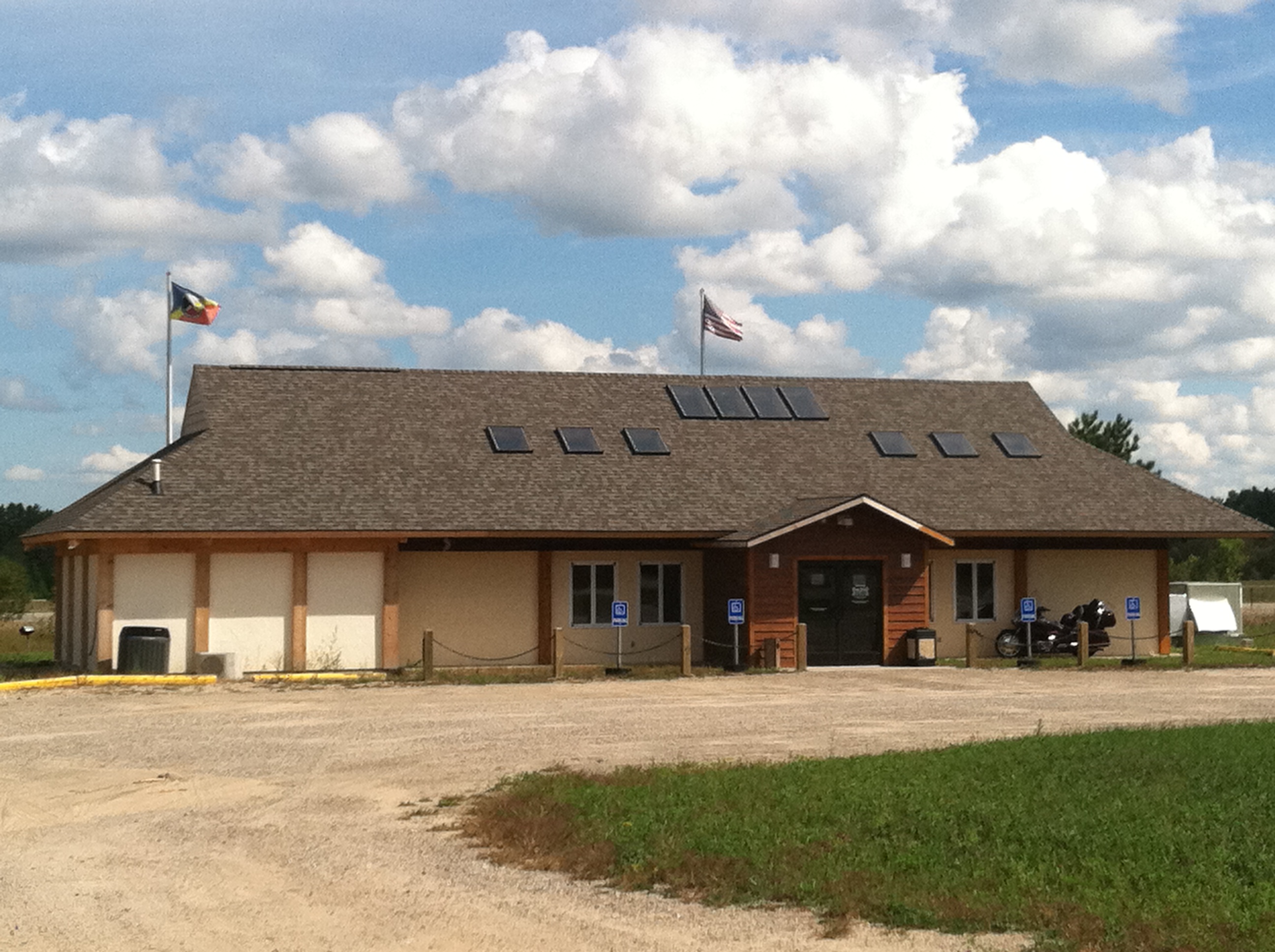
Here is a pic of the now-shuttered BMIC Vanderbilt Casino:
And some lovely intertribal rhetoric:
News Coverage of Saginaw Chippewa Disenrollment Efforts
Here. An excerpt:
By MARK RANZENBERGER
A hearing officer has ruled that the Saginaw Chippewa Indian Tribe cannot revoke the membership of an 87-year-old elder, despite the fact that she is not directly descended from a person listed on one of the Tribe’s base rolls.
But the disenrollment case of Anna Bell Atwell may not be over, according to her attorney.
“Tribal government officials, both certifiers and enrollment department staff, had a policy that collateral tracing to a constitutional base roll was sufficient to satisfy the tracing requirement for membership eligibility for enrollment,” said a ruling from the Tribe’s Office of Administrative Hearings. Continue reading
Sault Ste. Marie Tribe of Chippewa Indians rejects proposed Michigan moose hunt
As reported in the September 2nd issue of Win Awenen Nisitotung, Sault Tribe Inland Conservation Committee elected not to support a moose hunting season in Michigan. Provisions in the 2007 Inland Consent Decree require tribal (and state) approval of moose hunting. This outcome may frustrate people interested in moving forward with a moose hunt in Michigan; but for Sault Tribe officials, the precautionary route was prudent given the small number of moose that currently reside in the Upper Peninsula and the uncertainty over their population dynamics.
PRESIDENT OBAMA TO NOMINATE MSU LAW PROFESSOR WENONA SINGEL TO SERVE ON NATIONAL BOARD
PRESIDENT OBAMA TO NOMINATE MSU LAW PROFESSOR WENONA SINGEL TO SERVE ON NATIONAL BOARD
East Lansing, MI (September 6, 2011) — President Barack Obama today announced his intention to nominate Michigan State University College of Law Professor Wenona T. Singel to serve as a member of the Advisory Board of the Saint Lawrence Seaway Development Corporation (SLSDC).
The SLSDC, a wholly owned government corporation operating within the U.S. Department of Transportation, collaborates with its Canadian counterpart to operate, maintain, and ensure the safety and security of navigational facilities in the Saint Lawrence Seaway. Its five-member advisory board meets quarterly to advise the corporation’s administrator on policies involving the operation, development, and effects of the Seaway.
“President Obama’s nomination of Professor Singel to this important board is a tremendous honor both for her and for the Law College,” said Joan W. Howarth, dean of MSU College of Law. “We are so pleased that the White House has recognized Professor Singel’s extensive record of public service and dedication to research on major policy issues.”
Singel is an assistant professor of law and the associate director of the Indigenous Law & Policy Center at MSU Law, where she teaches courses in the fields of federal Indian law and natural resources law. She also is an associate appellate justice for the Little Traverse Bay Bands of Odawa Indians and the former chief appellate judge for the Grand Traverse Band of Ottawa and Chippewa Indians.
Prior to joining the faculty at MSU Law, Singel was an assistant professor at the University of North Dakota School of Law and a fellow with the Northern Plains Indian Law Center. She earlier worked in private practice with firms including Kanji & Katzen and Dickinson Wright. She has served as a member of the Economic Development Commission of the Little Traverse Bay Bands of Odawa Indians and as general counsel for the Grand Traverse Resort, a tribally-owned resort in northern Michigan.
Professor Singel is an enrolled member of the Little Traverse Bay Bands of Odawa Indians. She received an A.B. from Harvard College and a J.D. from Harvard Law School.
The Indigenous Law & Policy Center is the heart of the Indigenous Law Program at MSU College of Law. The Center has two goals: to train law students to work in Indian Country, and to provide services to institutional clients such as Indian tribes, tribal courts, and other tribal organizations on a wide variety of legal and policy questions. The Center’s “Turtle Talk” blog is a popular and influential source for up-to-the-minute updates and analysis on Indian law and politics. One of the most followed law blogs in the country, Turtle Talk is followed by tribal citizens; indigenous law scholars; and tribal, state, and federal leaders.
 Turtle Talk
You must be logged in to post a comment.