Here.
This is a different article than the NYT’s OpEd and the Star Tribune’s article on this topic.
Here.
Here.
Here.
An excerpt:
The sequester will impose cuts of 5 percent across the Indian Health Service, the modestly financed agency within the United States Department of Health and Human Services that provides basic health care to two million American Indians and native Alaskans. It is underfinanced for its mission and cannot tolerate more deprivation.
Here lies a little-noticed example of moral abdication. The biggest federal health and safety-net programs — Social Security, Medicaid, the Children’s Health Insurance Program, the Supplemental Nutrition Assistance Program, Supplemental Security Income, and veterans’ compensation and health benefits — are all exempt from sequestration. But the Indian Health Service is not.
Adam Liptak wrote about my favorite exchange of the day:
The question for the justices was whether that state law conflicted with the National Voter Registration Act of 1993, which allows voters to register using a federal form that asks, “Are you a citizen of the United States?” Prospective voters must check a box yes or no, and they must sign the form, swearing that they are citizens under penalty of perjury.
Several members of the court’s conservative wing indicated that the state was free to impose additional requirements to make sure only citizens vote.
Justice Antonin Scalia said the federal form was inadequate. “So it’s under oath,” he said. “Big deal. If you’re willing to violate the voting laws, I suppose you’re willing to violate the perjury laws.”
“Under oath,” he added, “is not proof at all. It’s just a statement.”
Patricia A. Millett, a lawyer for several groups challenging the Arizona law, responded that “statements under oath in criminal cases are proof beyond a reasonable doubt” sufficient to lead to the death penalty.
She added that tens of thousands of people had been rejected from the registration rolls because of the Arizona law, though there was no evidence that they were not citizens.
Briefs and other materials are here.
Contacts:
Mashpee Wampanoag Tribe: Brooke Scannell – 617-922-0094
Office of Governor Deval L. Patrick: Heather Johnson, Bonnie McGilpin, Juli Hanscom – 617-725-4025
GOVERNOR PATRICK AND CHAIRMAN CROMWELL SIGN GAMING COMPACT BETWEEN COMMONWEALTH AND MASHPEE WAMPANOAG TRIBE
BOSTON- Wednesday, March 20, 2013 – Governor Deval Patrick and Chairman Cedric Cromwell today announced that a new gaming Compact between the Commonwealth and the Mashpee Wampanoag Tribe has been signed and will now be sent to the Legislature for approval. This Compact paves the way for a resort-style casino in Region C in the southeast of Massachusetts, created by the Expanded Gaming Act signed by Governor Patrick in 2011. Continue reading
Here.
Here.
Here is the post, authored by Jodi Gillette:
On December 5, 2012, tribal leaders from across the country convened in Washington, D.C. for the fourth consecutive White House Tribal Nations Conference. President Obama has hosted the event each year of his presidency, affirming his commitment to strengthen the government to government relationship with tribes. The President delivered the keynote address at the Conference, which also featured remarks by senior Administration officials. Today we are releasing the synopsis of the 2012 Conference.
The Conference featured five break-out sessions, connecting tribal leaders and federal agency officials in focused areas of Indian Country priorities. The “Synopsis of the 2012 White House Tribal Nations Conference” reflects the concerns and feedback provided by tribal leaders in each break-out session. The break-out session topics included:
- Protecting Our Communities: Law Enforcement and Disaster Relief
- Strengthening and Advancing the Government-to-Government Relationship
- Strengthening Tribal Communities: Economic Development, Housing, Energy and Infrastructure
- Securing Our Future: Cultural Protection, Natural Resources and Environmental Protection
- Healthy Communities, Excellence in Education and Native American Youth
Prior to the Conference, we released the 2012 White House Tribal Nations Conference Progress Report. The Report compiles some of the President’s key accomplishments for Indian Country. These accomplishments include signing the HEARTH Act to streamline the process for tribes to manage their land independently, continuing implementation of the Tribal Law and Order Act by providing critical resources to tribal law enforcement and expanding educational opportunities for Native youth with grants through the State-Tribal Education Partnership (STEP) program.
The President and his Administration will continue to partner with tribes to accomplish the priorities laid out by leaders at the Tribal Nations Conference. President Obama is proud to have achieved two of those priorities in the first two months of 2013. First, in January, President Obama signed a bill that included an amendment to the Stafford Act allowing tribes to make direct applications for emergency relief, just as state governments do. Second, just in the past few weeks, the President signed into law a reauthorization of the Violence Against Women Act (VAWA), which includes new protections for Native American women. As President Obama said before signing VAWA, “Tribal governments have an inherent right to protect their people, and all women deserve the right to live free from fear.
While much progress has been made, the President recognizes that works remains, including a legislative Carcieri fix, increased energy development on tribal lands and expanded economic and education opportunities for Native American communities. In pursuing each of these priorities, the President and his Administration are committed to working with tribal leaders in, what the President called, “a true and lasting government-to-government relationship.”
Jodi Gillette is Senior Policy Advisor for Native American Affairs, White House Domestic Policy Council.
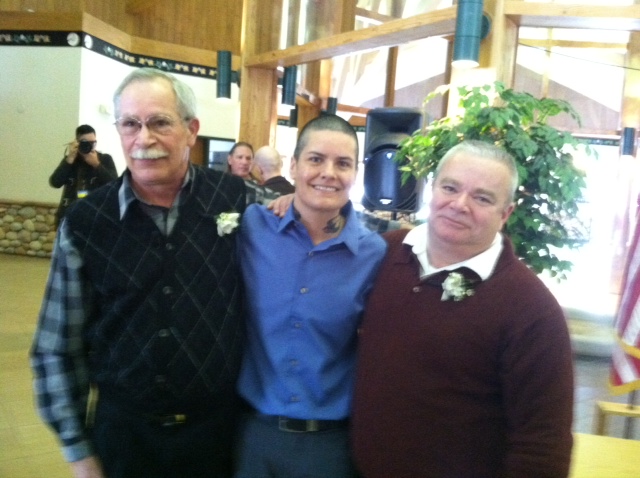
AP Article here features a quote from Cherie Dominic, who is pictured below today (on her birthday!) with the newly married couple. Congratulations to Mr. Barfield and Mr. LaCroix!
 Turtle Talk
You must be logged in to post a comment.