CTV recently released (October 4) a tiny story on what could be a monolithic advancement for the Mi’kmaq of Nova Scotia, and in turn for aboriginals throughout Canada. Here’s the story. However, be forewarned, this small piece, not even 200 words, barely offers any substance and reads more like an Onion article (“[O]ne of the most pressing details to work out for the Mi’kmaq is to find a place to put a House of Assembly”). And perhaps tellingly, Federal Aboriginal Affairs and Northern Development Minister John Duncan would not offer comment on it. Curioser and curioser. Stay tuned…
tribal courts
Congress Approves Tribal Court Improvement Program
From the National Council of Juvenile and Family Court Judges:
The President signed the Child and Family Services Improvement and Innovation Act on Friday with authorizes Court Improvement Program (CIP) funding and includes Tribal Court Improvement funding! The Court Improvement funding is to support states and tribes in actions to:
“increase and improve engagement of the entire family in court processes relating to child welfare, family preservation, family reunification, and adoption.”.
Here’s the portion specifically related to tribes. (See pages 7-8 of the Act here)
”(3) ALLOCATION OF FUNDS.- ”(A) MANDATORY FUNDS.-Of the amounts reserved
under section 436(b)(2) for any fiscal year, the Secretary shall allocate-
”(iv) $1,000,000 for grants to be awarded on a
competitive basis among the highest courts of Indian tribes or tribal consortia that-H. R. 2883-8
”(I) are operating a program under part E, in accordance with section 479B;
”(II) are seeking to operate a program under part E and have received an implementation grant under section 476; or
”(III) has a court responsible for proceedings related to foster care or adoption.
We will send any updates as we hear further information about this exciting opportunity for tribal courts!
Update in Columbe v. Rosebud Sioux Tribe
The court has dismissed the plaintiff’s claims that were not appealed to the tribal appellate court for failure to exhaust tribal remedies. Other claims remain extant due to a waiver of immunity.
Here are the materials:
DCT Granting Motion to Dismiss in Part
RST 2d Supplemental Memorandum
Prior materials are here.
Navajo Judicial Branch Press Release Opposing Changes to Judicial Qualifications
Here is the press release: 92311_ProposaltoAmendQualificationsofNavajoNationJusticeMayUn.
And here are links to other responses to the proposal, including comments by Dr. Raymond Austin, former Navajo Supreme Court Justice, from the judicial branch website:
September 23, 2011: The Judicial Branch has issued its comments on proposed amendments to the qualifications of Navajo Nation Supreme Court justices at 7 N.N.C. § 354 (B) that were submitted last week to the Navajo Nation Council legislative process through Legislation No. 0388-11. Chief Justice Yazzie and branch Human Resources Director Darren Tungovia commented separately, expressing concerns about the candidate pool and the consequences on Supreme Court’s ability to continue to be a leader in tribal court adjudication rather than in “a borrowed state or federal system in which our culture is merely anthropological speculation.” Late Friday, Asso. Justice Emeritus Raymond Austin also submitted comments. See press release.
Nevada Lawyer Magazine Indian Law Theme Issue

Nevada Lawyer – August 2011
Feature Stories:
- A Quick Guide to Nevada’s Tribal Courts
- Appellate Law in Nevada Indian Country: The Inter-Tribal Court of Appeals
- A Snapshot of Indian Criminal Law in the District of Nevada
- Tribal Courts in Nevada: Alive and Well
- Nevada Legal Services Tribal Court Advocate Training Project
- Washoe Tribal Court Tradition Comes Full Circle
- Judge “Joe” Van Walraven – Full-time Judge for the Reno-Sparks Indian Colony
- Article for CLE Credit: The ABCs of Practicing in Tribal Court (Want CLE Credit for this article? Take the quiz online!)
- Online Exclusive: Bureau of Indian Affairs Oversees Tribal Governance and Courts
- Online Exclusive: All Over the Map
- Event Recap: The State Bar of Nevada Annual Meeting
Regular Columns:
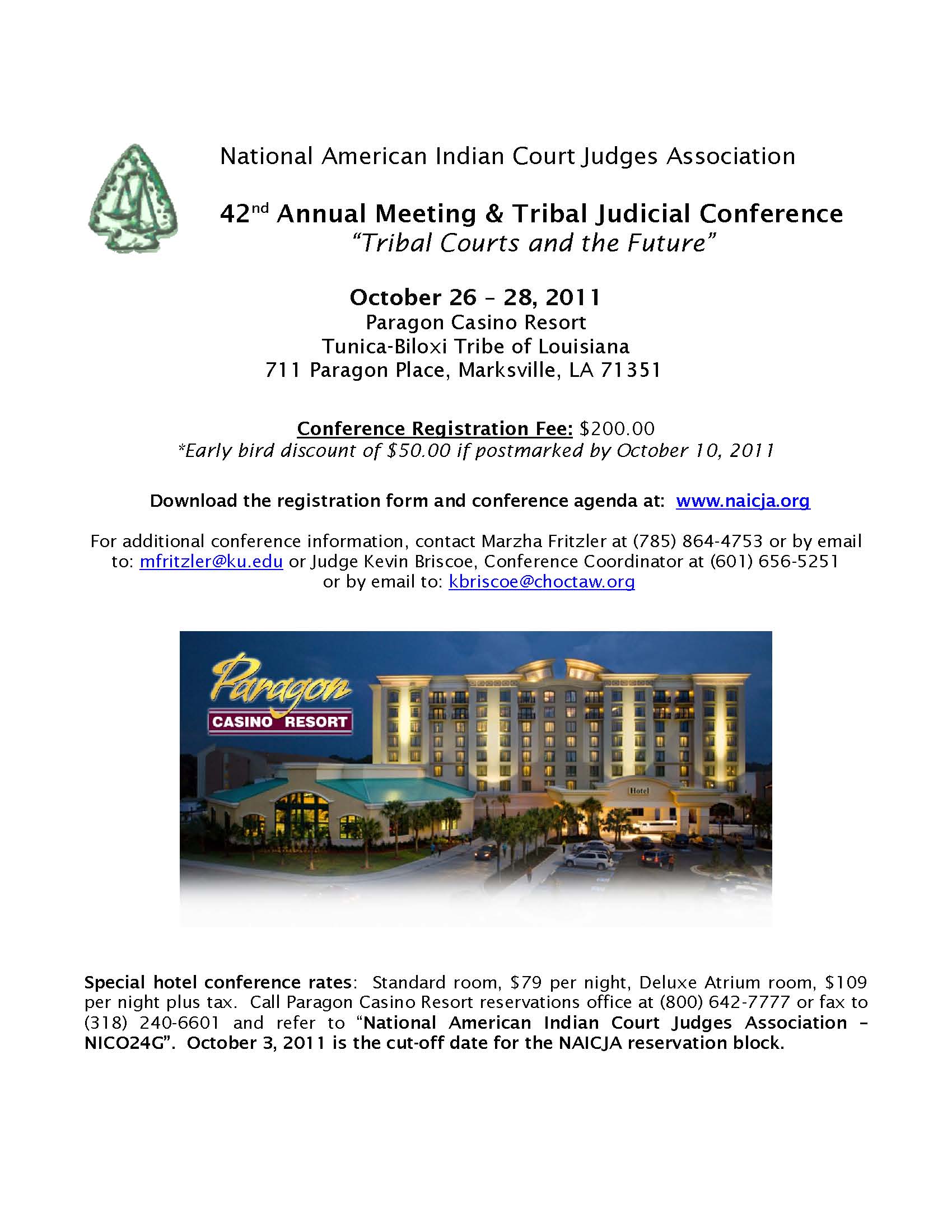
National American Indian Court Judges Association 42nd Annual Meeting: Oct. 26-28, 2011
NYTs “Room for Debate” — Tribal Rights vs. Racial Justice (Cherokee Freedmen Expulsion)
The New York Times’ “Room for Debate” series has published a series of articles on the Cherokee Freedmen controversy.
Debaters
-
Define ‘Real Indians’
 Kevin Noble Maillard, law professor, Syracuse University
 -
It’s About Ancestry
 Cara Cowan-Watts, speaker, Cherokee Council
 -
A Weak Sovereign
 Matthew L.M. Fletcher, Turtle Talk law blog
 -
The Role of Blood Quantum
 Rose Cuison Villazor, Hofstra University Law School
 -
My Cherokee Identity
 Heather Williams, Freedmen descendent
 -
Slavery’s Long Shadow
 Carla D. Pratt, law professor, Penn State University
 -
Why the Freedmen Fight
 Tiya Miles, historian, University of Michigan
 -
The True Meaning of Sovereignty
 Joanne Barker, associate professor, American Indian studies
Cherokee Nation AG Concurs with Freedmen Motion for Reconsideration before the Cherokee SCT
Hat tip Pechanga.
Here are those materials:
SC-11-02 16Motion to Reconsider Order of August 22 2011 9-13-11
The Cherokee AG’s response is curious: The AG agrees that the case should be reconsidered, largely in light of HUD’s decision to cut off funding and the BIA’s warning letter.
Here are the District Court stays in question:
11-Temp Order and Temp Injunction 5-14-2007
Order Continuing Current TO & Temp Injunction Pending Appeal
Will the Cherokee Supreme Court grant the motion????
MSNBC Coverage of Cherokee Freedmen Controversy
Here.
An excerpt:
“The Cherokee Nation will not be governed by the BIA,” Joe Crittenden, the tribe’s acting principal chief, said in a statement responding to the U.S. Bureau of Indian Affairs.
Crittenden, who leads the tribe until a new principal chief is elected, went on to complain about unnamed congressmen meddling in the tribe’s self-governance.
The reaction follows a letter the tribe received on Monday from BIA Assistant Secretary Larry Echo Hawk, who warned that the results of the September 24 Cherokee election for principal chief will not be recognized by the U.S. government if the ousted members, known to some as “Cherokee Freedmen,” are not allowed to vote.
Federal Government and Cherokee Nation Responses to Cherokee Freedmen Motion to Enjoin Principal Chief Election
Here are the updated materials in Vann v. Salazar (D. D.C.):
Cherokee Nation Response to Vann Motion
The Vann motion is here.
 Turtle Talk
You must be logged in to post a comment.