10th Cir. Decision in Crow Tribe of Indians v. Repsis

Despite the Supreme Court’s decision in Wyoming v. Herrera, which affirmed that the Crow Tribe’s treaty-reserved right to hunt in the Big Horn National Forest remained intact following Wyoming’s statehood, the State continued to prosecute Mr. Herrera for taking an elk in the Forest. The State argued that notwithstanding the Supreme Court’s decision in Herrera, Mr. Herrera was precluded from asserting his treaty defense because he (being in privity with the Crow Tribe as a Tribal member) was bound by the Tenth Circuit’s decision in Crow Tribe of Indians v. Repsis, which held that the Tribe’s treaty right was extinguished upon Wyoming’s statehood. Accordingly, the Crow Tribe sought relief from the Repsis judgments pursuant to Rule 60(b), so that the State could not continue to use Repsis. The Wyoming Federal District Court initially denied the Tribe’s Rule 60(b) motion, but the Tenth Circuit has now vacated that decision, remanding to the district court to consider the merits of the Tribe’s Rule 60(b) motion.

Here is the decision:

Prior posts on this matter here and here.

Ninth Circuit Affirms No Casino in Plymouth v. NIGC [Ione Band]

Here is the unpublished opinion.

Briefs:

Lower court materials here.

District of Alaska Dismisses Case Regarding Selawik Tribal Court Child Protection Case

The tribal child custody case here has received a lot of social media attention with very few details. The case is in Selawik Tribal Court.

Here was the attempt by the foster mother to receive a federal injunction in the case:

Memorandum In Support of Motion for Preliminary Injunction to Stay Tribal Court Judgement

Native Village of Selawik Motion to Dismiss

Exhibits accompanying Motion to Dismiss:

12-1

12-2

12-3

12-4

12-5

12-6

12-7

12-8

Opposition to Motion to Dismiss

Order Granting Motion to Dismiss


West Virginia Supreme Court Rejects EIF and Orders Transfer to Tribal Court

Opinion

Dissent

Yes, in fact, some states and foster parents are back to arguing the Existing Indian Family exception to ICWA.

Our decision in this regard is further supported by guidance from the Bureau of Indian Affairs (“BIA”) set forth in its 2016 BIA Guidelines pertaining to application of the Act’s provisions. Guidelines for Implementing the Indian Child Welfare Act (“2016 Guidelines”), 25 C.F.R. §§ 23.1 to -23.144 (2016). The 2016 Guidelines state, in relevant part:

In determining whether ICWA applies to a proceeding, the State court may not consider factors such as the participation of the parents or the Indian child in Tribal cultural, social, religious, or political activities, the relationship between the Indian child and his or her parents, whether the parent ever had custody of the child, or the Indian child’s blood quantum.

Id. § 23.103(c). This unequivocal statement plainly dispels any notion that the EIF exception is compatible with the ICWA. Accordingly, we join the “swelling chorus of [jurisdictions] affirmatively reject[ing] the EIF exception[,]” ICWA Proc., 81 Fed. Reg. 38778, 38802 (June 14, 2016), and hold that West Virginia does not recognize the Existing Indian Family exception to the Indian Child Welfare Act, 25 U.S.C. §§ 1901 to -1963 (2021). Accordingly, the circuit court erred in adopting the EIF exception and subsequently relying on that exception to determine that the ICWA was inapplicable to this case.

There are also a whole lot of parties citing to the 1979 Guidelines again these days, despite them being not in effect since 2015. It’s giving late 90’s/early 2000’s in ICWA practice these days.

Before this Court several of the parties cited this guidance as a basis for arguing that the Tribe is not entitled to transfer because it knew of these proceedings in December 2021 but did not move to transfer until eight months later in August 2022. What the circuit court and the parties fail to recognize is that the 1979 Guidelines were explicitly abrogated and replaced by the BIA when it promulgated the 2016 Guidelines. See Guidelines for Implementing the Indian Child Welfare Act, 81 Fed. Reg. 96476 (Dec. 30, 2016) (“The [2016] guidelines replace the 1979 and 2015 versions[.]”). Therefore, we do not find the 1979 Guidelines persuasive, nor do we rely upon any guidance contained therein.

But the WV Supreme Court saw through it:

For the reasons stated herein, we grant the Tribe’s petition for writ of prohibition and prohibit enforcement of the circuit court’s September 30, 2022, Order Denying Transfer. We remand this matter to the circuit court with directions to enter an order transferring jurisdiction in this action to the District Court of the Delaware Tribe.
Alaska Supreme Court Adopts In re Z.J.G. Reasoning in ICWA Reason to Know Opinion

JimmyE

[14]We consider the Washington Supreme Court’s reasoning to be persuasive and note that other states also consider a specific, recent claim of Native heritage to be a “reason to know” the child is an Indian child.47 Tribes have many methods to determine membership or eligibility for membership, including lineal descent or blood quantum.48Additionally, a tribe may enroll an eligible child after being notified by a state agency that the child is involved in a child custody proceeding.49 Because the tribe as sovereign has exclusive power to determine tribal membership or eligibility for tribal membership, notifying the tribe when a child who may be a member is involved in a child custody proceeding is imperative to implementing ICWA’s protections of tribes and tribal members.

***

Perhaps more importantly, treating a parent’s uncertain statements as determinative in a context like this could undermine tribal sovereignty, because the tribe decides who is a member.56 It is a “basic federal rule” that tribes are the exclusive authority on their membership.57 We have previously held that absent a determination by a tribe, a child’s membership or eligibility for membership in a tribe is likely not subject to judicial admission, recognizing the legal authority of tribes to determine membership.58 Giving too much weight to the statements of a party without proof or input from the tribe would undermine this fundamental principle.

***

We reiterate that a “reason to know” that children are Indian children may arise in many different ways, based upon a multitude of different pieces of information, and determining whether there is a “reason to know” is a fact-intensive analysis requiring consideration of the record of information and context presented in any given case.64 Here, Jimmy’s specific claim that he is a recent descendant of a CIRI shareholder, paired with his early assertions related to his children’s tribal affiliation, gave OCS and the court “reason to know” his children are Indian children, triggering OCS’s duty to inquire and to treat the children as Indian children pending a definitive answer as to their status.

Ninth Circuit Affirms Dismissal of Pro Se ICRA Suit Brought by Terminated Employee

Here is the unpublished opinion in Villasenor v. Torres-Martinez Desert Cahuilla Indians.

The tribe’s brief:

Ninth Circuit Rejects Effort to Stop Lithium Mine in Nevada

Here is the unpublished opinion in Western Watersheds Project v. McCullough. And same for the Bartell Ranch/Burns Paiute case.

Selected briefs:

Lower court materials here.

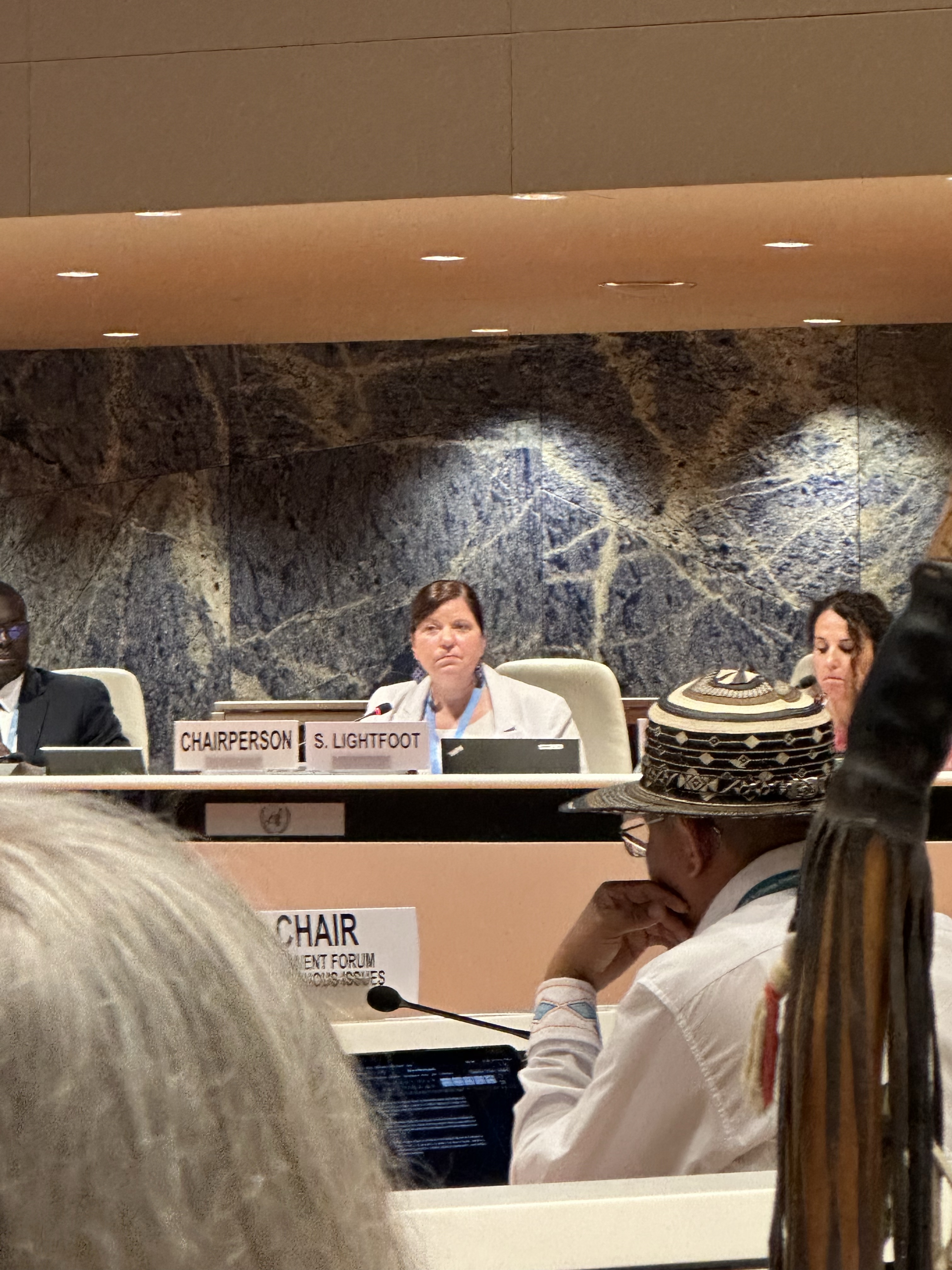
United Nations 16th Session Expert Mechanism on the Rights of Indigenous Peoples

Sheryl Lightfoot of Keewenaw Bay Indian Community is the Chairperson

Dear Tribal Leader Letter re. ICWA Support

Letter Here

The Administration (DOI, HHS, and DOJ) are asking for input on the following:

What additional supports would Tribal leaders find helpful to build their Tribe’s capacity to exercise their rights and responsibilities under ICWA? 

Are there specific supports you believe the federal government could provide to help state courts and child welfare agencies meet their obligations under ICW A?

In your experience, are there specific aspects or requirements of ICWA where state courts and agencies need to build greater understanding or capacity? 

Are there existing State-Tribe collaborative partnerships or processes that you believe have helped support effective implementation ofICWA? 


Consultation is August 7 online and August 11 in Anchorage. Commends are due by September 15, 2023.

I might note the lawsuit regarding data and ICWA is ongoing in the Ninth Circuit, though the Administration has promised to issue a notice of rule making in October. A description of the issue of funding tribal systems (with citations) can be found here.