Here is the complaint in Timbisha Shoshone Tribe v. Bernhardt (D.D.C.):
Friday Job Announcements
Friday job announcements will be posted next week.
Action Shots from the Stanford Law School’s Mini-Course on Tribal Law
Taught by Fletcher….
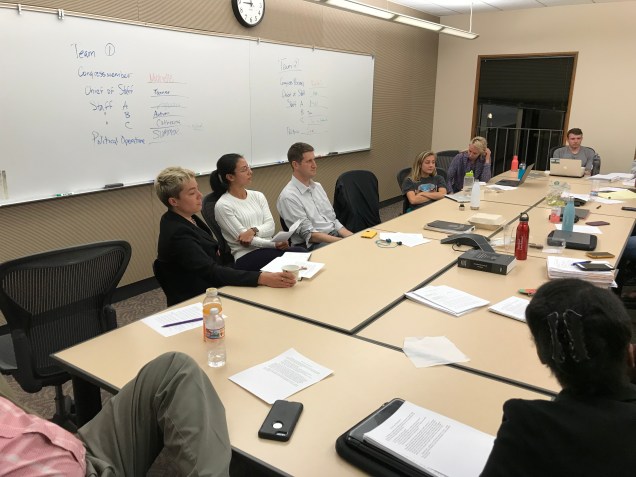

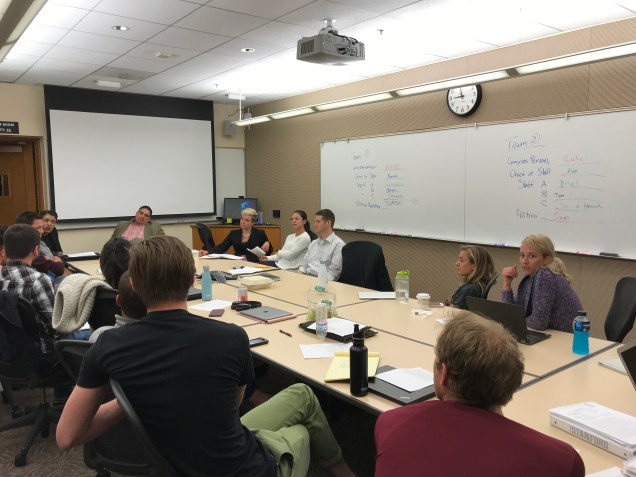
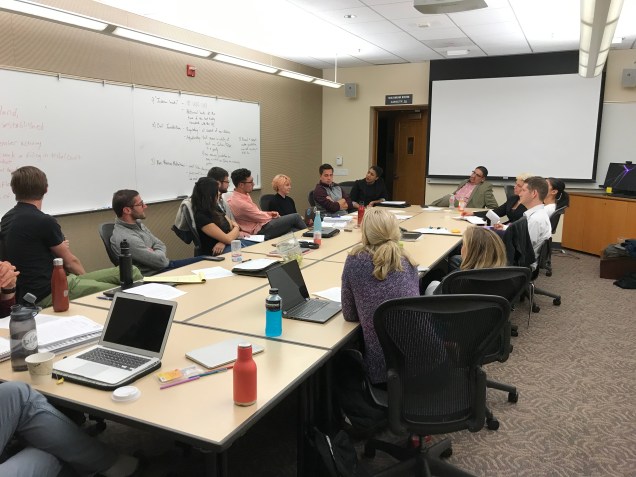
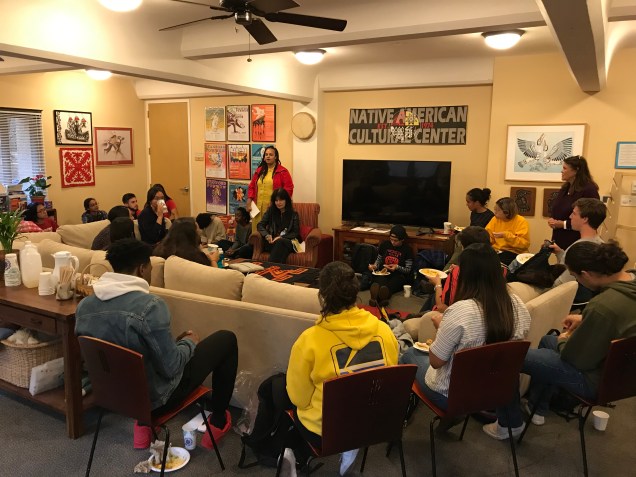
Joy Harjo Visit to the Stanford Native American Cultural Center
Wednesday, I was delighted to attend a reception for Joy Harjo (who read later on before a bigger audience).



Bay Mills Indian Community Comments on Operation and Future of Line 5
National Indian Law Library Bulletin (5/14/2019)
Here:
The National Indian Law Library added new content to the Indian Law Bulletins on 5/14/19.
Federal Courts Bulletin
https://www.narf.org/nill/bulletins/federal/2019.html
Diné Citizens Against Ruining Our Environment v. Bernhardt (Hydraulic Fracking; Environmental Assessments)
Standing Rock Sioux Tribe and Cheyenne River Sioux Tribe v. U.S. Army Corps of Engineers and Dakota Access, LLC (Oil & Gas Pipelines; Documents for Administrative Record)
State Courts Bulletin
https://www.narf.org/nill/bulletins/state/2019.html
The People of the State of Colorado, In the Interest of Z.C., a Child, and Concerning S.C. (Indian Child Welfare Act – Notice)
State of Minnesota v. Randy Lee Thompson (Arrest; Expulsion)
Tribal Courts Bulletin
http://www.narf.org/nill/bulletins/tribal/2019.html
Swinomish Tribal Community v. Peters (Domestic Violence)
Swinomish Tribal Community v. McCleod (Juries)
Law Review & Bar Journal Bulletin (contact us if you need help finding a copy of an article)
https://www.narf.org/nill/bulletins/lawreviews/2019.html
- Public land and resources law in the American West: Time for another comprehensive review?
- Environmental injustice and the limits of possibilities for environmental law.
- Federal Indian Law as Paradigm Within Public Law.
- Creating sustainable economic development on Indian reservations is an “access to justice” issue.
- The last judicial frontier: The fight for recognition and legitimacy of Tribal courts.
- Tribal (de)termination? Commercial speech, Native American imagery and cultural sovereignty.
- A jury of someone else’s peers: The severe underrepresentation of Native Americans from the western division of South Dakota’s jury-selection process.
- Agency pragmatism in addressing law’s failure: The curious case of federal “deemed approvals” of tribal-state gaming compacts.
- Blackhorse’s last stand?: The First Amendment battle against the Washington “Redskins” Trademark after Matal v. Tam.
- Empire States: The coming of dual federalism.
News Bulletin
https://www.narf.org/nill/bulletins/news/currentnews.html
In the Tribal Jurisdiction section, we feature an article about a Maine bill aiming to restore tribal sovereignty in certain crimes committed by non-Natives.
Regulatory Bulletin
http://www.narf.org/nill/bulletins/regulatory/2019.html
We feature notice of the Department of Health & Human Services, Administration for Children and Families, regarding tribal consultation meetings for tribal governments operating Head Start.
Legislation Bulletin
https://www.narf.org/nill/bulletins/legislation/116_uslegislation.html
- H.R.2599: To amend the Public Health Service Act to require State educational agencies and tribal educational agencies receiving funds under section 520A of such Act to establish and implement a school-based student suicide awareness and prevention training policy and school threat assessment team policy, and for other purposes.
- H.R.1367: Comprehensive Addiction Resources Emergency Act of 2019.
- H.R.2607: To expedite under the National Environmental Policy Act of 1969 and improve forest management activities on National Forest System lands, on public lands under the jurisdiction of the Bureau of Land Management, and on Tribal lands to return resilience to overgrown, fire-prone forested lands, and for other purposes.
Muscogee (Creek) Nation SCT Issues Opinion in Judicial Recusal Matter
Here is the order in Bruner v. Muscogee (Creek) Nation.
New Legal Aid Clinic for Native Americans in Buffalo, New York
Attorney Lee Redeye, a member of the Seneca Nation of Indians, recently started a legal aid clinic aimed increasing access to legal systems for Native American people living in Western New York. For more information, please read the article here.
National Intertribal Tax Alliance Conference
August 13-15, 2019
Pueblo of Pojoaque Buffalo Thunder
This one-day training, followed by a two-day conference, will explore how tribes can build a sustainable tribal economy and fiscal system with a focus on increasing tax revenues, improving tax administration efficiencies, negotiating compacts, financing infrastructure and other important topics. Participants will receive a certificate of completion.
See the draft agenda and the conference flyer for more information.
The Tulo Centre of Indigenous Economics is a Canadian charitable organization whose mission is to assist interested First Nations in building legal and administrative frameworks that support markets on their lands. The Tulo Centre offers university accredited tax administration programs and works in partnership with the First Nations Tax Commission, National Intertribal Tax Alliance, and other organizations. More information on the Centre can be found at https://www.tulo.ca/
Notice Case out of Alabama [ICWA]
Sometimes even I am struck dumb by the notice cases:
A second form, dated in 2017 and signed by C.L.B., was also introduced into evidence. C.L.B. testified that his mother had assisted him in completing the 2017 form. On the 2017 form, C.L.B. listed Cherokee and “Ojibwa-(Chippewa)” as the tribes in which he, B.E.B., or one of B.E.B.’s paternal grandparents might have membership.
Star Pope testified that, at the direction of C.L.B., she had inquired of the paternal grandmother of B.E.B. regarding with which tribes C.L.B.’s family might be affiliated. She testified that the paternal grandmother of B.E.B. had informed her that C.L.B. was not affiliated with the Cherokee or Sioux tribes but that she had identified the Chippewa or Ojibwe tribe as a possibility. Pope testified that she had contacted authorities in several different states and that she had eventually been directed to a central location to which, she said, she had mailed a letter requesting information concerning whether B.E.B. would be recognized as an Indian child or have benefits under the ICWA. DHR introduced into evidence a letter dated May 4, 2016, that had been mailed to the ICWA representative from the Chippewa Indians of Mackinac, Michigan . . .
DHR also introduced a letter from the Bay Mills Indian Community dated May 19, 2016, in response to an inquiry from DHR; that letter indicated that B.E.B. was not eligible for membership in the Bay Mills Indian Community.
 Turtle Talk
You must be logged in to post a comment.