Here are new materials in Bad River Band of Lake Superior Chippewa Indians v. Enbridge Energy Company (W.D. Wis.):
Here are new materials in Bad River Band of Lake Superior Chippewa Indians v. Enbridge Energy Company (W.D. Wis.):
Crispin T. South has published “Let Them Be Tribal Members: Exempting Nonmember Resident Indians from State Taxes” in the Arizona State Law Journal. Here is the abstract:
Under McClanahan v. Arizona State Tax Commission, States are categorically preempted from taxing the income of an Indian who lives within his own Tribe’s reservation and gains his income from reservation sources. Later cases have distinguished McClanahan, holding that the income of Indians who live and work within a different Tribe’s reservation is generally taxable by the State. State income taxation of these non-member resident Indians poses a number of problems for individuals, Tribal governments, and tribal sovereignty as a whole. This Comment argues that to push back against these problems, Tribes ought to enter into membership reciprocity agreements that allow non-member resident Indians to become Tribal members, thus exempting them from state income taxes under McClanahan’s categorical rule.
Emiliana Almanza Lopez has published “Tribal Sovereignty, Sales Tax, and States Interference: Why Tax Compacts May Be the Best Way Forward” in the Minnesota Journal of Law & Inequality. Here is the abstract:
Tribes as sovereigns have the power of taxation. When states seek to impede this power by imposing their own taxes on non-member transactions on Reservations, Tribes must decide if imposing their own Tribal tax outweighs the risk of increased prices deterring business and business partnerships. This is the issue of double taxation. This Note investigates paths of remedy that address the burden of double taxation specific to sales taxes. Specifically, it looks at tax preemption, litigation, and policy. Preemption is difficult, and the existing case law framework on state tax preemption in Indian Country is complex, fact specific, and generally favors the state. Current federal policies fail to address this issue, and states are unlikely to preempt their own taxes without gaining something in return. Tribe-state tax compacts offer a compromise that releives some of the burden borne by Tribes, but also requires concessions. This Note argues that while imperfect, these tax compacts may be the best remedy to double taxation in Indian Country and offers suggestions for how these binding agreements between sovereigns can be used to enforce state respect for Tribal sovereignty.
A Resource for Indian Country: Coalition for Tribal Sovereignty
What is the Coalition for Tribal Sovereignty?
Launched in early 2025, the Coalition for Tribal Sovereignty (CTS or Coalition) is a nonpartisan collaboration of nearly 40 inter-Tribal, policy-focused, non-profit organizations from across the United States. CTS’s member Tribal organizations regularly engage on coordination at the national and regional levels to support Indian Country with tools to use when interacting with the Trump Administration and others about the Administration’s policy initiatives, with the goal to get those tools into as many Tribal advocates’ hands as possible.
While member organizations continue their own advocacy and education efforts, CTS compliments those efforts by interfacing collectively with federal officials in the Administration and on the Hill regarding actions taken by the Trump Administration. CTS offers a space and platform for Tribal organizations to build consensus on key messaging and legal arguments, allowing CTS to speak with a single powerful and consistent voice. To learn more, visit our website at CoalitionForTribalSovereignty.Org.
What Tools Has CTS Created?
Access the Meeting Materials Toolkit here. The materials can be downloaded as individual documents or in a single toolkit PDF.
The Federal Grand Termination Toolkit is available for download as part of the password protected page on the CTS website. Please email info@CoalitionForTribalSovereignty.org for the access password. Please see the access page here.
These materials are available for download as part of the password protected page on the CTS website. Please email info@CoalitionForTribalSovereignty.org for the access password. Please see the access page here.
Why Now? The Coalition exists for one core purpose: to support Tribal Nations and Tribal organizations as they defend Tribal sovereignty and trust and treaty rights amid rapid and sometimes harmful impact of policy changes. In response to new executive orders, funding shifts, agency actions, and more that often overlook Tribal Nations’ sovereignty, the government‑to‑government relationship, and trust and treaty obligations, Tribal‑serving organizations came together to ensure Indian Country’s rights and status are respected and protected. By uniting local, regional, and national advocates who had previously been working in silos, the Coalition provides coordinated, proactive advocacy so that fast‑moving federal decisions do not erode Tribal Nations’ inherent sovereignty or the trust and treaty rights on which our communities rely.
What is Our Topline Message? CTS educates the Administration on why programs serving Indian Country are not like other federal programs because: (1) they deliver on the United States’ trust and treaty obligations to Tribal Nations, Tribal citizens, and Native communities, for which we prepaid with our lands and resources; and (2) the U.S. Supreme Court has said United States actions that deliver on trust and treaty obligations are not unconstitutionally race-based but are instead political in nature. CTS works to engage with the Administration on why and how it should insulate Indian Country from the disproportionate and potentially unintended negative impacts of its policy actions, while also finding opportunities to work with the Administration to pursue important shared priorities.
How Do I Access CTS Tools? To learn more about CTS and to access our material, please visit CoalitionForTribalSovereignty.Org. To subscribe to our newsletter, visit https://coalitionfortribalsovereignty.org/coalition-action-center/contact-us/. You can reach the CTS team, including to request the website password, by emailing info@coalitionfortribalsovereignty.org.
5:30pm – 8:30pm
What Does it Mean to Live with Treaties? A Roundtable on Indigenous History
This keynote roundtable will bring together several renowned Indigenous scholars with expertise in Indigenous and U.S. history, as well as in tribal, federal, and constitutional law. Together, they will reflect on the past, present, and future of Indigenous History, including the fundamental issue of treaties and their downstream effects into the present. A central theme of this session is: where did Indigenous history start from, where is it going, and what challenges and obstacles remain within the field? The panel will also consider the more specific question of treaties, land, and dispossession within a broader, comparative framework that builds upon recent studies of “land grab” politics across U.S. history as a whole. Additionally, the speakers will reflect on a second theme central to their scholarship: that U.S. history cannot be understood without recognizing the central role of Indigenous histories and experiences.
5:30 – 6:30pm: Reception with light fare with the panelists.
6:30 – 8:30pm: Conference welcome, opening remarks, keynote roundtable, and public Q&A.
All events are open to the public. This roundtable is made possible through the partnership of the IHP-1817 Project and the Eisenberg Institute for Historical Studies, who are co-sponsoring this event as part of their annual lecture series.
Keynote Panelists: Ned Blackhawk, Maggie Blackhawk, Matthew Fletcher, and Michael Witgen. Moderated by Greg Dowd.
9:15am – 11:00am
Why Study Michigan Now? Situating the University of Michigan and the Great Lakes Region in the Broader Histories of Native American Dispossession, Removal, “Land Grab” Politics, and U.S. Higher Education
This panel takes as a starting point the founding moment represented by the land transfer to U-M in Article 16 of the 1817 Treaty of Fort Meigs, but widens the scope of inquiry to include subsequent treaties and land transfer schemes that facilitated the development of the University and the state of Michigan. This panel will present the “receipts,” to visually represent the transfer of wealth from Native people to the citizens of the state of Michigan.
This panel will demonstrate that the histories of U-M, the state of Michigan, and the broader Great Lakes region are crucial contexts for understanding the broader histories of dispossession, removal, land grab politics, and the development of American higher education. Discussion of the 1817 Project, including an explanation of its origins and a showcase of its ongoing work, will illustrate how the project is addressing fundamental questions of U.S. history.
11:15am – 12:30pm
Universities and Indigenous Dispossession
This panel will explore the deep links between colonization, Indigenous dispossession, and the growth of colleges and universities in the United States. While the 1862 Morrill Land Grant College Act is often cited as a pivotal moment in the history of American higher education, centering the narrative on the mid-nineteenth century risks obscuring the broader role that Indigenous land played in underwriting American colleges and universities. Long before the Morrill Act, institutions such as the University of Michigan relied on land appropriated through treaties to finance operations, expand campuses, and diversify educational opportunities for students. At the same time, public domain land was being used for internal improvements, with universities serving as part of this larger project of development. The Morrill Act extended and formalized these practices, redistributing millions of acres of Indigenous land to fund the expansion of higher education across the United States. By bringing the pre- and post-Morrill Act eras into conversation, this panel will show how Indigenous land has remained a foundational resource for American higher education from its beginnings through the present.
1:30pm – 2:45pm
How to Read A Treaty: Legal Battles and the Continuing Impact of U.S.-Anishinaabeg Treaties
This panel will demonstrate how important Michigan-area treaties such as the 1836 Washington Treaty and 1855 Treaty of Detroit continue to shape the lives of the Anishinaabe people of the state, and how their meaning and enforcement remain subjects of legal challenges and political activism. To show the continuing impact of treaties, and the ways in which they serve as foundational documents of Anishinaabeg-U.S. political and legal relations, our speakers will draw from their experience as legal scholars, jurists, litigators, and expert witnesses. Collectively, they will discuss cases such as Little Traverse Bay Bands of Odawa v. Whitmer, which considered whether the 1855 Treaty of Detroit created a reservation for the LTBB Odawa in northern Michigan, as well as current litigation on the Line 5 Pipeline in the Straits of Mackinac and the broader historical contexts of these cases.
3:00pm – 4:15pm
On the Hidden Histories of Public Domain Land
This panel will explore the creation of public lands in the Michigan Territory and state through the multiple treaties negotiated by the federal government with the Indigenous peoples of Michigan. Historically, federal officials pressured tribes in Michigan to agree to the extinction of Native title to their lands, even when there was no immediate demand for those lands. This meant not only that tribes were deprived of a valuable asset, but also that this asset was able to appreciate in value until such time as it was sold by the state. In order to convince Native peoples to sign these treaties, the 1836 Washington and 1855 Detroit treaties guaranteed Native peoples the right to hunt, fish, and harvest on ceded territory not yet converted into private property. Reinforcing the enduring relevance of treaties across time, this panel will focus on the protests, activism, and legal battles that have emerged over Indigenous resource rights in Michigan, all of which revolve around differing interpretations of land and treaties. The panel will center the experiences and insights of community members who participated in these events.
9:15am – 10:30am
How to Think About the Origins of Indian Removal Politics From a Great Lakes Perspective
This panel will highlight how two Michigan Anishinaabe communities, the Pokagon Band of Boodewaadamii and the Burt Lake Band of Odawa and Ojibwe Indians, had different experiences with removal and federal recognition, shaping their distinct paths and histories. It will combine historical analysis of the development of various nineteenth-century land companies and land transfer schemes with presentations by community representatives who can discuss the resistance of their communities to Indian Removal, as well as how they have fought or are still fighting to have their sovereignty and territory recognized by the federal government. This panel will discuss the shifting understandings and contexts of Indian Removal, focusing on examples from Michigan and the broader Great Lakes Basin, such as encroachment from settler colonists, forced migration by military forces, and Indian Boarding schools, that illuminate nationally significant aspects of Indian Removal policy.
10:45am – 12:00pm
Teaching Native American and Treaty History in K-12 Classrooms
This panel brings together educators from public schools and library professionals to share their experiences and insights on teaching Native American history in a range of educational settings. Panelists will discuss best practices for engaging students, building inclusive curricula and lesson plans, and addressing the gaps and challenges that persist in public education. Drawing on their experience teaching Native American history, they will reflect on what has proven most effective, what barriers remain, and how educators can collaborate to move this work forward.
12:00 – 12:15pm
12:00pm – 3:00pm
Equal parts resource fair, poster session, and tabling event, the Community Connections Forum will serve as a platform for fostering connections among attendees, the 1817 Project, U-M campus partners, and student organizations connected to the themes of the conference.
1:15pm – 2:45pm
Teaching Native American and Treaty History
This session will consist of teaching workshops designed for K-12 educators, with two separate workshops targeted for elementary, junior, and high school level instructors. The workshops will include short preparatory presentations on subjects relevant to the conference, such as treaties or public domain land, with accompanying guidance on how to teach the subject matter. K-12 instructor participants will receive pre-prepared instructional materials at the start of the workshop, with additional materials provided at the conclusion.
*These workshops have a limited number of spots available. If you are interested in attending one of these workshops, please email inclusivehistory@umich.edu.
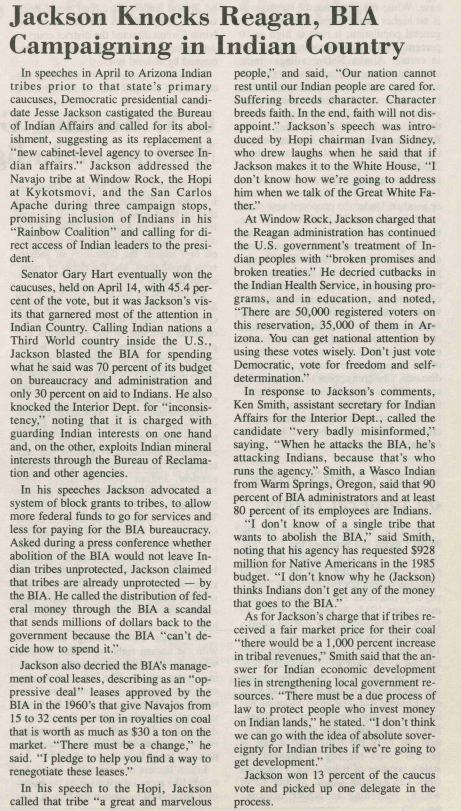
Indian Truth, June 1984, p. 9
Here are the materials in Avoyelles Water Commission v. Ward 3 Avoyelles Waterworks District (W.D. La.):
Here:
A Historical Review of Congressional Plenary Power and Tribal Treaties and the Implications Following Herrera
Skye Hosch Taylor
Unethical Business Practices Plague Native American Cultures and Economies – Solutions to the Ineffectiveness of the Indian Arts and Crafts Act
Benjamin Amoroso Sinder
A Survivor’s Tale: How the Northern and Eastern Districts of Oklahoma Survived the Tidal Wave Collision of McGirt v. Oklahoma
Darbi E. Robertson
Winner, Best Appellate Brief in the 2024 Native American Law Student Association Moot Court Competition
Molly Gunther and Kevin Burdet
 Turtle Talk
You must be logged in to post a comment.