Brief in Support of Petitioner here.
U.S. cert petition previously posted here.
Here is the unpublished opinion in In re K.P.:
An excerpt:
Michelle T., a member of the Pala Band of Mission Indians, contends that the juvenile court violated the Indian Child Welfare Act (ICWA), title 25 United States Code section 1901 et seq. and Welfare and Institutions Code section 224 et seq. by terminating her parental rights to her children, K.P. and Kristopher P., under section 366.26.
Throughout most of their dependency cases, K.P. and Kristopher were eligible for membership, or were enrolled, in the Pala Band of Mission Indians (Pala Band). At the children’s first section 366.26 hearing, the Pala Band did not consent to the children’s adoption and the juvenile court ordered a plan of guardianship. Several years later, when the children’s cases proceeded to a second section 366.26 hearing, the juvenile court learned that the Pala Band of Mission Indians had disenrolled K.P. and Kristopher, and others, on the ground that they lacked the blood quantum necessary for membership.Michelle argues that in view of a pending appeal in the United States Court of Appeals for the Ninth Circuit challenging the validity of the Pala Band’s enrollment ordinance that resulted in the disenrollment of K.P. and Kristopher and the others, the juvenile court erred when it found that K.P. and Kristopher were not Indian children within the meaning of the ICWA and declined to apply ICWA’s substantive and procedural protections at the children’s second section 366.26 hearings. Michelle also argues that enrollment in a tribe is not required to be considered an Indian child, and that the Pala Band did not provide written confirmation that enrollment is a prerequisite for Pala Band membership.
We conclude that the juvenile court correctly ruled that the Indian tribe has the sole authority to determine its own membership and that the juvenile court must defer to the membership decisions of an Indian tribe. Under federal and state law, the Indian tribe’s membership determination is conclusive. The record shows that enrollment is a prerequisite for Pala Band membership, and that the Pala Band determined that K.P. and Kristopher are not members of its tribe. Therefore, the juvenile court did not err when it determined that K.P. and Kristopher are not Indian children within the meaning of the ICWA and terminated parental rights without applying ICWA’s heightened substantive and procedural protections. We affirm.
Here is the complaint in Little River Band of Ottawa Indians and Its Employee Welfare Plan v. Blue Cross Blue Shield of Michigan (W.D. Mich.):
The summary:
This final rule provides procedures for the disposition of unclaimed human remains, funerary objects, sacred objects, or objects of cultural patrimony excavated or discovered on, and removed from, Federal lands after November 16, 1990. It implements section 3(b) of the Native American Graves Protection and Repatriation Act.
From the Federal Reserve Bank of Minneapolis’ Center for Indian Country Development, here.
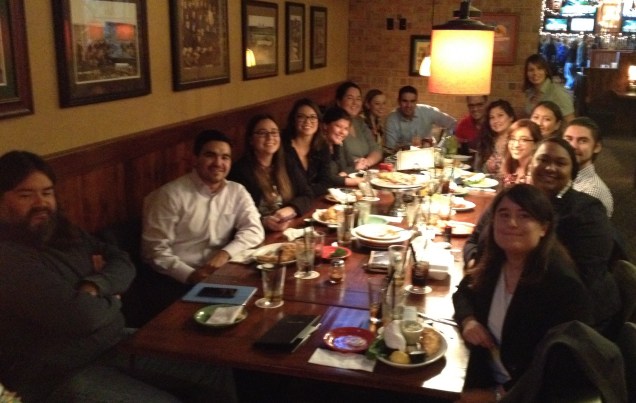
After much laziness and delay on my part, here is the 2015-16 NNALSA ed board about to devour a carb-heavy lunch at Pizza House in The EL (yes, it’s true I’m thinking about pizza in this pic, but having a great time!):
Here is the order in FMC Corp. v. Shoshone-Bannock Tribes (D. Idaho):
43 DCT Order Denying Discovery
An excerpt:
To allow a litigant to conduct full-blown discovery here, after he failed to conduct discovery in the tribal court litigation, would ignore National Farmers and Iowa Mutual. Those cases directed that all issues be fully presented to the tribal court so that it might cure any problems and give the federal court the benefit of its expertise. If a due process issue like judicial bias is not fully developed through discovery before being presented to the tribal court – and the litigant simply sits on his discovery rights until he gets into federal court – the tribal court never gets a chance to review the discovery, apply its expertise, and cure any unfair judicial bias revealed by the discovery. That is antithetical to the analysis of National Farmers and Iowa Mutual.
Nez Perce Tribe seeks Tribal Prosecutor to:
Requires at least two years (five preferred) of successful experience as a prosecutor or criminal defense attorney, preferably in a tribal government setting. Please provide a legal writing sample with application, and resume listing at least three work-related references. Must include a completed NPT application (available on www.nezperce.org). Applicant must possess a valid driver’s license with the ability to be insured under the Tribe’s policy; applicants who are not Idaho residents must provide their own Motor Vehicle Report.
Salary approximately $75K+ DOE/DOQ and includes generous health insurance and other benefits. Call (208) 843-7332 for assistance. Applications to be accepted until position is filled. Tribal preference applies. Incomplete application packets will not be considered.
Mail to:
TRIBAL PROSECUTOR HR-15-180
PO Box 365
Lapwai ID 83540-0365
The abstract:
Special domestic violence criminal jurisdiction for Indian tribes took effect nationally on March 7, 2015, and it was a historic moment for the tribes. Ever since the Supreme Court’s 1978 decision in Oliphant v. Suquamish Indian Tribe, tribes had been powerless to exercise criminal jurisdiction over non‐Indian defendants. Because the Court held that “Indian tribes do not have inherent jurisdiction to try and punish non‐Indians,” an unfortunate gap in enforcement resulted: for crimes committed in Indian country, where states’ criminal jurisdiction is limited and where the federal government lacks the resources to prosecute crimes effectively, non‐Indian offenders regularly escaped prosecution. This problem was particularly disturbing in the context of domestic violence and related crimes. For example, sixty‐seven percent of the sexual abuse and related offenses committed in Indian country and charged in fiscal years 2005–2009 were left unprosecuted by the federal government.
Enter VAWA 2013 and special domestic violence criminal jurisdiction for Indian tribes. Recognizing that “much of the violence against Indian women is perpetrated by non‐Indian men” who “regularly go unpunished,” Congress intended special domestic violence criminal jurisdiction to fill the prosecutorial enforcement gap for domestic violence offenses. Codified at 13 U.S.C. § 1304, the new provisions recognize tribes’ “inherent power . . . to exercise special domestic violence criminal jurisdiction over all persons”—including non‐Indians.
Although tribes and their advocates have celebrated VAWA 2013’s partial override of the Oliphantdecision, special domestic violence criminal jurisdiction has yet to withstand constitutional scrutiny at the Supreme Court. In the debates before VAWA 2013’s passage, tribal jurisdiction over non‐Indians sparked controversy because legislators and commentators understood that non‐Indian defendants prosecuted and tried in tribal court would not receive the full protection of the federal Constitution. This constitutional question—whether the Constitution applies in full force in prosecutions brought under special domestic violence criminal jurisdiction—turns on whether the expanded tribal jurisdiction is an exercise of “inherent” tribal sovereignty or delegated federal authority. If the new jurisdiction is an exercise of inherent tribal sovereignty, then tribes are not obligated to provide non‐Indian defendants with the full protection of the federal Constitution. But if the new jurisdiction is delegated federal authority, then non‐Indian defendants would be entitled to the full panoply of rights under the federal Constitution—including, potentially, the right to an Article III judge appointed by the President and confirmed by the Senate under Article II of the Constitution. The bounds of inherent tribal sovereignty could thus determine whether special domestic violence criminal jurisdiction lives or dies.
This Comment begins in Part I by outlining the history of tribal criminal jurisdiction in Indian country, with a focus on the law most relevant to analyzing the bounds of tribes’ inherent sovereignty to adjudicate crimes over non‐Indians. Part II explains VAWA 2013’s special domestic violence criminal jurisdiction in more detail and summarizes how it has been implemented since the statute’s enactment. Part III discusses the arguments for and against finding that tribes have inherent tribal sovereignty to exercise special domestic violence criminal jurisdiction, and why the outcome matters for both tribes and non‐Indian defendants. Part IV takes an aside to note the lurking influence of the congressional plenary power doctrine, which gives Congress broad authority to legislate in the realm of Indian affairs. And Part V outlines how courts’ ultimate rulings (and their underlying reasoning) would affect special domestic violence criminal jurisdiction’s future. The Conclusion addresses the underlying questions: What are the bounds of tribes’ inherent sovereignty? From what does that sovereignty derive? The answer will affect not just special domestic violence criminal jurisdiction under VAWA 2013, but also possible future expansions of tribal criminal jurisdiction by Congress.
On December 7, the Supreme Court will hear oral arguments in the Dollar General case. The National Indigenous Women’s Resource Center (NIWRC) and the Monument Quilt Project will join together in front of the Supreme Court carrying quilt squares of the Monument Quilt.
“NIWRC and the Monument Quilt Project will walk in support of safety for Native women and sovereignty of Indian nations,” said Cherrah Giles, Board President, NIWRC. “We ask everyone to join our effort to oppose Dollar General. Non-Indian corporations and sex predators must be held accountable. Race should not be a license to prey on Native women and children.”
“We invite those concerned about justice and safety of Native women to create a quilt square to share their support for justice and stories of survival,” said Rebecca Nagle, Co-director of FORCE Monument Quilt Project. “Contribute your quilt square to the growing Monument Quilt. Let us walk together on December 7 and call on the Supreme Court for justice for Native women and children.”
***Mail your quilt square by December 1, 2015, to:
FORCE: Upsetting Rape Culture, Shame on Dollar General Campaign
2315 Homewood Ave., Baltimore, MD 21218
Please add a note stating the quilt square is being made to support Native women in the ”Dollar General case.”
Link to the full announcement here
Directions on how to make the quilt square here
 Turtle Talk
You must be logged in to post a comment.