Aaron Mills on Anishinaabe Law and Kinship

Aaron Mills has published “First Nations’ Citizenship and Kinship Compared: Belonging’s Stake in Legality” in the American Journal of Comparative Law.

Here is the abstract:

Many First Nation individuals appear to accept that debates about belonging to First Nations political community are properly framed as debates about citizenship. Interlocutors frequently identify the ongoing significance of kinship, but fold it into their conception of citizenship. This Article resists citizenship’s orthodoxy. Kinship is not a unique feature of First Nations citizenship, but rather is its own model of belonging to a political community: a model internal to First Nations law, understood on its own terms. There are, then, two models of belonging to First Nations political community, citizenship and kinship, within and over which debates about belonging play out.

For First Nations political communities using their own systems of law, kinship is a source of fundamental legal interests, just as citizenship is a source of fundamental rights and freedoms in modern liberal democracies. However, comparativists, legal theorists, and political theorists have struggled to appreciate this reality because internal (or settler) colonialism disconnects kinship from legality conceptually and thus institutionally. Those connections must be reestablished.

To that end, this Article shows that, functionally, kinship is a full answer to citizenship. The argument is made in two interwoven parts, each of which turns on the picture of kinship as a structural feature of First Nations law, understood on its own terms. First, kinship is citizenship’s political equal insofar as it offers a justificatory account of belonging to a political community; second, kinship is citizenship’s legal equal insofar as it, too, serves as a foundation for fundamental legal interests. The gravamen of this Article is, thus, twofold. First, one is not hearing what First Nations law says about belonging if one is only willing or able to listen in the language of citizenship. Second, the stakes in one’s choice of model are significant: citizenship and kinship structure legality in fundamentally different ways.


Kekek Stark on Tribal Constitutions and Tribal Customs

Kekek Jason Stark has published “Exercising the Right of Self-Rule: Tribal Constitutions and Tribal Customary Law” in the Mitchell Hamline Law Review. PDF

Here is an excerpt:

In the context of the development and implementation of Tribal constitutions, Tribal Nations must ask themselves whether the federal government was playing a trick on Tribal Nations by imposing the Indian Reorganization Act (IRA) and its corresponding constitutions and Anglo-American governing principles upon Indian country. Are these documents and corresponding governing principles actually “shit,” dressed up as “smart berries” under the guise of making Tribal Nations “wise” in the image of Anglo-American law? Ninety years after the enactment of the IRA, it is time Tribal Nations become wise and return to traditional constitutional principles based on Tribal customary law and unwritten, ancient Tribal constitutions.

As always with KJS, highly recommended.

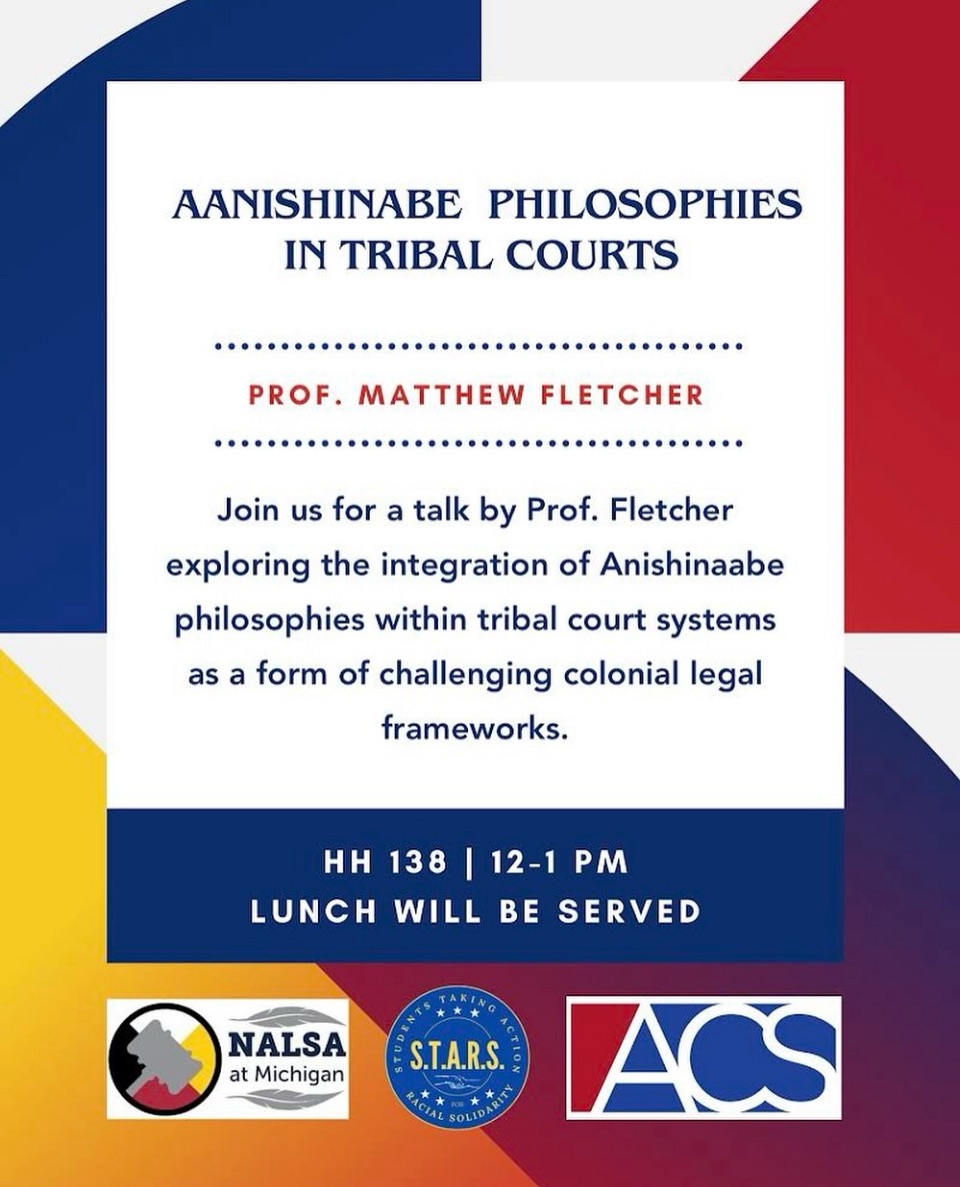
UM STARS Anti-Colonial Week Talk Today on Anishinaabe Law

Kekek Stark on Tribal Court Exhaustion

Kekek Jason Stark has published “Tribal Court Jurisdiction and the Exhausting Nature of Federal Court Interference” in the University of Cincinnati Law Review. PDF

HIGHLY RECOMMENDED.

Andrea Carlson

Fletcher on the Sovereignty Problem in Federal Indian Law

Check out “The Sovereignty Problem in Federal Indian Law” on SSRN.

Here is the abstract:

There is a sovereignty problem in federal Indian law, namely, that the federal government’s sovereign defenses prevent tribal nations and individual Indian people from realizing justice in the courts. Often, compelling tribal and Indian claims go nowhere as the judiciary defers to the interests of the United States, even where Congress has expressly stated its support for tribal interests. Conversely, tribal judiciaries allow claims to proceed to the merits, invoking customary and traditional law to hold tribal governments accountable.
Sovereignty theory helps to explain why justice can be done in one court system but not another. But federal, state, and tribal courts are all American courts than can and should learn from one another. This paper is an effort to show that federal sovereign defenses are not inevitable, nor are they even necessary.

Data good.

Kekek Stark on Anishinaabe Rights of Nature Cases

Kekek Jason Stark has published “Bezhigwan Ji-Izhi-Ganawaabandiyang: The Rights of Nature and its Jurisdictional Application for Anishinaabe Territories” in the Montana Law Review.

An excerpt:

This article examines the tribal law acknowledging the Rights of Na- ture as a deeply embedded traditional Anishinaabe law principle. This traditional law principle acknowledging the rights of nature is crucial for sustaining the Anishinaabe Nations’ relationship with their territorial lands and natural resources. What does it mean to recognize the rights of ma- noomin (wild rice) to “exist, flourish, regenerate, and evolve” or to be pro- tected in its traditional forms, natural diversity, and original integrity? This article then delineates the various ways that the White Earth Band of Ojibwe has codified their relationship with their territorial lands and natural resources into tribal law. While the rights of manoomin and similar laws have been widely touted in the press as important victories for tribal sover- eignty, this article more deeply evaluates the practical effects and applica- tions of this tribal law to determine whether this law can serve as a frame- work for other Tribal Nations or is merely a symbolic gesture. Moving beyond symbolic gestures is essential for tribes to implement legal regimes more protective than those provided by states that may otherwise permit development activities by non-Indian parties within treaty territories.

HIGHLY, HIGHLY recommended.

Kekek Stark on Anishinaabe Law

Kekek Jason Stark has published “Anishinaabe Inaakonigewin: Principles for the Intergenerational Preservation of Mino-Bimaadiziwin” in the Montana Law Review. PDF

I cannot recommend this paper enough. It’s exactly the kind of paper I’ve been waiting for — waiting for a very long time. Miigwetch to Professor Stark for this incredible work. The ancestors would be proud.

The Conversation: “Historical lawsuit affirms Indigenous laws on par with Canada’s”

Here, by Prof. Darcy Lindberg.

Fletcher on Anishinaabe Law and the Round House

Matthew Fletcher has published “Anishinaabe Law and the Round House” in the Albany Government Law Review.

Here is the abstract:

This paper addresses the Indian country criminal justice system’s difficulties through the context of the Great Lakes Anishinaabeg’s traditional customs, traditions, and laws, and their modern treatment of crime. Louise Erdrich’s The Round House expertly captures the reality of crime and fear of crime in Anishinaabe Indian country, and offers a bleak view of the future of criminal justice absent serious reform in the near future.