Whether Alaska Native regional and village corporations established pursuant to the Alaska Native Claims Settlement Act are “Indian Tribe[s]” for purposes of the CARES Act, 42 U.S.C. 801(g)(1).
Anishinaabewaki, East Lansing, MI—When COVID-19 created an atmosphere of uncertainty for conference and training programs in 2020, the Tribal In-House Counsel Association and the Indigenous Law and Policy Center responded. The pressures of many new conditions placed on tribal in-house counsel attorneys prompted us to host the webinar series known as QuaranTICA. QuaranTICA covered issues such as tribal court closures and child welfare concerns while also bringing insight, updates, and as always, good humor to issues affecting tribal attorneys. Now, we are back for more!
The 2020 Indigenous Law Conference will be hosted as a webinar for the first time ever. The date has also changed to accommodate this new format.
The important message here is: it is TICA time!
With some familiar faces and other speakers who are new to our virtual stage, join us November 10, 12, and 13, 2020 to hear follow-up discussions about child welfare and social services, COVID-19 related litigation, quarantine issues and their enforcement, and remote oral arguments. Stay tuned for new panels on voting rights and the McGirt decision. Plus, it isn’t TICA without a reception! We are delighted to host live music from across Turtle Island on the evening of the opening day of the conference—November 10th.
You can find all conference details including registration, the agenda at a glance, and sponsorship tiers at www.indigenouslawconference.com. Just like every year, the Indigenous Law Conference is the time to renew your TICA membership, which is included in the registration fee. The conference is free for law students who register with their current law school email.
Check the website to register. Prior to the event, you will receive a password to the Indigenous Law Conference Participant Portal where the Zoom links will be available.
The conference consists of 6 panels, each 1.5 hours long, and is approved for 9 CLE credits through the Minnesota State Board of Continuing Legal Education.
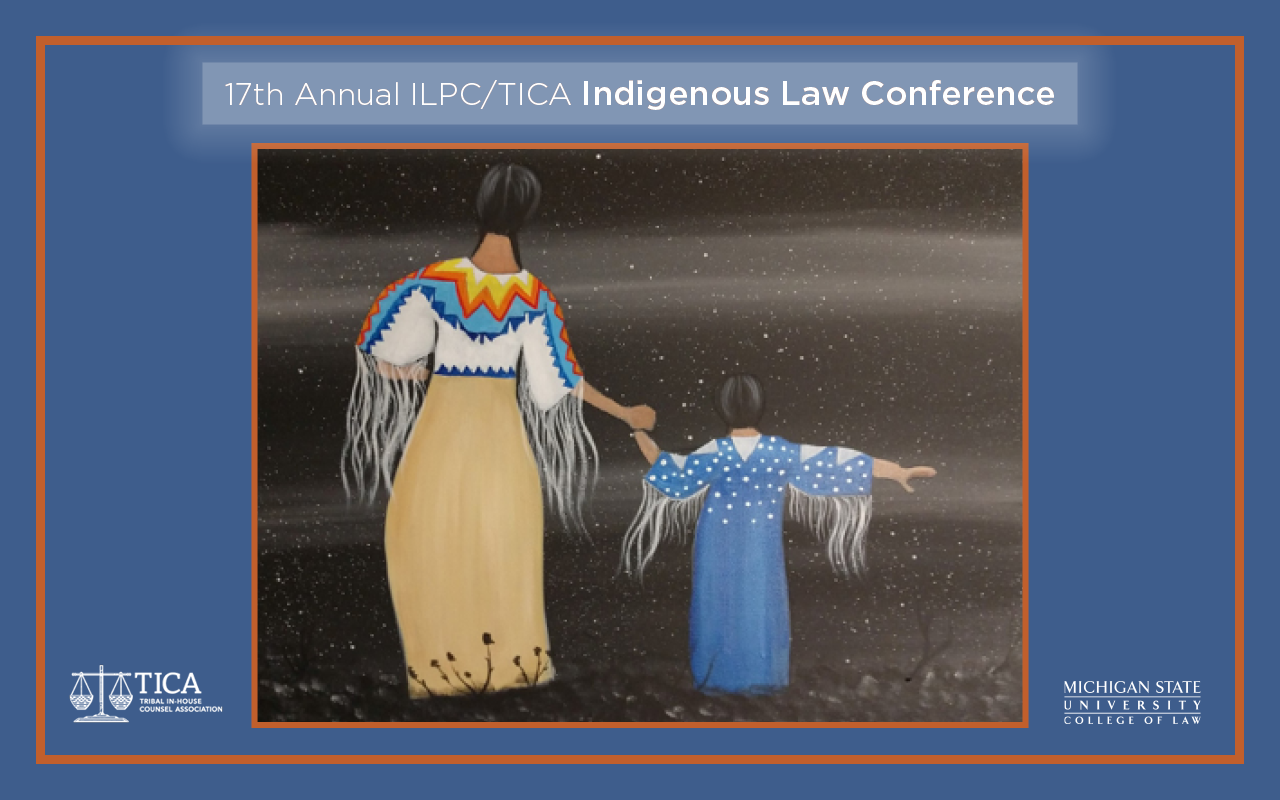
This year’s conference art is “I Will Show You The Stars” by Emily Courtney. Visit www.indigenouslawconference.com to learn about the artist.
The media has often highlighted the devastating toll COVID-19 has taken in many parts of Indian country – and that, to be sure, is part of the story. But there are other aspects of the picture as well. On the one hand, tribes have taken resourceful and creative measures to combat COVID-19. On the other, a troublesome doctrinal landscape has complicated their efforts to do so. The judicially crafted Montana framework severely restricts tribal civil regulatory power over nonmembers – a particular problem during the COVID-19 pandemic, when nonmembers have defied tribal curfews, camped in prohibited areas, and opened businesses on reservations despite closure orders. While Montana nominally contains a “health and welfare” exception allowing tribes to exercise power over nonmembers in emergencies, its contours are too ambiguous and fact-specific to allow tribes to act with the certainty and speed they require. The pandemic thus provides a vivid illustration of the way in which Montana hinders effective tribal governance. Further, the pandemic has occurred at a moment when the Court may be more receptive than it has been in the past to arguments favoring tribal sovereignty – and at a time when many of the concerns about tribal regulation that motivated the Court four decades ago in Montana seem increasingly distant both from current doctrine and contemporary tribal realities. As a result, it is time, at a minimum, for the Court to expand Montana’s “health and welfare” exception to resemble something closer to the powers states possess to safeguard public health.
This essay makes the following arguments. First, the US federal government knows how to electrify remote rural areas, and has in fact electrified rural areas as remote and inaccessible as the Appalachian Mountains. Yet, the US government has failed to electrify Navajo. Second, Navajo Nation is surrounded by power plants which send electricity to Phoenix, Los Angeles, and parts distant, yet transmission lines and infrastructure have not been properly extended from those power plants to inside of Navajo Nation. Third, the health risks of residential coal burning are well known, and given the health risks of COVID-19 and the fact that underlying respiratory conditions make the Navajo quite susceptible to this disease, the need to address this infrastructure gap is urgent.
 Turtle Talk
You must be logged in to post a comment.