Here are the materials in United States v. King Mountain Tobacco Co. Inc. (E.D. Wash.):
62 DCT Order Granting Summary J in 11-3038
70 US Renewed Motion for Summary J
87 DCT Order Granting Renewed Motion for Summary J
Related case here.
Here are the materials in United States v. King Mountain Tobacco Co. Inc. (E.D. Wash.):
62 DCT Order Granting Summary J in 11-3038
70 US Renewed Motion for Summary J
87 DCT Order Granting Renewed Motion for Summary J
Related case here.
Here is the opening brief in Confederated Tribes and Bands of the Yakama Indian Nation v. Alcohol and Tobacco Tax and Trade Bureau:
Lower court materials in King Mountain Tobacco Co. v. Alcohol and Tobacco Tax and Trade Bureau (E.D. Wash.) are here.
Decision here.
The central question on this appeal is whether Ontario has the power to take up lands in the Keewatin area under Treaty 3 so as to limit the harvesting rights under the treaty, or whether this is subject to Canada’s approval.
Ontario and only Ontario has the power to take up lands under Treaty 3. This is confirmed by constitutional provisions, the interpretation of the treaty, and legislation dealing with Treaty 3 lands.
First, although Treaty 3 was negotiated by the federal government, it is an agreement between the Ojibway and the Crown. Both levels of government are responsible for fulfilling the treaty promises when acting within the division of powers under the Constitution. Sections 109, 92(5) and 92A of the Constitution Act, 1867 establish conclusively that Ontario holds the beneficial interest in the Keewatin lands and has exclusive power to manage and sell those lands as well as to make laws in relation to the resources on or under those lands. Together, these provisions give Ontario the power to take up lands in the Keewatin area under Treaty 3 for provincially regulated purposes such as forestry. Further; s. 91(24) of that same Act does not give Canada the authority to take up provincial land for exclusively provincial purposes.
Second, nothing in the text or history of the negotiation of Treaty 3 suggests that a two‑step process requiring federal supervision or approval was intended. The text of the taking‑up clause supports the view that the right to take up land rests with the level of government that has jurisdiction under the Constitution. The reference in the treaty to Canada merely reflects the fact that the lands at the time were in Canada, not Ontario.
Lastly, legislation subsequent to the signature of the treaty and which dealt with Treaty 3 lands confirmed Ontario’s right to take up that land by virtue of its control and beneficial ownership of the territory. It did not amend the terms of Treaty 3.
Decision here
Held: The appeal should be allowed and a declaration of Aboriginal title over the area requested should be granted. A declaration that British Columbia breached its duty to consult owed to the Tsilhqot’in Nation should also be granted.
***
In finding that Aboriginal title had been established in this case, the trial judge identified the correct legal test and applied it appropriately to the evidence. While the population was small, he found evidence that the parts of the land to which he found title were regularly used by the Tsilhqot’in, which supports the conclusion of sufficient occupation. The geographic proximity between sites for which evidence of recent occupation was tendered and those for which direct evidence of historic occupation existed also supports an inference of continuous occupation. And from the evidence that prior to the assertion of sovereignty the Tsilhqot’in repelled other people from their land and demanded permission from outsiders who wished to pass over it, he concluded that the Tsilhqot’in treated the land as exclusively theirs. The Province’s criticisms of the trial judge’s findings on the facts are primarily rooted in the erroneous thesis that only specific, intensively occupied areas can support Aboriginal title. Moreover, it was the trial judge’s task to sort out conflicting evidence and make findings of fact. The presence of conflicting evidence does not demonstrate palpable and overriding error. The Province has not established that the conclusions of the trial judge are unsupported by the evidence or otherwise in error. Nor has it established his conclusions were arbitrary or insufficiently precise. Absent demonstrated error, his findings should not be disturbed.
APTN story here.
CBC here.
The Oregon Law Review has published New Ways to Fulfill Old Promises: Native American Hunting and Fishing Rights as Intangible Cultural Property.
Here is an excerpt:
Current law and policy in the United States has failed to develop a framework that accounts for the unique nature of intangible cultural heritage. Therefore, intangible cultural heritage, such as Native American hunting and fishing rights, lacks adequate protection. However, international laws—such as the United Nations Declaration on the Rights of Indigenous Peoples, and the United Nations Educational, Scientific, and Cultural Organization (UNESCO) Convention for the Safeguarding of Intangible Cultural Heritage—can help United States lawmakers develop a framework that recognizes Native American hunting and fishing rights as intangible cultural heritage, and adequately protects them as such.
An important read for anyone in northern Michigan:
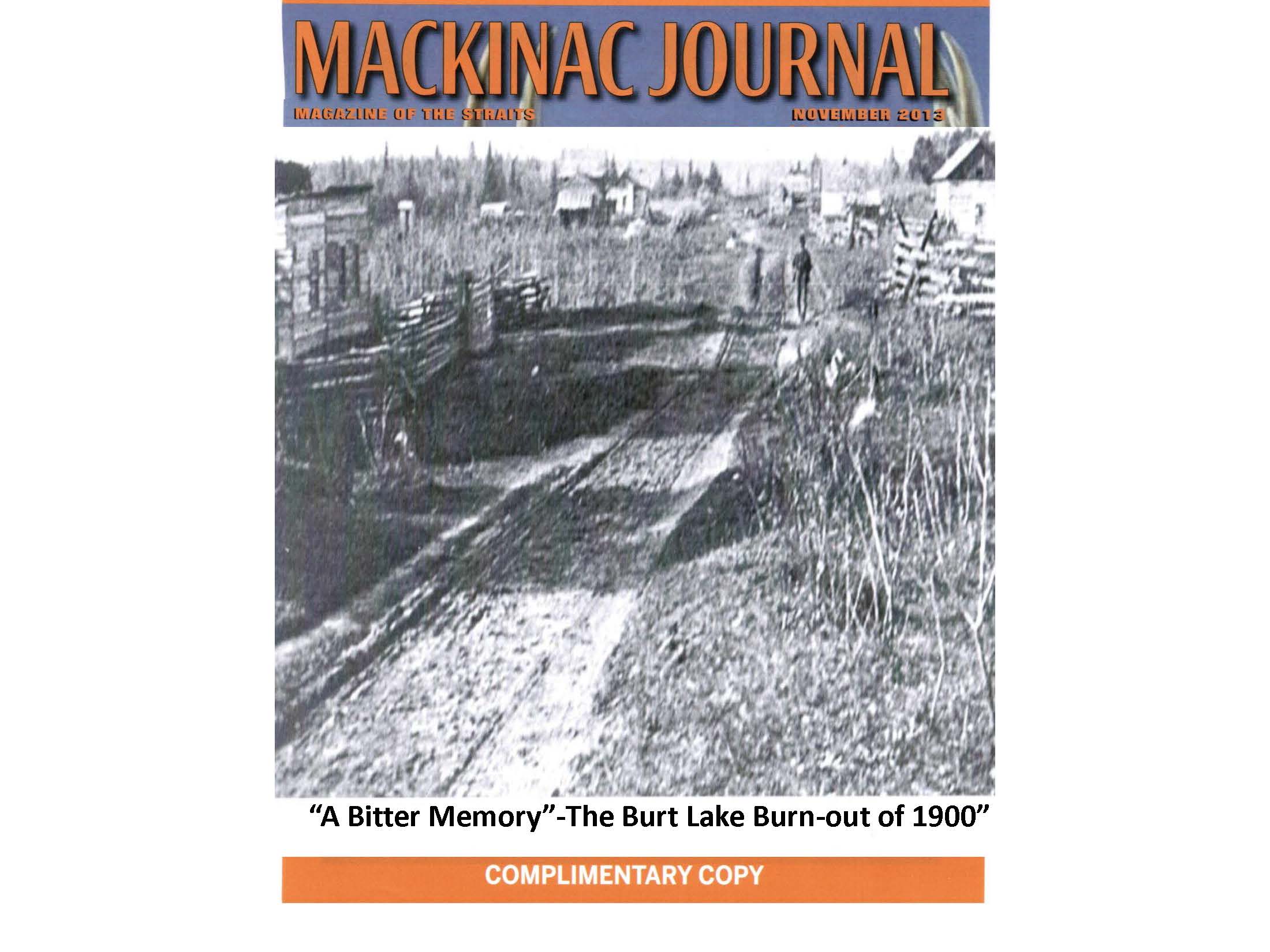
A Bitter Memory’ — The Burt Lake Burn-out of 1900
Moreover, it is a fairly direct response to the recent Michigan Historical Review article (here) that essentially argues it was perfectly legal to resort to arson to enforce a foreclosure order. Imagine if that were really true — a bank or a sheriff could simply set alight a foreclosed home, with people inside, in order to enforce a foreclosure order. Obviously not.
Here is an imaged version of article as well, with pics:
Here are the materials in King Mountain Tobacco Co. v. Alcohol and Tobacco Tax and Trade Bureau (E.D. Wash.):
149 DCT Order Granting US Motion
An excerpt:
The Court finds no exemption from federal excise taxes on manufactured tobacco products under the General Allotment Act because the finished tobacco products are not derived directly from the land. The Court finds no exemption under either Article II or III of the Yakama Treaty of 1855 because neither Article contains express exemptive language applicable to the manufacture of tobacco products. Finally, the Court finds no exemption under Section 4225 of the Internal Revenue Code because the exemption for Indian handicrafts on its face does not apply to excise taxes for the manufacture of tobacco products. Therefore, the United States is entitled to summary judgment on all claims.
Matthew L.M. Fletcher, Kathryn E. Fort, and Dr. Nicholas J. Reo have published “Tribal Disruption and Indian Claims” in Michigan Law Review’s First Impressions. PDF. Here is a taste:
Legal claims are inherently disruptive. Plaintiffs’ suits invariably seek to unsettle the status quo. On occasion, the remedies to legal claims can be so disruptive-that is, impossible to enforce or implement in a fair and equitable manner-that courts simply will not issue them. In the area of federal Indian law, American Indian tribal claims not only disrupt the status quo but may even disrupt so-called settled expectations of those affected by the claims.[1] The U.S. Court of Appeals for the Second Circuit has dismissed a round of Indian land claims at the pleading stage, including Onondaga Nation v. New York,[2] because it considered the claims so disruptive.
We agree that Indian legal claims are inherently disruptive and may implicate the centuries-old settled expectations of state and local governments and non-Indians. It is empirically and categorically false, however, that the remedies tribal interests seek are impossible to enforce or implement in a fair or equitable manner. Every year in cases against state governments and their political subdivisions, Indian tribes settle long-standing claims that at their outset, often appear intractable, if not downright impossible, to remedy. The recent settlements of claims by the Oneida Indian Nation of New York,[3] the Saginaw Chippewa Indian Tribe,[4] and five Michigan Anishinaabe tribes[5] demonstrate the falsehood of the idea that Indian claims are too disruptive to be remedied. These negotiated settlements powerfully illustrate that the disruption produced by Indian claims has an important function: forcing federal, state, and tribal governments to creatively seek solutions to difficult governance issues in Indian country.
Part I of this Essay describes recent common law, which dismisses Indian claims on the grounds that they are too disruptive. Part II briefly surveys the history of the relationship between Indians and the United States. Part III describes recent settlements between tribal and local governments. Part IV presents our theory of tribal disruption based on notions of ecological disturbance, studied in ecology and related fields. We argue that ecological disturbance in linked social-ecological systems offers a useful analog to the disruptive nature of Indian claims. These claims can be compared to disturbances in rivers, forests, or other ecosystems. Floods, forest fires, and windstorms break down existing structures, allowing space for reorganization, diversification, and new growth. Tribal claims similarly clear out a legal space for creative and improved governance institutions.
Here are the materials in Skokomish Indian Tribe v. Goldmark (W.D. Wash.):
59 State Defendants Motion to Dismiss
60 Prosecuting Attys Motion to Dismiss
67 Tribal Amici Motion to Dismiss
116 DCT Order Dismissing Complaint
An excerpt:
Being fully advised, the court GRANTS both motions on grounds that Skokomish Indian Tribe failed to join certain other Indian tribes in this action. These other tribes are required parties under Federal Rule of Civil Procedure 19, but cannot be joined due to their sovereign immunity. Because the court concludes that the action cannot proceed “in equity and good conscience” without these other tribes, see id., the court dismisses Skokomish Indian Tribe’s action without prejudice. With respect to Defendants Goldmark and Young only, the court also grants Defendants’ motions to dismiss on grounds of Eleventh Amendment sovereign immunity and because Skokomish Indian Tribe has failed to state a claim under Federal Rule of Civil Procedure 12(b)(6). Nevertheless, despite granting Defendants’ motions, the court also grants Skokomish Indian Tribe leave to amend its Amended Complaint.
We posted the complaint here.
Thanks to D.L.:
The American Public Media show “Marketplace” is doing a series on coal, and two of their stories have focused on Indian tribes. The first, about coal mining on the Crow Reservation, is more about the tribal economy; but the second, about a proposed coal shipping terminal in Washington state, has some legal issues (whether treaty fishing rights might be used to defeat the proposed coal terminal).
Both stories can be found at http://www.marketplace.org/topics/sustainability/coal-play
 Turtle Talk
You must be logged in to post a comment.