Michigan COA Decision on In re Morris

The Michigan Court of Appeals heard the ICWA notice case that the Michigan Supreme Court originally remanded back to Wayne County for notice. That case, In re Morris, details what is required of Michigan courts when notifying tribes of a potential ICWA case.

The decision is here. There is finally extensive detail on what DHS did or did not put in the notice to the three Cherokee tribes, something the Supreme Court demanded in Michigan ICWA cases.

Since respondent could not obtain any additional information regarding his relatives, it would be unreasonable to expect petitioner to find it. Imposing this burden on petitioner would also encourage parents, who can best research their own ancestry, to delay the proceedings by providing limited information. Because it would often take a long time to uncover ancestry details, a requirement that ICWA tribal notices include every detail of a child’s ancestry    would    undermine    ICWA ’ s    10-day    provision,    which    prevents    unreasonable    delays.    It would also jeopardize concepts of permanency and finality. The trial court did not err by finding that there was compliance with the ICWA’s notification requirements.
Law Professors Amicus Brief in Support of Respondents in Adoptive Couple v. Baby Girl

Here:

12-399 Professors of Indian Law Amicus

Thanks to Stuart Banner and Angela Riley of UCLA.


Friday’s Comment of the Day from Kansas Rep. Ponka-We Victors

Here, from the Topeka Capital Journal, via Jamelle Bouie

The Legislature’s annual attempt to repeal a statute allowing in-state tuition for Kansas students without legal residency drew an emotional crowd to a House committee Wednesday.

***

But nothing drew a bigger reaction than when Rep. Ponka-We Victors, D-Wichita, wrapped up a series of questions to the bill’s chief proponent, Secretary of State Kris Kobach.

“I think it’s funny Mr. Kobach, because when you mention illegal immigrant, I think of all of you,” said Victors, the Legislature’s lone American Indian member.

The heavily pro-immigrant gallery burst into cheers and applause — a rare reaction in normally staid hearings.


WaPo’s Article on Sequestration and the Fort Peck Reservation

Here.

This is a different article than the NYT’s OpEd and the Star Tribune’s article on this topic.

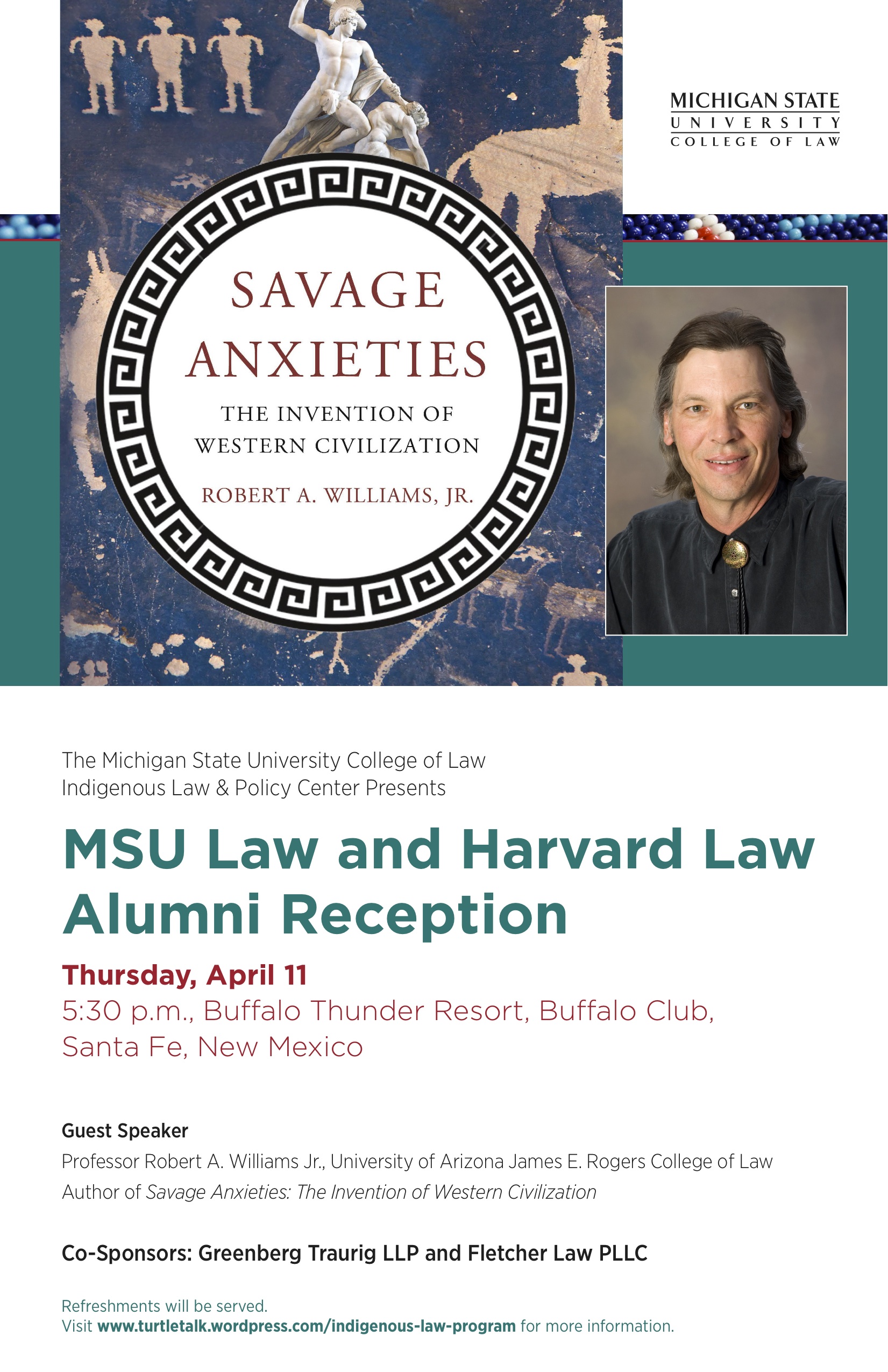
MSU ILPC and Harvard Law Alumni Event at Fed Bar Featuring Rob Williams

Thursday evening in the Kid’s Camp/Buffalo Club Room:

Spring Speaker Series_April_final

LSJ Article on Potential Wolf Hunt and Tribes: “Saving Ma’iingan”

Here.

Tribal leaders say they have more than a cultural stake in the wolf, however.

They also believe the state has a legal obligation to give Michigan’s tribes an equal say in the management of the wolf and other wildlife species because of a treaty signed in 1836.

The Treaty of Washington was an agreement between the Ottawa and Chippewa nations and the United States in which the Indians agreed to cede 13 million acres of tribal land to the U.S. government — a move that paved the way for Michigan to become a state in 1837.

In return, Indians were granted unlimited hunting, gathering and fishing rights to the land.

In 2007, the treaty was strengthened in a court-mandated consent decree between the Department of Natural Resources and the tribes. The agreement requires the DNR to manage the state’s natural resources based on “sound scientific management” and to coordinate their efforts with the tribes.


Morning Edition Story: Maine and Tribes Truth and Reconciliation Commission

Here.

In Maine, an unusual and historic process is under way to document child welfare practices that once resulted in Indian children being forcibly removed from their homes. Many of the native children were placed with white foster parents. Chiefs from all five of Maine’s tribes, along with Gov. Paul LePage, have created a Truth and Reconciliation Commission to help heal the wounds.

Opinion and Order in Saybrook v. Lake of the Torches

Here.

IT IS ORDERED that:
1) this case will be dismissed without prejudice for lack of subject matter jurisdiction, provided plaintiffs submit to the court within 14 days from the date of this order definitive proof of Wisconsin citizenship of one or more of the members of LDF Acquisition, LLC; or
2) absent such proof, this case shall proceed to a telephonic status conference on April 2, 2013, at 9:00 a.m.

Previous coverage here.

Comanche Nation v. CDST Gaming I, LLC, Tribal Jurisdiction

Opinion here

This Court is asked to determine whether, or not, the 2011 Tribal Court Ordinance of the Comanche Nation confers jurisdiction on the Court of Indian Offenses to hear the case entitled Comanche Nation vs. CDST-Ga~ing I, LLC. The case was filed in 2008, and has been the subject ofan Order by the United States District Court for the Westem District ofOklahoma (Judge Stephen P. Friot) wherein Judge Friot found that the Court oflndian Offenses should determine whether, or not, jurisdiction was appropriate witli the Court of Indian Offenses pursuant to the Ordinance adopted on April2, 2011 , by the Comanche Business Committee entitled Comanche Nation Tribal Court Civil Jurisdiction Ordinance of 2011, Resolution No. 36-11 which was approved by the
Bureau of Indian Affairs by a letter dated June 1O, 2011.

Pre-College Summer Program at Michigan State

Website here.

The Native American Business Institute is a week-long pre-college summer program for Native American high school students that will be in the 10th, 11th, or 12th grade during the Fall 2013- Spring 2014 school year. Participants work with MSU admissions officers, college counselors, tribal community leaders, and corporate representatives in a seven-day “business boot-camp” that prepares students for the college and exposes them to numerous academic and professional opportunities.