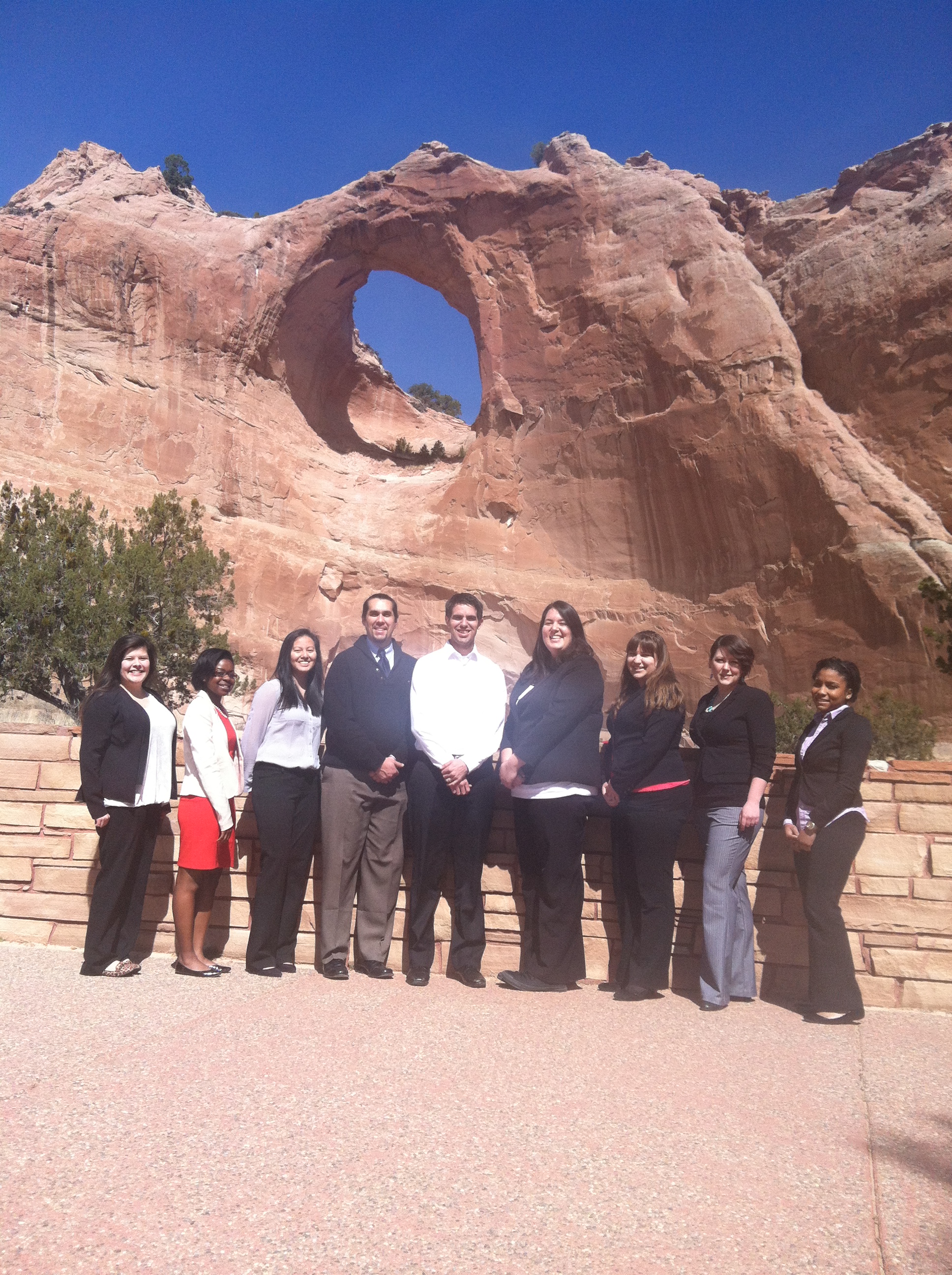
Law Students from Michigan on Alternative Spring Break at Navajo Nation

Michigan State University and University of Michigan law students coordinated an alternative spring break to Navajo Nation through the leadership of MSU Law student Tamera Begay and U of M Law student Hunter Cox. MSU students are working at Navajo Nation and U of M students are at DNA Legal Services. Impressive job.

MSU LAW:
Tamera Begay, Emily Smith, John Simermeyer, Chantelle Dial, Patricia Jjemba, Mavis Smith, Elise McGowan, Mike Hollowell, Whitney Gravelle

UofM Law:
Samantha Hall, Breeanna Brewer, Andrew Goddeeris, & Hunter Cox

image (2)

image (3)

image (4)

Order and Judgment in CDST Gaming v. Comanche Nation

Order here.

Accordingly, treating the tribal court papers filed by Comanche Nation and the tribal court papers of the Comanche Nation partially adopted by the Federal Defendants, as motions for summary judgment under Rule 56, Fed. R. Civ. P. (doc. nos. 160 and 161), the motions are GRANTED. Treating the tribal court papers of CDST as a motion for summary judgment (doc. no. 159), the motion is DENIED. Judgment shall issue forthwith.

Briefs here:

CDST Gaming Tribal Court Materials

Comanche Tribal Court Materials

Judgement here.

Previous post here.

NPR Morning Edition Coverage of Wind River Reservation and EPA Decision

Here.

Placement Preferences, Guardianship, and Identifying Tribe Unpublished ICWA Case from California

Unpublished opinion here.

Order Approving Oneida/NYS Settlement Agreement and Dismissing Interventions — UPDATED

Here is the order approving the settlement agreement between the Oneida Indian Nation and the State of New York, and dismissing both the Cayuga Nation and Stockbridge-Munsee Community’s motions for intervention.

UPDATE — briefs are here:

280-2 Cayuga Motion to Intervene

288 Oneida Response to CN Motion

289 Interior Response to CN Motion

290 NY Response to CN Motion

293 Cayuga Reply

300 MJ R&R Recommending Grant of CN Motion

303-1 Stockbridge-Munsee Motion to Intervene

312 NY Plaintiffs Objection to R&R

313 Oneida Objection to R&R

319 Settlement and Stipulation

326 NY Plaintiffs Response to SMC Motion

327 Oneida Response to SMC Motion

329 Interior Response to SMC Motion

332 Stockbridge Munsee Reply

344 Interior ROD Amendment

NCJFCJ Toolkit for Monitoring ICWA Compliance

Here.

The NCJFCJ is committed to helping state courts achieve full ICWA compliance. A new resource is now available to the courts (or Court Improvement Programs) to help achieve this goal. Measuring Compliance with the Indian Child Welfare Act: An Assessment Toolkit, provides concrete tools and recommendations for the state courts to assess their current compliance with ICWA. The Toolkit identifies strengths and weaknesses of different data collection approaches, provides sample tools or questions for the sites, and identifies resources and examples of putting this into practice. If you have any questions or would like additional information about measuring ICWA compliance in your jurisdiction, you can e-mail the research team at research@ncjfcj.org.

NARF Peacemaking Initiative

New website here. There are numerous upcoming events listed there as well. One that we have not yet announced is here (pdf), an event in Oklahoma on April 23-24.

(on a side note, NARF does a great job with its website addresses for these projects, making them very easy to pass on at events or when speaking: narf [dot] org [slash] icwa ; narf [dot] org [slash] peacemaking. It’s a little thing, but much appreciated.)

Indigenous Peacemaking Initiative
The mission of the Indigenous Peacemaking Initiative (IPI) is to support Native peoples in restoring sustainable peacemaking practices by:

* Promoting Traditional Peacemaking Practices
* Raising awareness about peacemaking practice
* Spotlighting existing programs that have had success with model programs
* Coordinating a Traditional Peacemaking Practices Clearinghouse
* Creating a peacemaking clearinghouse by cataloging codes, manuals, curricula and best practices
* Digitizing all records for easy dissemination
* Creating an anthology of successful programs and individuals within peacemaking
* Convening Traditional Peacemaking Meetings
* Coordinating meetings for a variety of audiences interested in peacemaking
* Tribal Leaders, Tribal Peacemakers, Tribal Judges, Policymakers, Non Native Peacemakers
* Training and Teaching Opportunities
* Documenting and disseminating best practices
* Development of curriculum, case studies, and tools
* Provide training on various components and techniques of peacemaking
* Mentoring and Nurturing
* Supporting relationships and mentoring between and among individual peacemakers, programs, and communities

Additional Briefs in Mining Company Challenge to Interior Withdrawal of Lands at Grand Canyon related to Indian Sacred Sites

Proposed Amicus Brief by Indian Peaks

Federal Government Cross Motion for Summary Judgment

Federal Government Statement of Facts in support of Cross Motion

Previous post on this here.

Supreme Court Grants RLUIPA Petition

The Supreme Court granted Holt v. Hobbs, a (handwritten) prisoner petition with the following issues:

(1) Whether the Arkansas Department of Corrections’ no beard growing policy violates the Religious Land Use and Institutionalized Persons Act (RLUIPA) or the First Amendment; and (2) whether a ½ inch beard would satisfy the security goals sought by the policy.

SCOTUSblog page here.

Order here.

MSU Extension Webinars for Tribal Leaders

Here.

RSVP here.

Department of Human Services, Native American Affairs &
Tribal Services: How We Work Together to Improve Lives
March 12th
– Stacey Tadgerson, Director of the Office of Native
American Affairs, Michigan Department of Human Services (DHS)
Congress enacted the Indian Child Welfare Act (ICWA) to eliminate the
wholesale state removal of abused/neglected Indian children from their tribes
and culture. Participants in this session will learn about the history of ICWA,
Native American Affairs, and resources available to youth in care, tribal
governments, and urban Indian organizations from the DHS that will assist
tribal youth in becoming self-sufficient while reaching for their dreams.

Baby Veronica & Inside the Michigan Indian Family
Preservation Act – April 2nd
– Kate Fort, Staff Attorney and Adjunct
Professor – MSU Indigenous Law & Policy Center
The United States Supreme Court decided only the second case on the
Indian Child Welfare Act since its passage. This presentation will give the
basic facts and holding of the case, as well as its potential implications for
ICWA cases in the future. It will also address the way the Michigan Indian
Family Preservation Act helps to limit the application of the Baby Girl case.

Making Smart Choices for Health Insurance – April 16th

Brenda Long, Educator – MSU Extension
To help people navigate the complex and confusing health insurance
landscape, MSU Extension is teaching people how to take control of their
health insurance situation through webinars and in-person presentations.
Those who participate will be able to analyze their insurance needs, learn
important terms and concepts, compare health insurance plans, and figure
out what fits in their budget. People will also become more confident