Here are the updated materials in Coyote Band of Pomo Indians v. Findleton (N.D. Cal.):
Prior post here.
Here are the updated materials in Coyote Band of Pomo Indians v. Findleton (N.D. Cal.):
Prior post here.
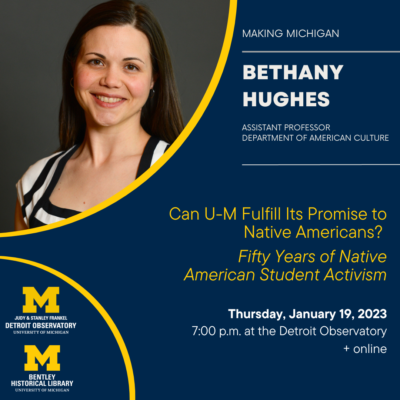
The University of Michigan has a complicated history with Native American communities, which were vital to its very existence. Join us for a discussion with Bethany Hughes, assistant professor of American Culture, on the historic and ongoing activism of Native American students.
Can U-M Fulfill Its Promise to Native Americans?
Fifty Years of Native American Student Activism
Thursday, January 19, 20237:00 – 9:00 P.M. Guests may attend in-person at the Judy and Stanley Frankel Detroit Observatory or attend virtually.
The talk will examine the founding of the Native American Student Association, the work to compel the University to recognize the promise of education made to Native Americans in the 1817 Treaty of Fort Meigs (including a critical lawsuit brought by a U-M football player), and the decades-long work to bring to light the racial stereotyping and misuse of Native American symbols by the Michigamua student organization.
>> REGISTER TO ATTEND IN PERSON <<
>> REGISTER TO ATTEND VIRTUALLY <<
ABOUT THE SPEAKER: Bethany Hughes is an Assistant Professor in the Department of American Culture and a core faculty member in the Native American Studies Program. A performance scholar and cultural historian, her research focuses on theatre and performance in America, Indigenous performance, and the possibilities for making and remaking culturally legible categories through live performance. She teaches classes on Native American Studies, Indigeneity and Performance, Authenticity and Representation, American Performance, and Broadway and American Culture. An enrolled member of the Choctaw Nation of Oklahoma, her writing can be found in Theatre Journal, Theatre Survey, Theatre Topics, Mobilities and on HowlRound.com. Her current book project is an investigation of redface in 19th and 20th century American theatre and its implications for Indigenous identity and sovereignty.
Supreme Court Update on Indian Law
Co-Sponsored by the State Bar of Arizona and the State Bar’s Indian Law Section
January 18, 2023, 12:00-1:00 MST
1.0 Total CLE Unit
Join Professor Matthew Fletcher as he reviews the most recent Supreme Court decisions affecting Indian Country.
Faculty:
Matthew Fletcher, Harry Burns Hutchins Collegiate Professor of Law, Michigan Law
Chairpersons:
Doreen McPaul, President, Tribal In-House Counsel Association
Virjinya Torrez, Assistant Attorney General, Pascua Yaqui Tribe
Register: https://azbar.inreachce.com/Details/Information/1661e72a-831b-45a2-ad84-a06a235557ee

Jack Fiander has posted “The Melding of International Law and the Customary Law of Tribal Nations; The Constitutional Origin of Federal-Tribal Relations” on SSRN.
Here is the abstract:
To seek understanding of the basis for the relationship of the government of the United States with tribal nations it is necessary to examine not only the intent of the “Founding Fathers” but also that of the tribal nations with whom those framers of the United States Constitution dealt at the time of America’s founding. To do otherwise is ethnocentric, at best, and omits half the equation. Establishing a Constitutional relationship requires the perspective of both sides, not only that of those acting on behalf of the fledgling United States. At the time this nation’s founding, tribal nations were mighty in number and therefor treated by Colonists as sovereign nations to be dealt with in conformity with respect for their respective forms of customary and international law. Recognizing tribal sovereignty required adherence to what might be described as tribal laws of nations to manage their own internal affairs, as is evident in the framers’ deferential dealings with Tribal Nations in the founding era and thereafter. Because Colonists understood the need to gain alliances with the powerful tribal nations to secure protection against foreign powers, the Framers appropriated concepts from Tribal nations, which paralleled those in the international Law of Nations, to which much Constitutional authority for the relationship of the United States with tribal nations is traceable.
Here is the opinion in Navajo Nation v. Dept. of the Interior.
An excerpt:
We conclude that the ISDEAA does not require the DOI to approve Navajo Nation’s funding requests for the years 2017 through 2020 but its regulations do. The 2017 proposal requested “the renewal of a term contract” with “no material [or] substantial change to the scope or funding” of the previous contract, see 25 C.F.R. § 900.33, and the 2018 through 2020 proposals are “successor[s]” to and “substantially the same as” the 2017 proposal, see id. § 900.32. The DOI therefore violated 25 C.F.R. §§ 900.32 and 900.33 when it considered the section 5321(a)(2) declination criteria and partially declined the Tribe’s proposed AFAs. Accordingly, we reverse the district court.
Briefs here.
Lower court materials here.

Here are the materials in Mille Lacs Band of Chippewa Indians v. County of Mille Lacs (D. Minn.):



 Turtle Talk
You must be logged in to post a comment.