Here are the materials in Darden v. Vines (W.D. La.):

Here are the materials in Darden v. Vines (W.D. La.):
Interesting idea.
Adam Crepelle has published “An Intertribal Business Court” in the American Business Law Journal. Here is the abstract:
Few Indian reservations have any semblance of a private sector. Consequently, poverty and unemployment are major problems in much of Indian country. While there are many reasons why private enterprise is scarce in Indian country, one of the foremost reasons is businesses do not trust tribal courts. Businesses’ distrust of tribal courts is not unique as outsiders often fear bias in foreign tribunals. Similarly, businesses are often concerned about a court’s capacity to adjudicate complex disputes. Federal diversity jurisdiction was developed to allay fear of bias, and many states have developed business courts to address questions about court capacity. Tribes can overcome these issues by creating an intertribal business court (IBC). Tribes will be free to sculpt the IBC as they see fit. However, the IBC’s intertribal nature will help reduce fears of bias, and an IBC’s focus on business disputes will answer doubts about court capacity. An IBC will also make tribal law more accessible, further increasing confidence in this new tribunal. As businesses gain greater confidence in tribal legal institutions through the IBC, they will be more likely to operate in Indian country. Accordingly, the IBC could help to transform tribal economies.
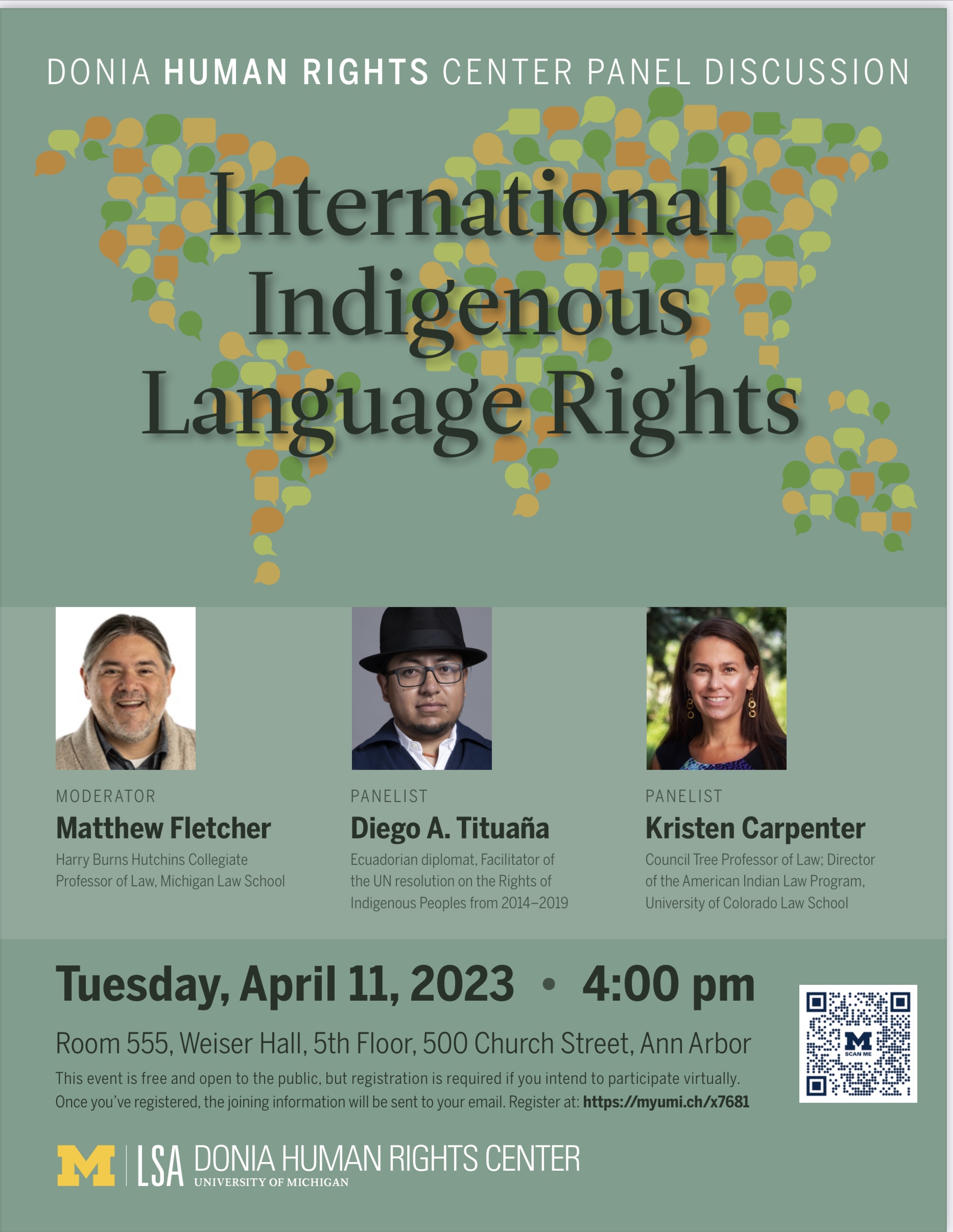
Panel Discussion: International Indigenous Language Rights
April 11 @ 4 PM, 555 Weiser Hall
Panelists: Diego A. Tituaña, Ecuadorian diplomat, Facilitator of the UN resolution on the Rights of Indigenous Peoples from 2014-2019, and Kristen Carpenter, Council Tree Professor of Law; Director of the American Indian Law Program, University of Colorado Law School; Moderator: Matthew Fletcher, Harry Burns Hutchins Collegiate Professor of Law & Professor of American Culture, University of Michigan
Here are the materials in Shoshone-Bannock Tribes v. Daniel-Davis (D. Idaho):

Here:
Highlights of a related suit, Baldwin v. Harper (D. Wyo.):

Here:

Questions presented:
Lower court materials here.
Here.

Trevor Reed has posted “Restorative Justice for Indigenous Culture,” forthcoming in the UCLA Law Review, on SSRN. Here is the abstract:
One still unresolved aspect of North American colonization arises out of the mass expropriation of Indigenous peoples’ cultural expressions to European-settler institutions and their publics. Researchers, artists, entrepreneurs, missionaries, and many others worked in partnership with major universities, museums, corporations, foundations, and other institutions to capture and exploit Indigenous cultural creativity, often in violation of Indigenous peoples’ laws, protocols, and standards of care. Much of this cultural material remains in Institutional repositories today, where it has been treated as the raw material for settler research, creativity, and innovation, circulating outside the control of the Indigenous communities who created it. These institutions must grapple with their legacies of intellectual and cultural abuse towards Indigenous peoples and emerging industry norms that increasingly demand respect for Indigenous rights, while continuing to make knowledge resources available and accessible to the public, to the extent allowed by law. Faced with these two seemingly incommensurable objectives, many institutions have begun to adopt cumbersome, generally unenforceable internal policies and procedures that tend to limit access to Indigenous culture as a remedy for past abuses rather than looking to Indigenous communities for guidance on methods for repair and redress. This Article advocates for a different approach – one which merges restorative justice theory and well-established methods for “Open Source” or “Creative Commons”-style licensing into what I call restorative licensing. I further advocate for the integration of privately ordered licensing structures within the restorative justice process to ensure Indigenous expectations for repair and redress are met, and that Indigenous cultural expressions can circulate once again on terms consistent with Indigenous law, protocol, and standards of care.


 Turtle Talk
You must be logged in to post a comment.