Student Note on U.S. v. Bryant

University of Nebraska law student Sara Rips has posted “Mind the Gap: The Unique Disadvantage Faced by Indigent Indians” on SSRN.

Here is the abstract:

In 2014, the Ninth Circuit created a federal circuit split over the use of tribal court convictions in federal prosecutions that the Supreme Court will soon resolve. In United States v. Bryant, the Ninth Circuit held that tribal court convictions cannot be used as predicate offenses in subsequent federal prosecutions unless the tribal court guarantees a right to counsel commensurate with the Sixth Amendment right. The Court accordingly dismissed a federal domestic assault charge under 18 U.S.C. § 117(a) because the predicate offense upon which the prosecution relied would have violated the Sixth Amendment right to counsel had the case arisen in federal or state court. The Court rooted its decision in the principle commonly espoused in criminal procedure jurisprudence that uncounseled convictions are unreliable. Extending this reliability principle to tribal proceedings is, perhaps predictably, problematic since indigent defendants are rarely guaranteed the right to appointed counsel, and the Constitution itself is without force in tribal courts. The Eighth and Tenth Circuits have thus upheld the use of uncounseled tribal court convictions on comity grounds. This Note analyzes the Eighth, Ninth, and Tenth Circuit cases to highlight the unique disadvantage indigent Indian defendants with prior uncounseled tribal court convictions confront when prosecuted under § 117(a). With an eye toward the Supreme Court, this Note proposes an alternative interpretation of the statute that avoids the constitutional quandary created by the Eighth and Tenth Circuits’ holdings. This Note concludes by urging the Court seize the opportunity United States v. Bryant presents to reassess Congress’ immense plenary power under the Indian Commerce Clause.
Nooksack ICW Presenting Officer/Prosecutor Posting

RFP – Request for Proposals for Prosecution and ICWA Case Services

The Nooksack Indian Tribe is soliciting proposals from individuals and/or firms interested in serving as Prosecutor for the Nooksack Indian Tribe.  The Prosecutor is responsible for all prosecutor duties related to adult criminal and juvenile delinquency matters, also for ICWA hearings in state court and child dependency matters in Tribal Court.  Criminal dockets at Tribal Court are held the 1st and 3rd Wednesday of each month.  For the complete updated RFP including caseload statistics and further details, please visit our website at NooksackTribe.org, click on the Careers tab.  Proposals (4 hard copies) may be hand delivered to the Nooksack Tribe at:  Attn Office of Tribal Attorney, 5016 Deming Rd, Deming, WA 98244, or mailed to:  Office of Tribal Attorney, PO Box 63, Deming, WA 98244.  Questions may be directed to Sue Gearhart at sgearhart@nooksack-nsn.gov

Yakama Nation Prosecutor Posting

The Yakama Nation has an opening in the Yakama Nation Prosecutor’s Office, the position closes on April 8, 2016 and the announcement is available at:

http://www.yakamanation-nsn.gov/showlistings.php

Tohono O’Odham Prevails in Gaming Compact Dispute before Ninth Circuit

Here is the opinion in State of Arizona v. Tohono O’Odham Nation

Briefs and other materials here

Gila River Indian Community Sues the VA over Health Care Costs Reimbursements

Here is the complaint in Gila River Indian Community v. Dept. of Veterans Affairs (D. Ariz.):

Complaint

An excerpt:

In 2010, the Patient Protection and Affordable Care Act (“ACA”) was enacted. One goal of the ACA was to improve health care access and delivery for Native Americans. A provision in the ACA allows Indian tribes to be reimbursed for health care provided to veterans and states:
The Service, Indian tribe, or tribal organization shall be reimbursed by the Department of Veterans Affairs or the Department of Defense (as the case may be) where services are provided through the Service, an Indian tribe, or a tribal organization to beneficiaries eligible for services from either such Department, notwithstanding any other provision of law.
25 U.S.C. § 1645(c). This law provides that, if an Indian tribe or tribal organization provides health care services to an individual who is otherwise eligible for care from the VA, the VA must reimburse the Indian tribe or tribal organization for the services provided. Despite this plain and mandatory language directing the Department of Veterans Affairs (“VA”) to reimburse Indian tribes and tribal organizations for health care services provided to veterans, the VA refuses to do so unless Indian tribes and tribal organizations agree to conditions well beyond the plain language of the law and which reduce the reimbursements that Indian tribes are entitled to under the law.

Materials in Osage Nation v. Leese (Updated 4/6/16)

Here are the materials, filed in the District Court for Osage County, Okla.:

Redcorn-MTD filed (FEB 11 2016)

Redcorn-Response to MTD (filed March 2016)

Redcorn-Reply brief 04 05 16 (Final w Signatures)

SCOTUS Denies Cert in Alaska v. Organized Village of Kake (Roadless Rule)

Here.

Cert petition here.

Jim Harrison Walks On

Here.

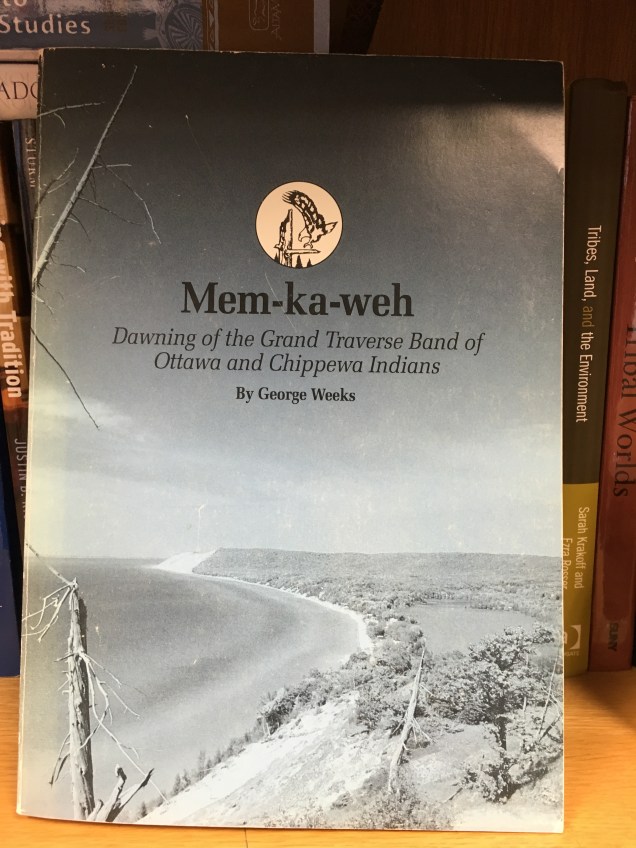
Harrison was a long time resident of Michigan, including Leelanau County, where he knew many Anishinaabe people. He wrote a compelling introduction to the history of the Grand Traverse Band of Ottawa and Chippewa Indians, Mem-ka-Weh: The Dawning of the Grand Traverse Band of Ottawa and Chippewa Indians.

Mem-ka-weh

He also wrote many Indian characters into his books. He wrote them as human beings, with all their flaws and strengths, and not as exotic others like so many writers do.

Patty Ferguson-Bohnee on Indian Voting Rights in Arizona

Patty Ferguson-Bohnee has posted “The History of Indian Voting Rights in Arizona: Overcoming Decades of Voter Suppression,” which she published in the Arizona State Law Journal. Here is the abstract:

Native Americans “have experienced a long history of disenfranchisement as a matter of law and of practice.” This comes from a complicated and contradictory history of laws and policy that has recognized tribes as separate sovereigns, reduced tribal status to that of domestic dependent nations, sought to remove, relocate, or assimilate tribal citizens, terminated numerous indigenous nations, and has now moved to a policy of tribal self-government. Unfortunately, the right to vote for Arizona’s first people has only recently been achieved, and there are continuing threats to the electoral franchise.

Voter suppression has been used to discourage or prevent Indian people from voting in Arizona. Voter qualifications such as literacy tests were used to prevent Indians from participating in elections for approximately fifty years. Once Native Americans started voting, redistricting and vote dilution were used to reduce the effectiveness of the Native vote.

This article will review the history of Indian voting rights in Arizona. The author begins by reviewing the history of Native American voting rights and the history of voting discrimination against Native Americans in Arizona. The Voting Rights Act turned the corner for Native people to participate in the state and federal election processes. The article then discusses the current challenges faced by Native American voters and specifically discuss the voter ID law passed in 2004. The voter ID law is a roadblock that impedes full participation by all Arizona Indians. The last part of the article focuses on strategies to protect Indian voting rights. Notwithstanding the Supreme Court’s invalidation of the Section 5 coverage formula in Shelby County, tribes should consider proactive measures to ensure that tribal citizens can participate in elections.

Highly recommended.

Galanda Broadman Lawyers Sue to Challenge Disbarment in Tribal Court

Here are the materials in Galanda v. Bernard (Nooksack Tribal Court):

Galanda v. Bernard Complaint

Galanda v. Bernard Motion for Injunction and Declaratory Relief