Rick Collins on Strict Scrutiny in Religious Freedom Cases & American Indian Sacred Sites Claims

Richard B. Collins has posted “Too Strict?” on SSRN. It is forthcoming in the First Amendment Law Review.

The abstract:

Should the strict scrutiny standard govern judicial review of claims that government has burdened religious freedom? American law’s patchwork of rules applies that demanding standard to some claims but denies any meaningful review to others. A major difficulty is that most claims alleging denial of religious freedom depend on beliefs that cannot be reviewed by secular courts. Claims based on allegations alone shift the burden to the defending government. Strict scrutiny purports to make justification very difficult; governments are supposed to lose most cases. A second defect of the test in religious freedom cases is its failure to consider harm that granting a claim may inflict on other persons; the test asks only about government interests. When judges suspect a claim may be trivial or false or unfair to others, they look for ways around the test. This accounts for the failure rate of strict scrutiny when it was the constitutional test and for the Court’s 1990 abandonment of that test. Another result is failure of nearly all sacred sites claims made by American Indian faiths.

Congress restored strict scrutiny for some claims by statute, reviving the problem. Ohio claimed that one of these statutes violated the Establishment Clause. The Court rejected the facial attack but in dictum suggested a solution. It said the Establishment Clause as applied should require consideration of interests of persons who would be harmed by sustaining a religious claim, and the context of religious freedom should make strict scrutiny less strict. That would bring American law into accord with doctrines applied abroad, notably by the European Court of Human Rights. But the Court’s 2014 Hobby Lobby decision instead allowed wealthy corporate owners to prevail over their employees in opinions that seemed to let religious claims override interests of others.

Massachusetts Gaming Claims against Wampanoag Tribe of Gay Head Survive Motions to Dismiss; Counterclaims Do, Too

Here are the updated materials in Commonwealth of Massachusetts v. Wampanoag Tribe of Gay Head (Aquinnah) (D. Mass.):

65 Massachusetts Opposition to Rule 19 Motion

67 Aquinnah-Gay Head Community Opposition to 11th Amendment Motion to Dismiss

71 Wampanoag Tribe of Gay Head Reply in Support of Rule 19 Motion

72 Wampanoag Tribe of Gay Head Reply in Support of Motion to Dismiss on Immunity Grounds

77 Massachusetts Motion to Dismiss

86 Massachusetts Officials Motion to Dismiss

87 Wampanoag Tribe Opposition to Massachusetts Immunity Motion

88 Massachusetts Reply

95 DCT Order Denying Motions to Dismiss

An excerpt:

This lawsuit involves a dispute between the Commonwealth of Massachusetts and a federally recognized Indian tribe concerning regulatory jurisdiction over civil gaming on Indian lands on Martha’s Vineyard. The Wampanoag Tribe of Gay Head (Aquinnah) and related entities have taken steps to commence commercial gaming operations on tribal lands without a license from the Commonwealth. The Commonwealth contends that operating gaming facilities without such a license would violate a 1983 settlement agreement that subjects the lands in question to state civil and criminal jurisdiction (and thus subjects them to state laws regulating gaming). Count 1 of the complaint alleges breach of contract, and Count 2 seeks a declaratory judgment.

The Commonwealth filed suit in state court on December 2, 2013. On December 30, 2013, the Tribe removed the action to this Court on the basis of federal-question and supplemental jurisdiction. See 28 U.S.C. §§ 1331, 1367. On August 6, 2014, the Court granted motions to intervene by the Town of Aquinnah and the Aquinnah/Gay Head Community Association (“AGHCA”). The Tribe has moved to dismiss the AGHCA complaint on the basis of sovereign immunity and for failure to state a claim upon which relief can be granted; it has further moved to dismiss all three complaints (with leave to amend) for failure to join the United States as a required party.

On October 24, 2014, the Tribe filed an amended answer that included a counterclaim against the Commonwealth and counterclaims against three third-party defendants (all of whom are officials of the Commonwealth). Plaintiff and third-party defendants have moved to dismiss the counterclaims on the grounds of sovereign immunity (as to the counterclaims against the Commonwealth) and failure to state a claim upon which relief can be granted.

For the reasons stated below, the motions of the Tribe will be denied and the motion of counterclaim-defendants will be granted in part and denied in part.

We posted motions to dismiss here. Materials on the state court removal and remand motions here. Complaint here.

Opening Sessions from the Tribal Marijuana Conference

Miigwetch to our own Elaine Barr:

IMG_0339 IMG_0340 IMG_0348 IMG_0351 IMG_0352

House Resources Committee Chair Letter to AG Holder and ASIA Washburn re Indian Water Rights Settlement Legislation

Here.

PDF.

Written Order Enjoining Nooksack Disenrollments

Here:

Order

Materials are here.

“An Annotated Timeline of the Navajo Presidential Election Dispute: Part 2, January 29-February 23, 2015”

Paul Spruhan has updated his timeline. It is posted in SSRN here.

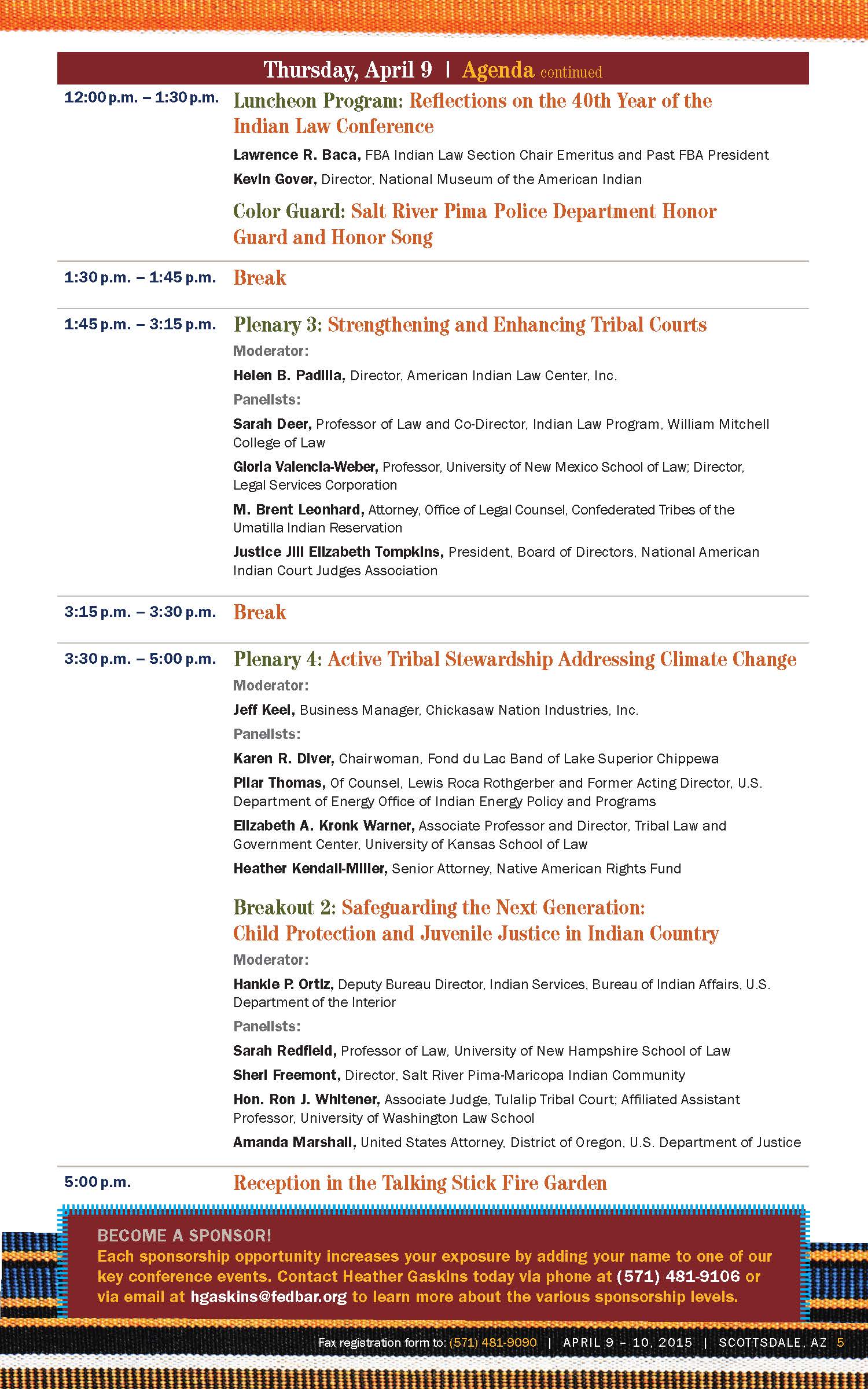
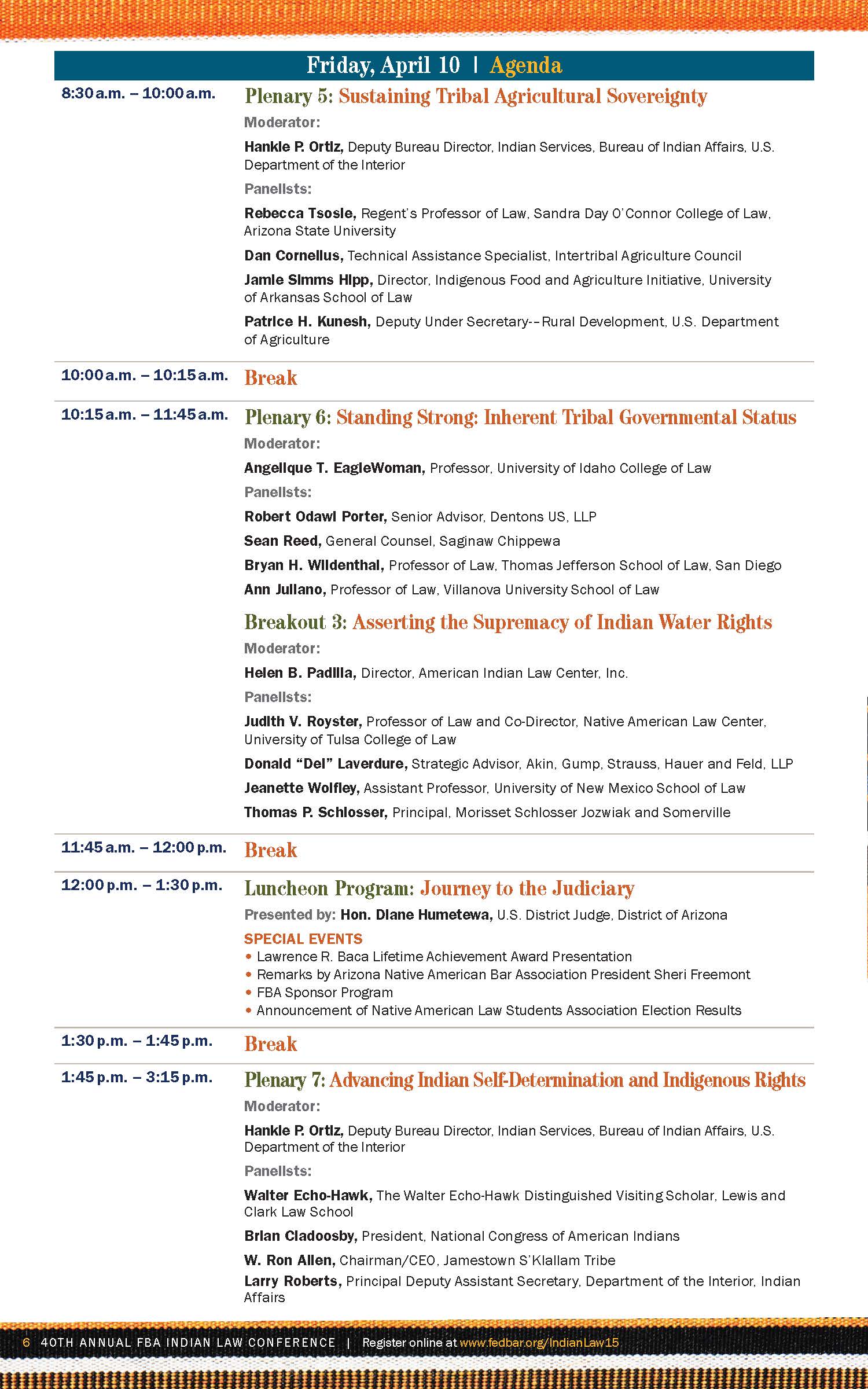
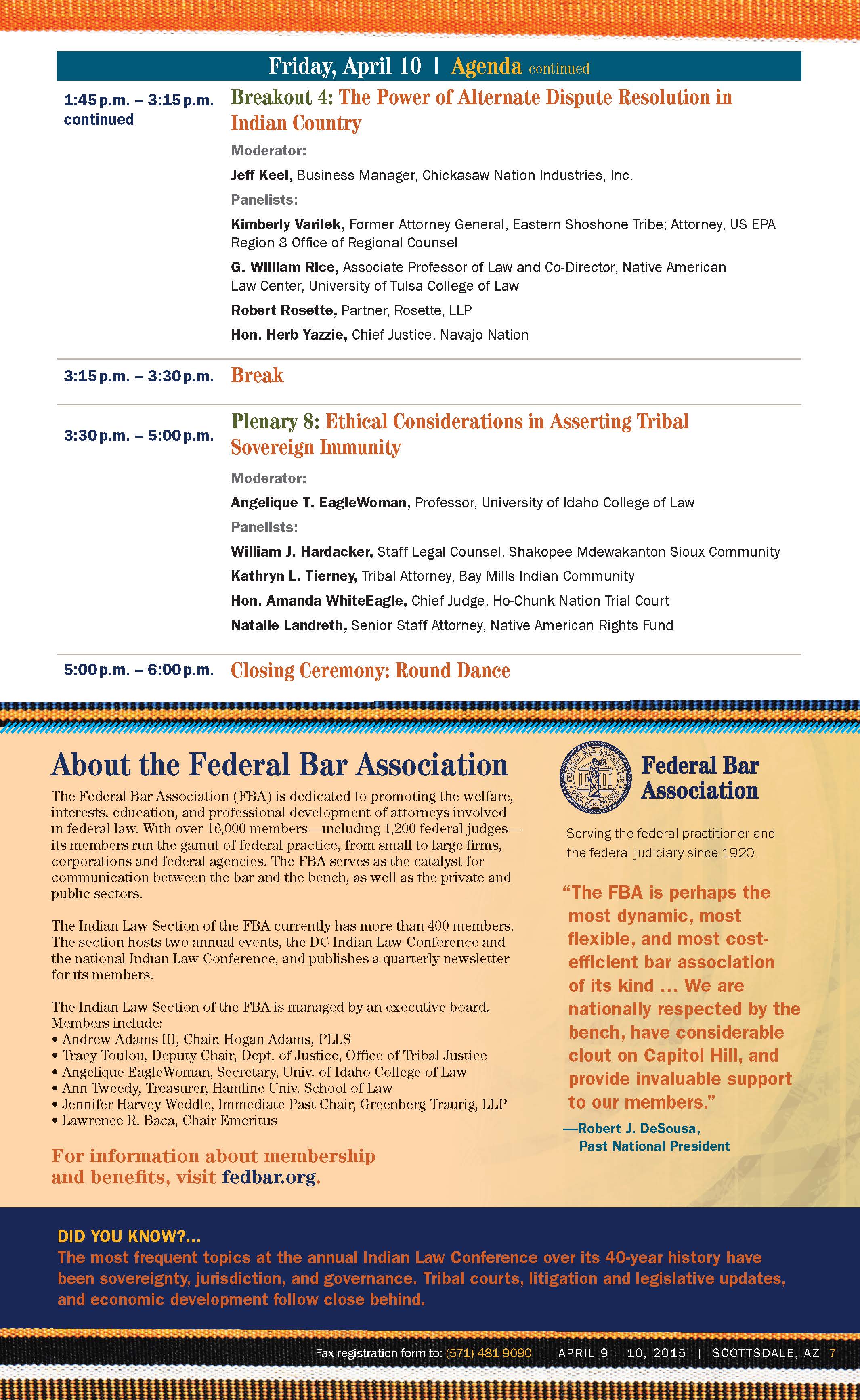
FBA 2015 Agenda and Registration Information

IndLaw_leaderboard

Here is the FBA 2015 brochure (PDF). And the blurb:

40th Annual Indian Law Conference | April 9–10, 2015 | Talking Stick Resort | Scottsdale, Ariz.

If you are working with—or on behalf of—Native Americans, this is the largest annual law event designed for you. At this year’s conference, Forty Years Strong: The Indian Self-Determination Era Strengthening Tribal Sovereignty, attendees will hear scholars, federal appointees, and other community leaders discuss some of the most pressing issues related to Indian law and the future independence and health of tribal communities. Special events commemorating this landmark event include colorguard presentation and honor song during the Thursday luncheon and a celebratory round dance at the conclusion of the conference on Friday. Don’t miss this celebration 40 years in the making!  Visit www.fedbar.org/IndianLaw15 today for more information about attending this premier Indian Law event.

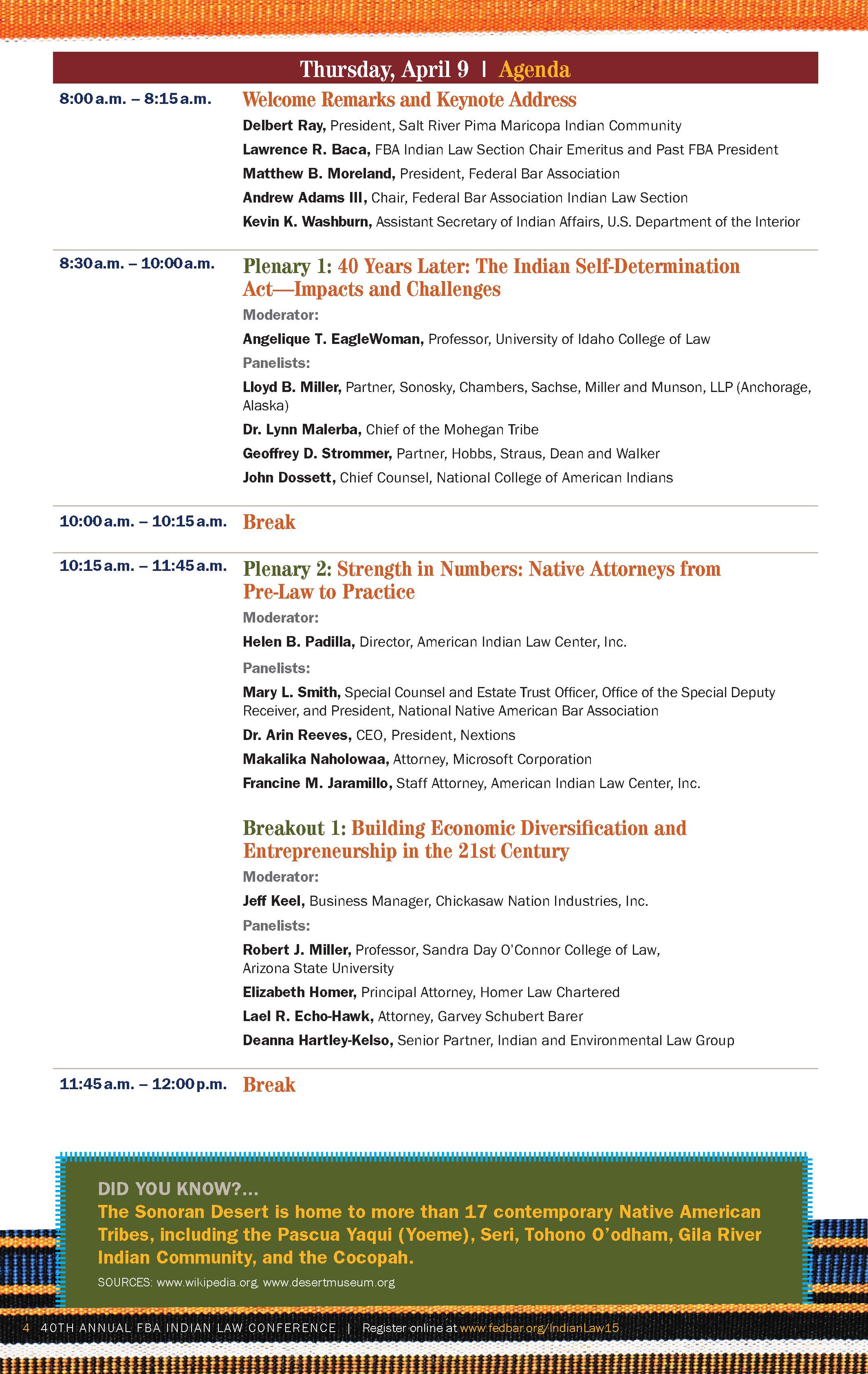
Agenda:

226 UPDATE Ind Law brochure_Page_4 226 UPDATE Ind Law brochure_Page_5 226 UPDATE Ind Law brochure_Page_6 226 UPDATE Ind Law brochure_Page_7

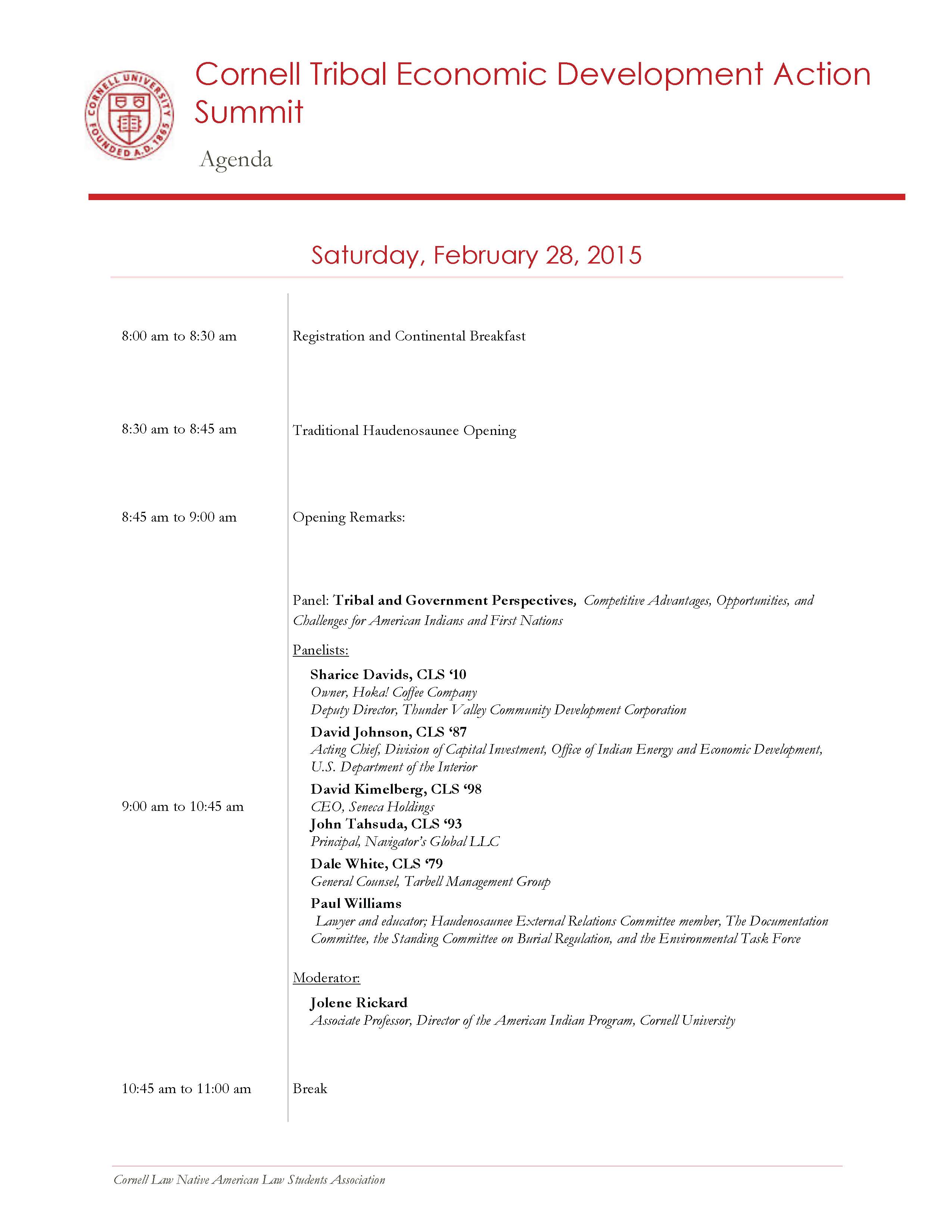
Cornell NALSA to Host Tribal Economic Development Summit This Saturday (To be Live Streamed)

Here:

Cornell Tribal Economic Development Summit Poster

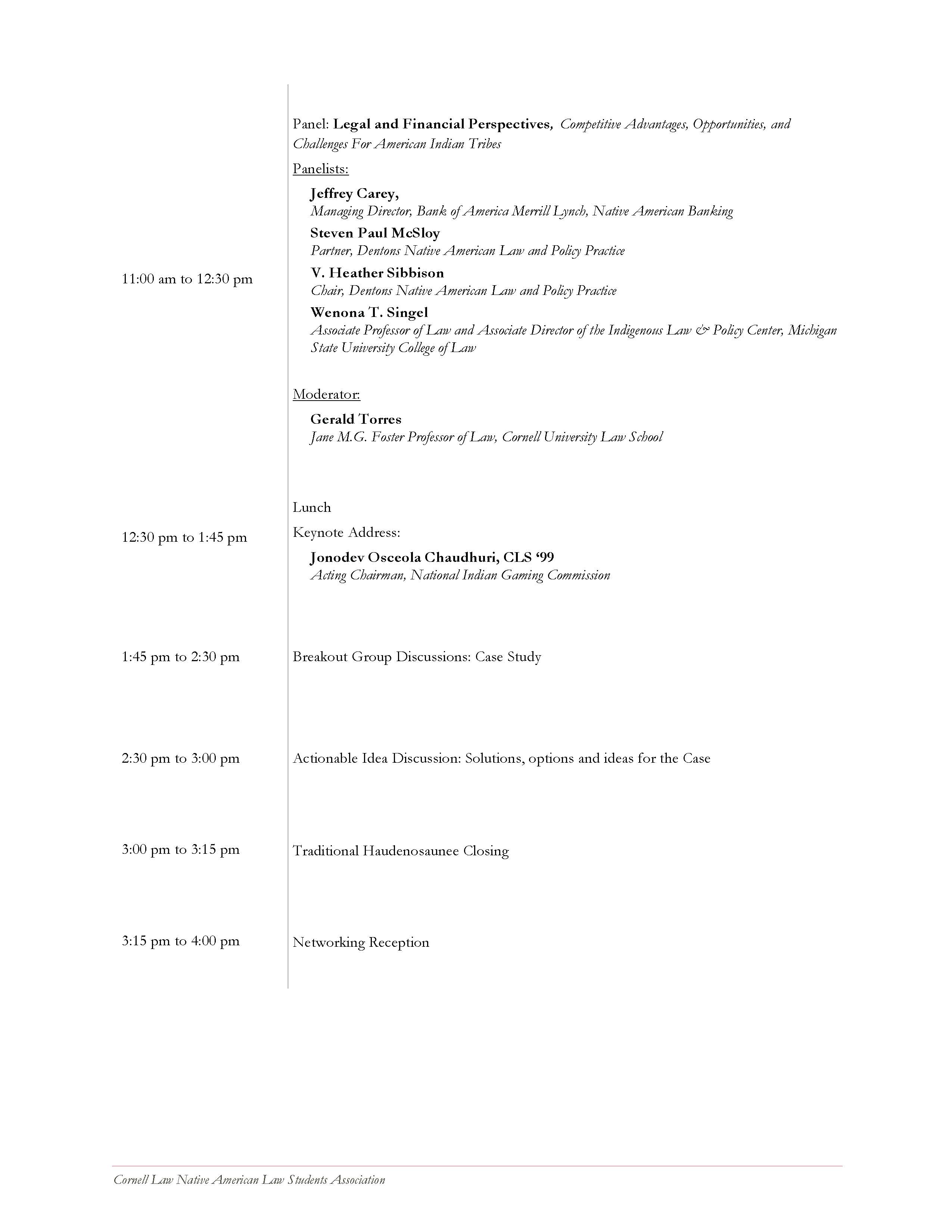
Here is the agenda (PDF):

Summit Agenda-1_Page_1 Summit Agenda-1_Page_2

Here is the live stream link for the morning panel sessions:
http://law.webcast.video.cornell.edu/Mediasite/Play/4c30d7814aec4710a6f84e9dc33dfc851d

And here is the link for the Keynote address:
http://law.webcast.video.cornell.edu/Mediasite/Play/e5f613f211524a7abaaa8401574bca081d

University of South Dakota NALSA Extends Support to the Lakota 57 

The University of South Dakota School of Law Native American Law Student Association IMG_1490(NALSA) organized a Peace Gathering in honor of the 57 children from American Horse School on the Pine Ridge Reservation.  These students, age 9 to 13, were attending a Rapid City Rush hockey game in recognition of their school accomplishments.  Unfortunately, these students had beer poured on them and were subject to racial epithets.  The alleged perpetrator was charged with a low level misdemeanor of disorderly conduct. 


The gathering brought together almost 30 law students and faculty members into the courtroom. The Law School community was invited to write personal letters of encouragement and support to send to the students. NALSA’s goal is to send a strong message to the children so that they know we support them in their efforts to continue to strive and to grow from this negative and ugly experience. 


Tysolake House, second year law student and Vice-President of NALSA, shared his thoughts on the incident. For Tysolake, this incident hit very close to home. He mentioned the obstacles he had to overcome dealing with racially charged issues as a child. He also expressed his sympathies for the children as he envisioned this situation potentially happening to his own children, who are the same age. 


USD Law Professor Frank Pommersheim shared a few thoughts about how to move forward from this horrible incident. His remarks focused on the need for ‘solidarity,’ particularly from NALSA and the legal community, to show support for these young native students. These students need to know that there are many people of good will who want them to succeed.


Gene Thin Elk, Director of the Native American Cultural Center, also attended the Peace Gathering in support of the children from American Horse School. Gene expressed his support by sharing a few words about overcoming adversity and by singing a Lakota Song.


At the conclusion of this gathering everyone gathered to take a group picture. Everyone in attendance firmly stood behind the banner that exclaimed the words, “They are our children too.” 


-Kyle Chase

USD NALSA President

National NALSA Press Release on 2015 Alternative Spring Break Program

From here:

I am proud to announce the 2015 Alternative Spring Break (ASB) Program projects that have been selected to receive an award. The National Native American Law Student Association Executive Board has chosen a project from Columbia Law School and the University of Michigan Law School! Columbia Law School will be working with Anishinabe Legal Services on three reservations in northwestern Minnesota to assist indigent program clients with civil needs, including a strong emphasis on domestic violence. Michigan Law School will be travelling to the Navajo Nation to work with DNA Legal Services to gain legal and practical skills, while also learning about Navajo life in Window Rock, Arizona. NNALSA has budgeted $1,000 for this year’s program, and each school will receive an award of $500! NNALSA would also like to recognize all program applicants for the high quality projects that were submitted. Congratulations to this year’s award winners!

In other news, Alex Kitson has made the difficult decision to resign from her duties as the Public Relations Director of NNALSA. On behalf of the Board of NNALSA, I would like to thank Alex for her time and commitment at helping NNALSA achieve its goals by helping to spread the word through numerous media outlets. Alex, you will be missed and good luck in all of your future endeavors.

The Executive Board took a vote and appointed P. Nelson Lambert to the PR Director position.  Nelson entered NNALSA as the Area 5 representative. Because the Board appointed him to PR Director Area 5 is now vacant and we are looking to fill the position. If any member is interested in representing Area 5 please send an interest statement to nnalsa.president@gmail.com.

Be sure to keep a look out for future announcements because NNALSA has some wonderful events and opportunities coming up! Events such as the National Moot Court Competition at the University of Arizona, and “Fed-Bar” where the new future board members of NNALSA will be elected and where the best 1L, 2L, 3L, and Chapter of the Year awards will be given. I hope everyone is excited about the future of NNALSA, and the positive future we are trying to achieve for Indian Country.

Nelson Lambert

J.D. Candidate, 2016

Charlotte School of Law

National NALSA Public Relations Director

nnalsa.publicrelations@gmail.com

www.nationalnalsa.org