Here is the complaint in St. Croix Chippewa Indians of Wisconsin v. McKesson Corp. (W.D. Wis.):
Author: Matthew L.M. Fletcher
American Indian Scholarship Update
Here are selected papers available online:
Reimagining Relocation in a Regulatory Void: The Inadequacy of Existing Us Federal and State Regulatory Responses to Kivalina’s Climate Displacement in the Alaskan Arctic
Climate Law, Vol. 7, No. 4, pp. 290–321 (2017) ,
Posted: 05 Dec 2017
Accepted Paper Series
Here Today, Gone Tomorrow – Is Global Climate Change Another White Man’s Trick to Get Indian Land? The Role of Treaties in Protecting Tribes As They Adapt to Climate Change
Michigan State Law Review, Vol. 2017
Number of pages: 54 Posted: 27 Nov 2017
Accepted Paper Series
Tribal Sovereignty and the Recognition Power
Number of pages: 77 Posted: 08 Nov 2017
Working Paper Series
Stanford Law School
Invited Written Testimony of Professor Kirsten Matoy Carlson, on H.R. 3744, a Bill to Provide That an Indian Group May Receive Federal Acknowledgment as an Indian Tribe Only by Act of Congress, before the Subcommittee on Indian, Insular, and Alaska Native Affairs, Natural Resources Committee, United States House of Representatives, 115th Congress, September 26, 2017
Number of pages: 8 Posted: 11 Oct 2017
Working Paper Series
Wayne State University Law School
Tribes Lobbying Congress: Who Wins and Why – Draft Report Presented at the 13th Annual Indigenous Law Conference Michigan State University
Number of pages: 13 Posted: 28 Sep 2017
Working Paper Series
Wayne State University Law School
The Body Subject To The Laws: Louise Erdrich’s Metaphorical Incarnation Of Federal Indian Law In “The Round House”,
2017 University of Washington Tacoma
University of Washington TacomaParchment As Power: The Effects Of Pre-Revolutionary Treaties On Native Americans From The Colonial Period To Present,
2017 Purdue University
Purdue UniversityAccounting for Conquest: The Price of the Louisiana Purchase of Indian Country
Journal of American History, Volume 103, Issue 4, 1 March 2017, Pages 921–942, https://doi.org/10.1093/jahist/jaw504
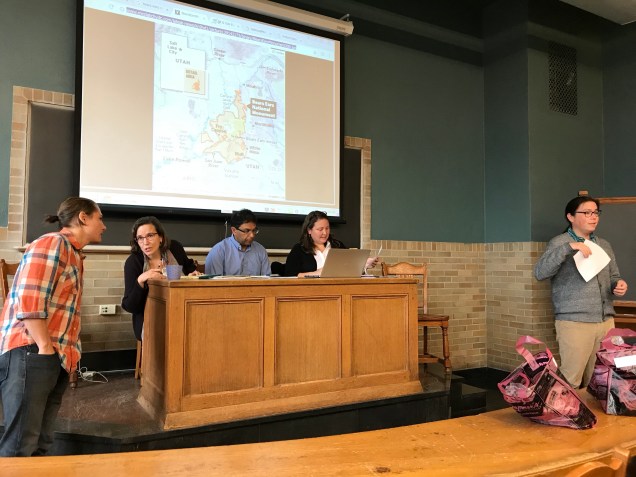
Bears Ears National Monument Panel at Michigan Law: Nina Mendelson, Riyaz Kanji, and Wenona Singel
Nick Reo & Kyle Whyte et al. on Indigenous Principles for Cooperating on Great Lakes Conservation
Nick Reo, Kyle Whyte, and others have posted “Seven Indigenous principles for successful cooperation in Great Lakes conservation initiatives.”
Chilkat Indian Village Suit over Mining Affecting Chilkat River [updated]
Here is the complaint in Chilkat Indian Village v. Bureau of Land Management (D. Alaska):
Five Tribes Complaint against Trump over Bears Ears
Here is the complaint in Hopi Tribe et al. v. Trump (D.D.C.):
Update on the parallel suit involving Grand Staircase-Escalante National Monument: Wilderness Society v. Trump is here
NARF Presser on Bears Ears
Here:
President Trump’s action to revoke and replace the Bears Ears National Monument is not only an attack on the five sovereign nations with deep ties to the Bears Ears region, it is a complete violation of the separation of powers enshrined in our Constitution. No president has ever revoked and replaced a national monument before because it is not legal to do so. Only Congress may alter a monument. In light of this blatant violation of law, the Native American Rights Fund, representing the Hopi Tribe, Pueblo of Zuni, and Ute Mountain Ute Tribe filed a lawsuit today to protect Bears Ears.
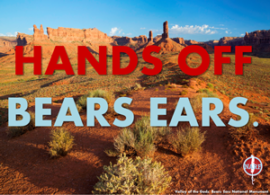 Five tribes—Hopi Tribe, Navajo Nation, Pueblo of Zuni, Ute Indian Tribe, and Ute Mountain Ute Tribe—led the effort to establish the Bears Ears National Monument, an area still used for cultural and religious purposes. Increased looting of the estimated 100,000 plus structures, sites, and objects within every reach of the monument dictated the need for protections in the form of a monument designation.
According to NARF Staff Attorney Matthew Campbell, “Bears Ears is one of the most important places for Indian Country, and that is why Indian Country came together to advocate for this important place. Trump’s attack on Bears Ears is an attack on all of us, and we will fight to protect it.”
NARF Staff Attorney Natalie Landreth said “The Administration is not telling the truth. The Bears Ears monument as created by President Obama preserved hunting, fishing, gathering and grazing rights, and protected these incredible lands from widespread looting and oil, gas and mineral development.” No matter what the President said today, his action does the opposite: by its own terms, in 60 days the revoked lands are open to “entry, location, selection, sale” and “disposition under all laws relating to mineral and geothermal leasing” and “location, entry and patent under mining laws.” Landreth continued, “this is taking public lands that belong to the American people and selling to the highest bidder, there is just no other way to understand it.”
This latest action follows on the heels of the Administration’s other actions against Tribes: (1) issuing the permit to the Dakota Access Pipeline, (2) issuing the permit to the Keystone XL, and (3) revoking the Executive Order to protect the Bering Sea on April 28th. Tribes vigorously opposed all of these efforts. The Administration uses the term “tribal sovereignty” but clearly does not understand what that means.
Read more about NARF’s work to protect Bears Ears National Monument.
Ninth Circuit Restores Navajo Nation Trust Breach Claim in Colorado River Water Rights Matter
Here is the opinion in Navajo Nation v. Dept. of the Interior.
An excerpt:
The panel held that the Nation’s breach of trust claim was not barred by sovereign immunity, and remanded to the district court to consider the claim on its merits. The panel held that the broad waiver of sovereign immunity found in § 702 of the Administrative Procedure Act (“APA”) waived sovereign immunity for all non-monetary claims, and § 704 of the APA’s final agency action requirement constrained only actions brought under the APA. The panel concluded that the Nation’s breach of trust claim sought relief other than money damages, and the waiver of sovereign immunity in § 702 applied squarely to the claim.
Lower court materials here.
NYTs: “President Trump Expected to Shrink Bears Ears by as Much as 90 Percent”
Here.
Ninth Circuit Rules in Favor of Lummi over Klallam Tribes in U&A Litigation
Here is the opinion in Lower Elwha Klallam Tribe v. Lummi Nation.
From the syllabus:
The panel reversed the district court’s summary judgment in favor of the Lower Elwha Klallam Indian Tribe, and held that the disputed waters west of Whidbey Island, Washington were included in the Lummi Nation’s right of taking fish at usual and accustomed grounds and stations (“U & A”) under the 1855 Treaty of Point Elliot.
In United States v. Washington, 384 F. Supp. 312 (W.D. Wash. 1974), Judge Boldt developed a framework for determining U & As for Indian signatories to the Treaty. In Finding of Fact 46, Judge Boldt stated that the U & A for the Lummi Indians “included the marine areas of Northern Puget Sound from the Fraser River south to the present
environs of Seattle.”To determine whether the waters west of Whidbey Island were included in the Lummi’s U & A, the panel followed a two-step procedure. At step one, the panel held that Fact 46 was ambiguous because it did not clearly include or exclude the disputed waters. At step two, the panel examined the record before Judge Boldt to clarify his intent, and concluded that the district court erred in excluding the disputed waters
from the Lummi’s U & A. The panel held that the district court improperly imposed a heightened standard in holding that logic or linguistics needed to “compel the conclusion” that contested waters be included in a U & A.
Briefs here.
 Turtle Talk
You must be logged in to post a comment.