Here are the materials in Chemehuevi Indian Tribe v. Brown (C.D. Cal.):
Author: Matthew L.M. Fletcher
The Apolitical Case against Judge Gorsuch
Here is Emily Bazelon and Eric Posner’s “The Government Gorsuch Wants to Undo.” An excerpt:
But the reality is that Judge Gorsuch embraces a judicial philosophy that would do nothing less than undermine the structure of modern government — including the rules that keep our water clean, regulate the financial markets and protect workers and consumers. In strongly opposing the administrative state, Judge Gorsuch is in the company of incendiary figures like the White House adviser Steve Bannon, who has called for its “deconstruction.” The Republican-dominated House, too, has passed a bill designed to severely curtail the power of federal agencies.
Here are several other tidbits on this issue:
Richard Hasen’s “Neil Gorsuch got where he is because of a form of affirmative action.”
Elie Mystal’s “Truck Drivers Weigh In On TransAm Trucking Case, Neil Gorsuch Nomination.”
NCAI/NARF Support Documents: NCAI NARF Gorsuch letter Final and NCAI Summary of Gorsuch Confirmation Hearing
Turtle Talk’s summary of Judge Gorsuch’s Indian law record.
Federal Court Partially Dismisses Pauma Band Claims against California’s Use of Gaming Compact Special Distribution Fund
Here are the materials in Pauma Band of Luiseno Mission Indians of the Pauma & Yuima Reservation v. State of California (S.D. Cal.):
Sprint’s Request for $690K in Attorney Fees to Accompany $29K Judgment against Native American Telecom Dropped by Court to $36K
More News on Whiteclay: Profile of Jennifer Bear Eagle
Here is “From the Rez and Back: Legal Eagle Helps Her Tribe.”
Rosebud Sioux Breach of Trust Claim against IHS to Proceed
Here are the materials in Rosebud Sioux Tribe v. United States (D.S.D.):
An excerpt:
The above affirmations of a health care trust responsibility are tempered by Supreme Court rulings on the subject of the general trust responsibility, as noted above, and specifically on American Indian health care. The Government argues that because of the lack of a trust corpus, “the sole question is whether the IHS owes any trust duty in relation to its annual appropriations.” Doc. 18 at 18. Where money is appropriated to fulfill a treaty obligation, a trust responsibility attaches; where money is a “gratuitous appropriation,” no trust responsibility is created. See Quick Bear v. Leupp, 210 U.S. 50, 80 (1908). The Supreme Court dealt specifically with an issue regarding appropriations to IHS in Lincoln v. Vigil, 508 U.S. 182 (1993). In Lincoln, the Court held that lump-sum amounts appropriated to IHS were committed to agency discretion, so long as it allocated funds “to meet permissible statutory objectives.” 508 U.S. at 193. At issue in Lincoln was the decision by IHS to discontinue a program assisting handicapped American Indian children in the Southwest and to move that funding to a nationwide program for handicapped American Indian children. Id. at 184. Lincoln focused specifically on whether IHS’s decision to terminate the program could be reviewed under the APA, and whether it should have abided by the APA’s notice-and-comment rulemaking provisions; it did not opine on a general trust responsibility held by IHS for the care of handicapped American Indian children. Id. at 190, 196.
The Eighth Circuit has recognized, in a limited fashion, the trust responsibility of the United States to provide health care to American Indians. See White v. Califano, 581 F.2d 697 (8th Cir. 1978) (per curiam). In White, the Eighth Circuit in a two-page decision required the federal government, rather than the state of South Dakota, to provide and pay for the involuntary commitment of an indigent mentally ill woman enrolled in the Oglala Sioux Tribe on the Pine Ridge Indian Reservation. Id. The Eighth Circuit quoted from the district court’s opinion and explained that “[i]n affirming, we adopt the district court’s statement of facts and its reasoning as applied to the conclusions quoted above.” Id. at 698. Specifically, the Eighth Circuit quoted from Judge Bogue’s opinion:
We think that Congress has unambiguously declared that the federal government has a legal responsibility to provide health care to Indians. This stems from the ‘unique relationship’ between Indians and the federal government, a relationship that is reflected in hundreds of cases and is further made obvious by the fact that one bulging volume of the U. S. Code pertains only to Indians.
Id. (quoting White v. Califano, 437 F. Supp. 543, 555 (D.S.D. 1977)). Although the White decisions pre-date the Mitchell line of trust responsibility cases, nothing in those cases overrules or otherwise negates White, especially because White involved a request for specific equitable relief, while the Mitchell line of cases dealt with monetary damages claims made possible under the Tucker Act, 28 U.S.C. § 1491, and the Indian Tucker Act, 28 U.S.C. § 1505. Relatedly, in Blue Legs v. United States Environmental Protection Agency, 668 F. Supp. 1329, 1330 (D.S.D. 1987)—a case seeking declaratory and injunctive relief based on the trust responsibility outside of the health care context—Judge Battey summarized White, explaining that “the law was clear that the trust responsibility of the federal government in relation to Indian tribes in the area of health services was explicitly mandated by the Indian Health Care Improvement Act . . . and the law then in existence.” Id. at 1340. On appeal, the Eighth Circuit affirmed that the specific agency responsibilities towards the Oglala Lakota Sioux Tribe in cleaning up waste dumps was “buttressed by the existence of the general trust relationship between these agencies [the BIA and IHS] and the Tribe.” Blue Legs, 867 F.2d at 1100. The Eighth Circuit explained that “[t]he existence of a trust duty between the United States and an Indian or Indian tribe can be inferred from the provisions of a statute, treaty or other agreement, ‘reinforced by the undisputed existence of a general trust relationship between the United States and the Indian people.'” Id. (quoting Mitchell, 463 U.S. at 225).
We posted the complaint here.
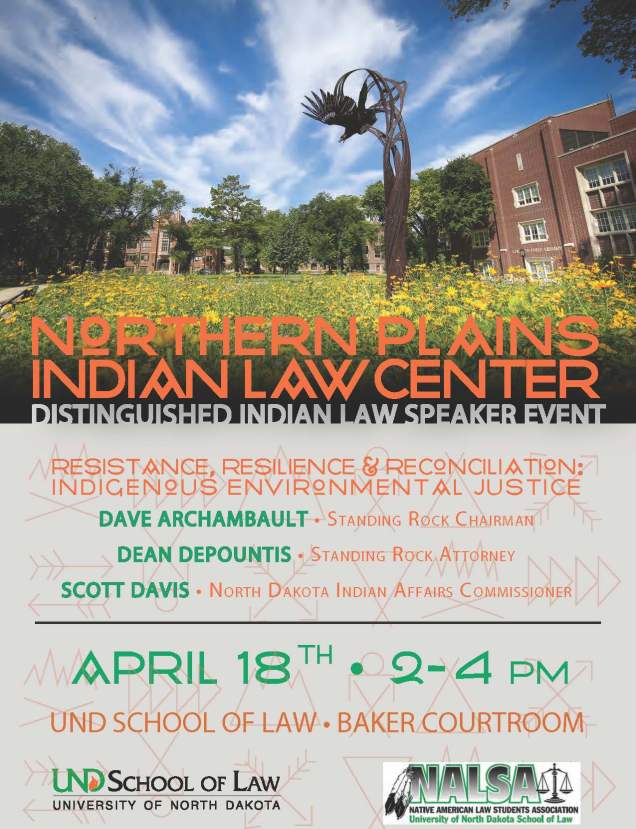
UND Law to Host “Resistance, Resilience & Reconciliation: Indigenous Environmental Justice” April 18, 2017
Here (PDF):
News on Whiteclay Beer Mills: $6.3M To Buy Out Liquor Store Owners
SCOTUS Denies Cert in Citizens Against Reservation Shopping v. Zinke
Here is today’s order list.
 Turtle Talk
You must be logged in to post a comment.