Here are the materials in Scudero v. Moran (D. Alaska):
Author: Matthew L.M. Fletcher
Federal Indictment against Former Paskenta Band Leaders Alleging $6M in Embezzlement
Here is the indictment in United States v. Crosby (E.D. Cal.):
News coverage here.
Federal Court Denies State and Tribal Motions for Summary Judgment in Quil Ceda Tax Disputes
Current Issue of the American Indian Law Review
Here:
Vol. 40, No. 2 (2015-2016)
Click any link to view in PDF format
Article
Comments
A Pretty Smart Answer: Justifying the Secretary of the Interior’s “Seminole Fix” for the Indian Gaming Regulatory Act – Austin R. Vance
Special Feature
Second Circuit Briefs in Gingras v. ThinkFinance & Plain Green
Here are the materials in Gingras v. ThinkFinance LLC:
Lower court decision in Gingras v. Rosette here.
Federal Court Refuses to Vacate Sentence of Man Convicted of Bribing Ho-Chunk Nation Leaders
Here are the materials in Whiteagle v. United States (W.D. Wis.):
An excerpt:
In August 2012, after an 8-day trial, a jury found petitioner Timothy Whiteagle guilty of twelve counts relating to bribing and conspiring to bribe a Ho-Chunk Nation legislator to secure favorable treatment for three different vendors wishing to do business with the Nation. United States v. Whiteagle, Case No. 11-cr-65-wmc-1. On October 24, 2012, this court sentenced him to serve 120 months in prison, to be followed by 3 years of supervised release. Petitioner filed and lost motions for acquittal, a new trial, resentencing, and a direct appeal. He has now filed a motion for post-conviction relief under 28 U.S.C. § 2255, arguing that his conviction should be vacated for numerous reasons. Because none of petitioner’s challenges support overturning his conviction, the court will deny the motion.
Letter to Editor re: ABA J. Article on Alexandria P./R.P. Case
Here:
“Children of the Tribe”, October, sadly reports without question the Pages’ version of Lexi’s transfer to a kinship placement supported by her own attorney, the state of California and the Choctaw Nation. Worse, the article uncritically highlights the media event created by the foster parents and their counsel (and disappointingly includes photographs). The affair violated Lexi’s privacy rights, which is why state social workers attempted to block cellphone video, and may have also violated their attorney’s duties under the ABA Model Rules of Professional Conduct: 3.4 (fairness to opposing parties), 3.6 (trial publicity) and 4.4 (respect for rights of third persons). Hopefully, readers will not learn from this article that the best way to fight a child’s placement with her family is by creating an unethical media circus.
The article misstates the law as well. Lexi would be with her Utah relatives with or without the Indian Child Welfare Act. California law weighs placement heavily in favor of relatives, not foster families, in these cases. However, only in California could a foster family appeal the placement of their ward under its unique “de facto parent” doctrine. In addition, the Multiethnic Placement Act, enacted by Congress in 1994, explicitly excludes ICWA cases from its application. Finally, the article devolves from reportage into racial politics, asserting that this tragedy only transpired because of Lexi’s racial heritage. Lexi herself is a citizen of the Choctaw Nation. The Choctaw Nation’s citizenship requirement, like that of the United States, requires a political connection between the individual and the nation, not mere ancestry. The only reason there was a media-fueled tragedy is because counsel for the foster family pointed at the act and the Choctaw Nation to incite race-based animosity when the facts and the law were not in their favor.
Matthew L.M. Fletcher
East Lansing,
Suquamish Enterprise Attorney Posting
Here:
associategeneralcounselannnouncement2016
And a link as well: http://clearwatercasino.iapplicants.com/ViewJob-748343.html.
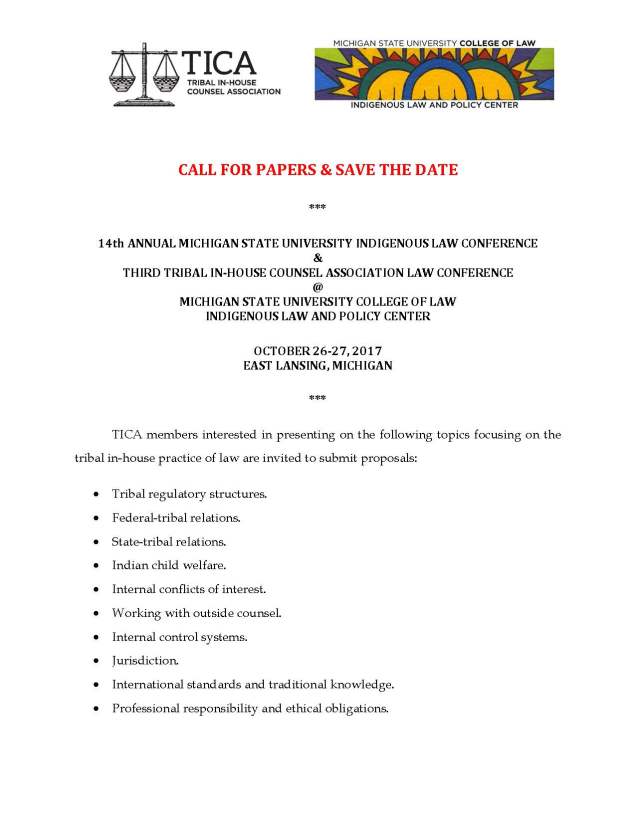
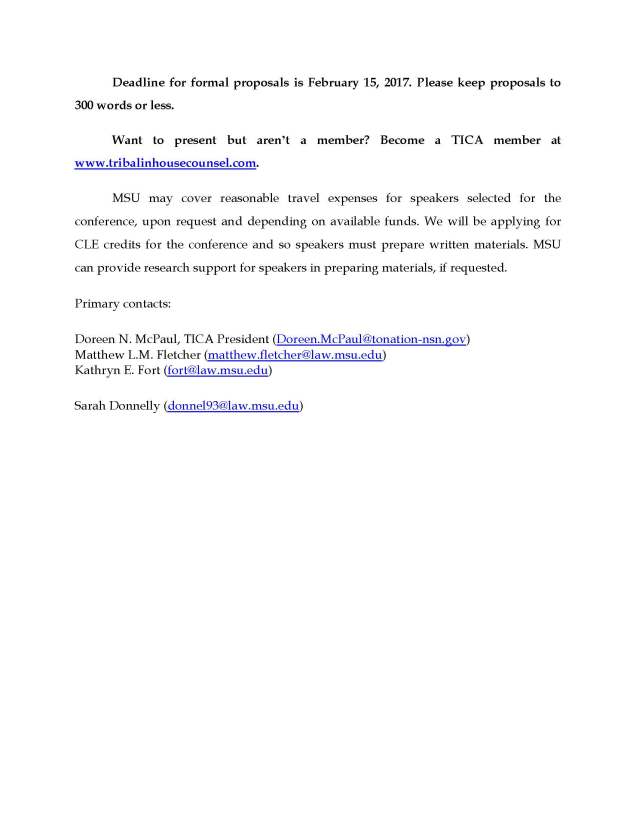
ILPC/TICA Call for Papers & Presentations — 2017 Conference (Oct. 26-27, 2017) — Feb. 15, 2017 Deadline
Tribal Remedies Held Exhausted in AMERIND Risk Management Corporation v. Blackfeet Housing
Here are the materials in AMERIND Risk Management Corporation v. Blackfeet Housing (D. N.M.):
 Turtle Talk
You must be logged in to post a comment.