Here is “More Choctaws Have Died of COVID Than Those Who Died of the Disease in Hawaii. Or Alaska. Or Wyoming” from the Pulitzer Center.
Author: Matthew L.M. Fletcher
Ak-Chin Indian Community Water Rights Claim to Proceed
Here are the materials so far in Ak-Chin Indian Community v. Maricopa-Stanfield Irrigation & Drainage District (D. Ariz.):
2020-05-08 – Dkt 011 – Maricopa-Stanfield_s Motion to Dismiss
2020-05-08 – Dkt 012 – Central Arizona Irrigation Motion to Dismiss
2020-05-29 – Dkt 017 – Plt_s Consolidated Response in Opposition to Defs_ Motions to Dismiss
2020-06-15 – Dkt 021 – Reply ISO Maricopa-Stanfield Irr & Drainage District_s Motion to Dismiss
2020-06-15 – Dkt 022 – CA Irr & Drainage District_s Reply ISO Motion to Dismiss
The complaint is here.
Ninth Circuit Decides Southcentral Foundation v. Alaska Native Tribal Health Consortium
Here is the opinion, holding the Southcentral Foundation has standing to sue over the provision of heath care services.
Briefs here.
Bridge Magazine: “In Michigan, rising lake levels disturb sacred ground”
Here.
Navajo Man Loses Federal Criminal Sentencing Disparity Claim in Tenth Circuit
Jamestown S’Klallam Loses Indian Health Services Funding Claim
Here are the materials in Jamestown S’Klallam Tribe v. Azar (D.D.C.):
Warigia Bowman on COVID, Coal, and the Navajo Nation
Warigia M. Bowman has posted “Dikos Nitsaa’igii-19 (The Big Cough): Coal, COVID, and the Navajo Nation” on SSRN.
Here is the abstract:
This essay makes the following arguments. First, the US federal government knows how to electrify remote rural areas, and has in fact electrified rural areas as remote and inaccessible as the Appalachian Mountains. Yet, the US government has failed to electrify Navajo. Second, Navajo Nation is surrounded by power plants which send electricity to Phoenix, Los Angeles, and parts distant, yet transmission lines and infrastructure have not been properly extended from those power plants to inside of Navajo Nation. Third, the health risks of residential coal burning are well known, and given the health risks of COVID-19 and the fact that underlying respiratory conditions make the Navajo quite susceptible to this disease, the need to address this infrastructure gap is urgent.
Robison on Tribal-Federal Cooperative Management of the Grand Canyon
Jason Robison has posted “Indigenizing Grand Canyon,” forthcoming in the Utah Law Review, on SSRN.
Here is the abstract:
The magical place commonly called the “Grand Canyon” is Native space. Eleven tribes hold traditional connections to the canyon according to the National Park Service. This Article is about relationships between these tribes and the agency—past, present, and future. Grand Canyon National Park’s 2019 centennial afforded a valuable opportunity to reflect on these relationships and to envision what they might become. A reconception of the relationships has begun in recent decades that reflects a shift across the National Park System as a whole. This reconception should continue. Drawing on the tribal vision for Bears Ears National Monument, this Article advocates for Grand Canyon tribes and the Park Service to consider forming a Grand Canyon Commission for cooperative management of Grand Canyon National Park. Establishing this Commission would mark the vanguard of the relational reconception, and, in this precise sense, the Commission would lay a foundation for “indigenizing” Grand Canyon.
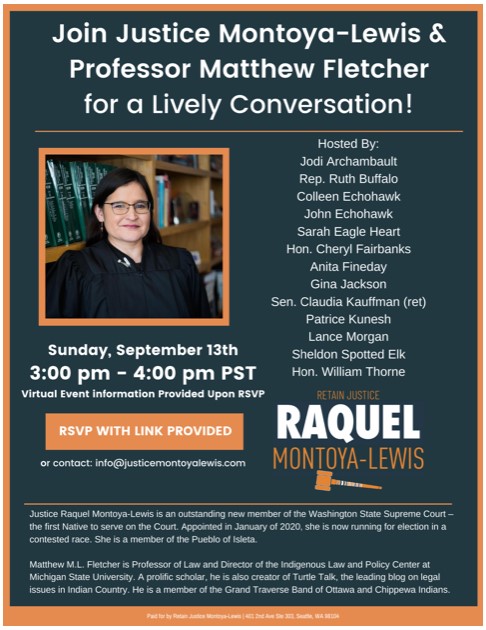
Important Reminder: Please Register for the Conversation between Justice Montoya-Lewis and Fletcher THIS SUNDAY
Register here:
Kronk Warner & Tanana on McGirt and Energy Development
Elizabeth Ann Kronk Warner and Heather Tanana have posted “Indian Country Post McGirt: Implications for Traditional Energy Development and Beyond” on SSRN.
The abstract:
The decision in McGirt v. Oklahoma is being heralded as the most important Indian law decision of the last 100 years, as it affirmed the reservation boundaries of the Muscogee (Creek) Reservation – an area long considered by many to be under Oklahoma’s jurisdiction. Yet, following release of the Court’s decision, the outcry from the oil and gas industry was almost instantaneous, as roughly twenty five percent of Oklahoma’s oil and gas well and sixty percent of its oil refineries are impacted by the Court’s decision. Additionally, the territory affected by the Court’s decision also includes pipelines crucial to the successful operation of the nationwide Keystone XL pipeline. While the Court was clear that its holding was limited to criminal jurisdiction under the Major Crimes Act, the decision nonetheless has broader implications for Indian country, including natural resource development and regulatory framework. Because the oil and gas industry will now have to work with tribes and the federal government instead of favorable state officials, industry officials decry the Court’s decision as being detrimental to the industry. But what exactly will be the impact of the Court’s McGirt decision on the oil and gas industry, and the natural resources development in Indian country more broadly? While the full impacts of the Court’s decision are only beginning to unfold, this Article seeks to answer the questions left hanging by the Court’s decision as they relate to traditional energy development. This Article explores the future impacts of the McGirt decision on traditional energy development. The second Part of the article summarizes the legal background that governs oil and gas development in Indian country. Part three provides an in-depth analysis of McGirt—first, describing its predecessor, Sharp v. Murphy, followed by an explanation of McGirt and its holding. The article concludes by discussing future implications of McGirt, including what it means for oil and gas development going forward as well as collateral effects. The article constitutes an important scholarly contribution as it answers important questions left open after the Court’s decision and explains how the Court’s decision has broader implications for Indian country and natural resource development generally.
 Turtle Talk
You must be logged in to post a comment.