FTCA/Civil Rights Suit against BIA Officers Enforcing N. Cheyenne Tribal Bench Warrant against Non-Indian Dismissed

Here are the materials in the case captioned In re Roberts Litigation (D. Mont.):

33 Federal Motion for Summary J

44 Opposition

45 Federal Reply

54 DCT Order Granting Federal Motion for Summary J

An excerpt:

In order for Roberts’ claim under Bivens to survive, the law must have been sufficiently clear to place a reasonable officer on notice that the Tribal Court acted in complete absence of jurisdiction in issuing the warrants, and that in carrying out the Tribal Court mandate to serve the warrants, reasonable officers would have known they were [8]  engaging in an unlawful act, Existing law permits no such conclusions, notwithstanding Roberts’ contention that the law was clearly established that the Tribal Court lacked criminal jurisdiction over non-Indians under the authority of Oliphant v. Suquamish Indian Tribe, 435 U.S. 191, 98 S. Ct. 1011, 55 L. Ed. 2d 209 (1978) and that the officers had personal knowledge that Roberts was a non-Indian.

Roberts’ argument fails to take into account the Northern Cheyenne Tribal Court’s claim of capacity to exercise jurisdiction over non-Indians by consent. It is not necessary, however, for this Court to decide the question of whether a tribal court may exercise such jurisdiction. Rather, the issue is whether the law was so clearly established at the time of Roberts’ arrests that a reasonable officer would have known that the tribal court was wholly without jurisdiction and that he was engaging in a null and void act. Existing law is not sufficiently clear to warrant that conclusion. The jurisdictional issue remains.

The officers were presented with facially valid warrants, they were charged with the responsibility to execute the warrants, and they had a reasonable basis to believe in the validity of the warrants and in the lawfulness of their actions in executing the warrants. They are entitled to qualified immunity for the personal capacity claims brought against them under the Bivens doctrine.
Ninth Circuit Materials in Carsten v. Nevada Inter-Tribal Council — FMLA Claims

Here:

Carsten Opening Brief

ITC Answer Brief

Carsten Reply Brief

Oral argument video and audio.

Lower court materials here.

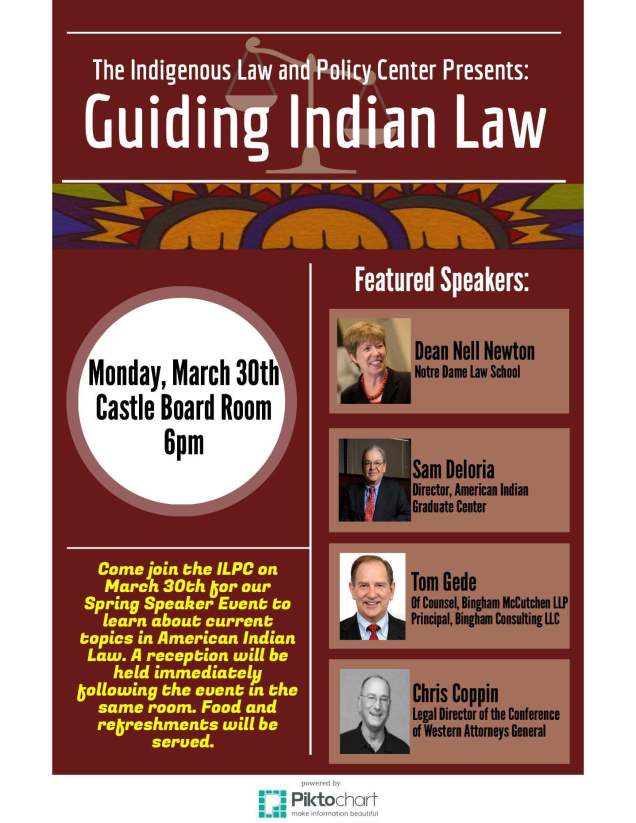
ILPC Event March 30, 2015: “Guiding Indian Law” with Dean Nell Newton, Sam Deloria, Tom Gede, and Chris Coppin

Please join us!

GIL4

Suit for Injunctive Relief against Blackfeet Elected Officials over Utility MOA Dispute May Proceed

Here are the materials in Town of Browning v. Sharp (D. Mont.):

71 12b1 Motion to Dismiss

73 12b6 Motion to Dismiss

75 12b7 Motion to Dismiss

95 Response to 12b1 Motion

96 response to 12b6 Motion

97 Response to 12b7 Motion

115 Reply in Support of 12b7 Motion

123 DCT Order

140 Magistrate Report

144 Objection to Magistrate Report

148 DCT Order

An excerpt:

Defendants and Plaintiff have not objected to Judge Johnston’s Findings and Recommendations on any other grounds. The Court finds no clear error in Judge Johnston’s Findings and Recommendations, and adopts them in full. A plaitiff may seek only prospective, injunctive relief under the doctrine of Ex Parte Young. Burlington N. & Santa Fe Ry. Co. v. Vaughn, 509 F.3d 1092 (9th Cir.2007). Plaintiff seeks compensatory damages, exemplary damages, treble damages, and costs and attorney fees for counts 2–5. Plaintiff has failed to state a claim for which relief can be granted. Dismissal of counts 2–5 is appropriate pursuant to Federal Rule of Civil Procedure 12(b)(6). Plaintiff seeks prospective, injunctive relief in count 1. Defendants have failed to demonstrate that Plaintiff has not stated a claim for which relief can be granted in count 1.

Stephen Cornell on Indigenous Self-Government

Stephen Cornell has published “‘Wolves Have A Constitution:’ Continuities in Indigenous Self-Government” (PDF).

The abstract:

This article is about constitutionalism as an Indigenous tradition. The political idea of constitutionalism is the idea that the process of governing is itself governed by a set of foundational laws or rules. There is ample evidence that Indigenous nations in North America—and in Australia and New Zealand as well—were in this sense constitutionalists. Customary law, cultural norms, and shared protocols provided well understood guidelines for key aspects of governance by shaping both personal and collective action, the behavior of leaders, decision-making, dispute resolution, and relationships with the human, material, and spirit worlds. Today, many of these nations have governing systems imposed by outsiders. As they move to change these systems, they also are reclaiming their own constitutional traditions.

Murphy v. Western Sky Financial & CashCall Complaint

Here:

1 Complaint

California Valley Miwok Tribe v. California Gambling Control Commission Complaint

Here:

1 Complaint

Navajo Nation DOJ — Litigation and Employment Unit Job Posting

Here:

LEU NNDOJ attorney position

The Navajo Nation Department of Justice is seeking an energetic and motivated attorney to work in the newly formed Litigation and Employment Unit. The qualified applicant will focus on litigation for the Navajo Nation government before federal, Navajo Nation, and state courts and administrative tribunals in a variety of subject areas, including natural resources, public safety, and jurisdictional issues, with some work with Navajo Nation government programs advising and representing programs on labor and employment matters.

Keweenaw Bay Indian Community Attorney Job Posting

Here:

A Tribal Attorney position was posted this morning at KBIC.  Please feel free to forward this opportunity.


http://www.kbic-nsn.gov/content/personnel

http://www.kbic-nsn.gov/sites/default/files/open/Attorney%203-2015.pdf

Agua Caliente Band Prevails on Winters-Based Water Rights Claim; Aboriginal Title Claim Denied

Here is the order in Agua Caliente Band of Cahuilla Indians v. Coachella Valley Water District (C.D. Cal.):

115 DCT Order

Briefs are here, here, and here.