Moapa Drops Tribal Court Suit against Wells Fargo; Agrees to Mediation (Updated 2/25/13)

Here is the tribe’s press release:

MOAPA DISMISSES TRIBAL COURT ACTION
Moapa, NV –The Moapa Band of Paiute Indians today announced that it and Wells Fargo Financial Advisors LLC had agreed to submit to mediation certain issues between the parties, and that the Band had caused dismissal of an action against Wells Fargo Financial Advisors commenced in the Tribe’s tribal court.
Tribal Chairman William Anderson commented that “The Tribe will always defend its inherent sovereign rights. However, the Tribe also observes its valid agreements, including valid waivers of its sovereign immunity. Further, the Band strives to be commercially responsible in its contractual relationships. We believe that the Band’s voluntary submission of the issues to mediation and dismissal of the tribal court action reflect these principles. We hope that through good faith mediation the parties will mutually resolve the issues.”
About the Moapa Band of Paiutes
The Moapa Band of Paiute Indians is located on its 72,000 acre Moapa River Reservation in Nevada. The Tribe’s reservation is the proposed site of a solar 350 megawatts energy project generating (sufficient to power 100,000 homes) being developed by K Road Power.

We posted on this case here.

Update — docs here:
Moapa 2-22-13 Press Release

Moapa Tribal Court Dismissal


Tenth Circuit Decides Important Second Amendment/Official Immunity Appeal

Here is the opinion in Peterson v. Martinez.

Not an Indian law case, but the material on state official immunity is interesting, in my view, because of how much of the Tenth Circuit’s jurisprudence on the subject derives from Indian law cases.

“The Indians Won” — A Blast from the Past — And a Shout-Out to Law Students

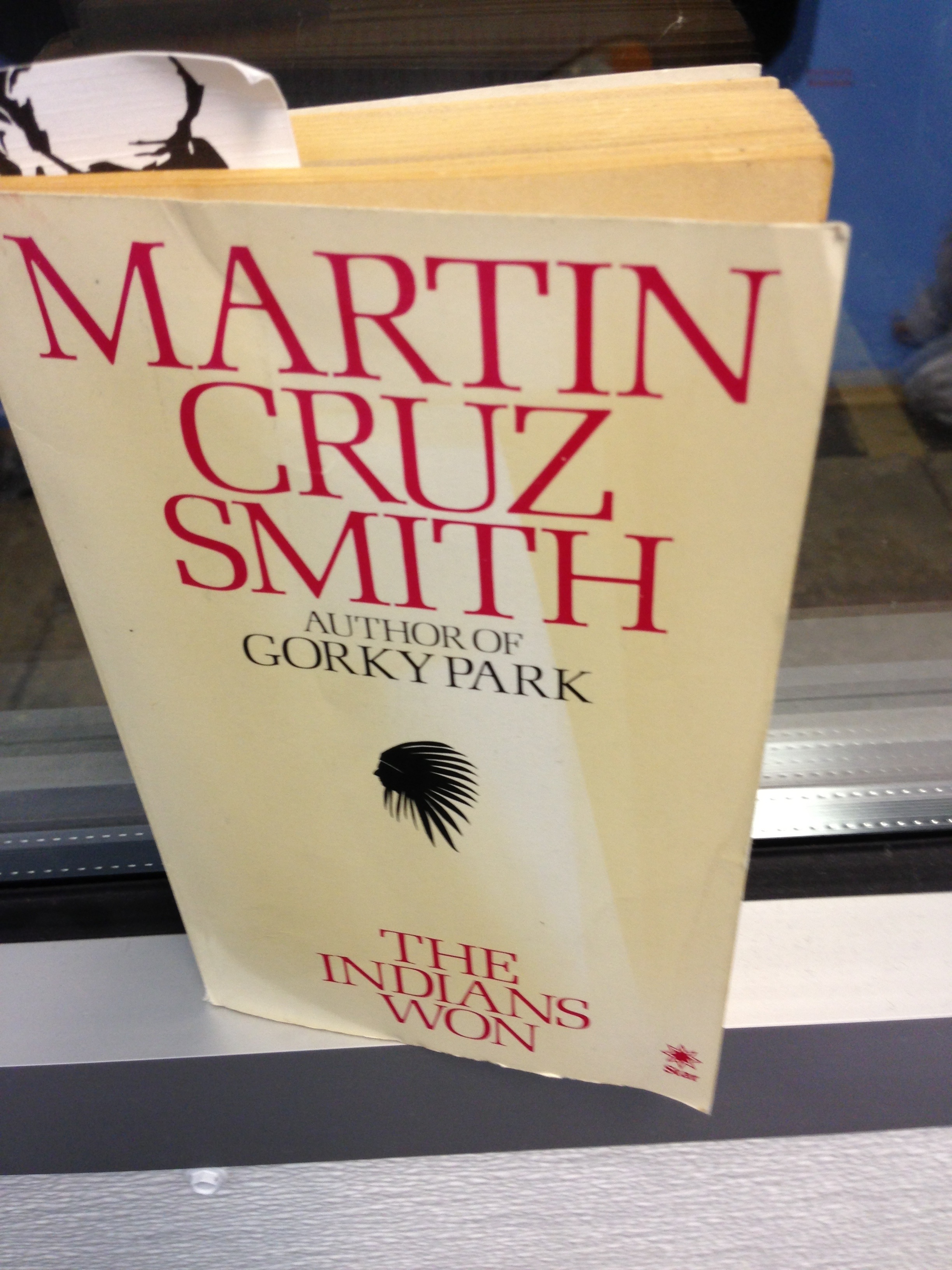
At Sam Deloria’s mention, I found a copy of the long out of print 1970 novel by Martin Cruz Smith (better known for the Arkady Renko mysteries), “The Indians Win”, and read it. It’s a short read. And fun. The edition I have includes commentary from the author who states he researched Indians for a couple months, then wrote the novel in one month. Not to give away the plot (spoiler alert), but in this fictional world, the Indians win. Yeah, the ‘Nishnaabes don’t get much play — it’s all Sitting Bull and Stand Watie and Wovoka — but the Potawatomis get a few good ones in.

20130221-231921.jpg

For those not in the know about this novel, here is a quick plot summary. In 1876, rather than Custer’s Last Stand being the Indians’ last stand, all the remaining Indian tribes of the plains and the far west band together. Armed with European arms smuggled down from Canada through Dakota, the Indians win a bunch of military clashes with a post-Civil War American military that doesn’t put up much of a fight. It all ends up with … You guessed it … The Indians winning. Speculative fiction at its early 1970s best and funnest. The best part of the subplot is the 1952 declaration by the “Indian Nation” that they have bomb, but are unwilling to prove to the world they have the bomb by testing it because to do so would unnecessarily injure Mother Earth.

It reminds me of the National NALSA moot court competition. Year after year, law students gather to compete in a fictional world that could be like the one where “The Indians Win.” If you’re like me and you think of this reality as one reality in a universe of infinite parallel … universes, then why can’t the Indians win after all? How else could a dude like me marry the most beautiful and brilliant Odawa woman in the world?

In the end, I say this — have a great competition, law students. The National NALSA Moot Court Competition should be fun. Anything, absolutely anything can happen. US News rankings fly right out the window. Make friends, renew old friendships, network like crazy, and crush your opposition with an iron boot.

Harvard Law Review Student Note: “Indian Canon Originalism”

Harvard Law Review has published “Indian Canon Originalism.”

From the article:

Indian treaties are “quasi-constitutional” documents. So why not read them like constitutions? In fact, scholars of Indian law have urged federal judges to interpret Indian treaties “in the same manner as [they do] constitutional provisions.” But no scholar has ever explained how the principles of constitutional interpretation would actually apply to an Indian treaty — and whether those principles might change in that new environment. This Note attempts to do just that.

ASU Symposium on UN DRIP’s Impact of Federal Indian Policy

Can International Law Support Changes to Federal Indian Policy? Implementing the United Nations Declaration on the Rights of Indigenous Peoples Conference

April 19, 2013 – 8:30 a.m. – 5:15 p.m.

Sandra Day O’Connor College of Law at Arizona State University

Great Hall, Armstrong Hall, 1100 S. McAllister Avenue, Tempe, AZ 85287

Agenda and registration online at: http://conferences.asucollegeoflaw.com/drip/ Register early!

Contact: Darlene Lester / darlene.lester@asu.edu / 480-965-7715

Sponsored by the Indian Legal Program and the Center for Law and Global Affairs at ASU

Keynote Speaker: S. James Anaya, U.N. Special Rapporteur on the Rights of Indigenous Peoples

Omaha Tribal Court Opinion Holding Tribe Has Authority to Tax Liquor Retailers on 1854 Reservation

Here is the opinion:

Village of Pender v Morris — Omaha Tribal Court

The District of Nebraska previously ordered exhaustion of tribal remedies in this matter, materials here.

And here is the briefing schedule:

DCT Order w Briefing Schedule

News coverage here.

MSU International Law Review Symposium on the Arctic

Our own Victoria Sweet — the 2013-14 ILPC Fellow — has organized an amazing legal symposium — “Battle for the North: Is All Quiet on the Arctic Front?” She put together an amazing line-up of international scholars — and the leader of the US Coast Guard will unveil a new strategic approach to the Arctic at the conference.Polar Bear

Here is the symposium website. And here is the description:

This symposium will highlight the current concerns and questions surrounding the Arctic. The event will raise awareness of and encourage discussion about various topics such as: international security concerns; indigenous people in the Arctic region; environmental law; regulation, governance and management of Arctic lands and resources; exploration, exploitation, and transportation of oil, gas, and minerals; and the law of the sea.

Papers will be published in the Michigan State International Law Review.

Agenda:

Thursday, February 21, 2013
5:00 p.m. Check In: Kellogg Hotel & Conference Center, Big Ten C
5:30 p.m. Reception
6:00 p.m. Dinner
7:00 p.m. Opening Remarks
Victoria Sweet, Executive Editor, Michigan State International Law Review

Bruce W. Bean, Professor and Michigan State International Law Review Faculty Advisor, Michigan State University College of Law, International Law Review Faculty Advisor

7:15 p.m. Keynote
Lawson Brigham, “The New Maritime Arctic: Global Connections and Complex Challenges”
7:45 p.m. The Impacts of Climate Change
Moderator: Jennifer Carter-Johnson, Assistant Professor, Michigan State University College of Law
Sumudu Atapattu, “Climate Change, Indigenous Peoples and the Arctic: The Changing Horizon of International Law”
Avi Brisman, “Climate Change and the Future of the Arctic: Cultural and Environmental Considerations”
8:30 p.m. Closing Remarks
Friday, February 22, 2013
8:00 a.m. Breakfast and Registration: MSU College of Law Castle Boardroom
8:45 a.m. Opening Remarks
Dean Joan W. Howarth, Dean, Michigan State University College of Law
9:00 a.m. Keynote
Rear Admiral Frederick J. Kenney Jr., “The U.S. Coast Guard and the Challenge of the Arctic”
9:35 a.m. Arctic Governance
Moderator: Michael Lawrence, Associate Dean, Michigan State University College of Law
Waliul Hasanat, “Reforming the Arctic Council against Increasing Climate Change Challenges in the North”
Tanja Joona, “ILO Convention 69 and the Governance of Indigenous Nordic Lands”
Tony Penikett & Adam Goldenberg, “Devolution & Democracy – Equal Citizenship in Canada’s North”
Danielle Sibener Pensley, “Subsistence as Resistance: Implications of Environmental Ethics for Property Law”
10:45 a.m. Coffee Break
11:05 a.m. Shipping & The Law of the Sea
Moderator: Beverly Moran, Visiting Professor, Michigan State University College of Law, (visiting from Vanderbilt University College of Law)
Erik Franckx, “The Northern Sea Route Shipping Season 2012: A First Assessment”
Donald R. Rothwell, “International Law and Arctic Shipping”
Ingvild Jakobsen, “The Adequacy of the Law of the Sea and International Environmental Law to the Arctic Ocean”
12:05 a.m. Lunch
12:40 p.m. Keynote
Timo Koivurova, “Final Battle over the ‘Final’ Hydrocarbon Province – the Arctic”
1:15 p.m Indigenous Peoples’ Resources and Lands
Moderator: Wenona Singel, Associate Professor, Michigan State University College of Law
Dorothee Cambou, “Control over Resources: A Prerequisite for the Realization of the Arctic Indigenous Right to Self-Determination”
Tim Heleniak, “The Migration of Arctic Populations”
Susann Funderud Skogvang, “Legal Questions Regarding Mineral Exploration and Exploitation in Indigenous Areas: Examples from Sami Areas in Norway”
Rutherford Hubbard, “Risk, Rights and Responsibility: Navigating Corporate Responsibility and Indigenous Rights in Greenlandic Extractive Industry Development”
2:25 p.m. Coffee Break
2:45 p.m. Natural Resources
Moderator: Noga Morag-Levine, Professor, Michigan State University College of Law
Andrew van Wagner, “A Heating Competition for Unclaimed Resources”
Vladimir Gladyshev, “Delimitation Issues: Cutting up the Arctic Pie”
Nikolas Sellheim, “The Neglected Tradition? – The Crafting of the EU Seal Products Ban and Commercial Sealing”
Betsy Baker, “Governance of the Marine Arctic for Resource Development”
3:55 p.m. Coffee Break
4:15 p.m. Arctic Security
Moderator: John Reifenberg, Professor, Michigan State University College of Law
Adele Buckley, “Arctic Nuclear-Weapon-Free Treaty Ratification by Non-Nuclear Weapons States Models Cooperation and Presses Nuclear Weapon States to New Strategy”
Natalia Loukacheva, “Polar Law, Arctic Security and Geo-Political Trends”
Zhixiong Huang, “Governance of the Arctic: The Role of China”
5:15 p.m. Closing Remarks

Federal Circuit Affirms Dismissal of Fifth Amendment Claim re: Colorado River Indian Tribes’ Reservation Lease

Here is the opinion in McGuire v. United States.

Briefs:

McGuire Opening Brief

Federal Appellee Brief

McGuire Reply

An excerpt:

Jerry McGuire leased a plot of farmland in Arizona from the Colorado River Indian Tribes (“CRIT”) with the approval of the Bureau of Indian Affairs (“BIA”). He filed this Fifth Amendment regulatory takings claim after the BIA removed a bridge that he used to access portions of the leased property. McGuire does not claim that removal of the bridge was itself a taking, but rather that the BIA’s  alleged refusal to authorize replacement of the bridge was a taking of his property rights. After trial the Court of Federal Claims (the “Claims Court”) denied McGuire’s regulatory takings claim. McGuire appeals. Because we hold that McGuire’s regulatory takings claim never ripened and that, even if McGuire’s claim had ripened, he had no cognizable property interest, we affirm.

Lower court materials here.

2013 Hamline University International Indigenous Symposium

2013 IndigenousFORUM13 flyer (3) (1)

Here is the flyer in pdf form:

2013 IndigenousFORUM13 flyer (3) (1)

Opening Briefs in Baby Veronica Case

Here (thanks to NARF/NILL):

Opening Brief for Petitioners Adoptive Couple

Opening Brief for Respondent GAL Supporting Reversal