Scalia Memorandum to Brennan in Duro v. Reina

In the spirit of posting old documents (see our Nixon post yesterday), we are delighted to present a find from the late David Getches’ papers (many, many thanks to Jane at the Colorado Law Library for hunting for this and sending it along!):

DuroVReinaScaliaMemo

Here is an image of the memo, which David made a centerpiece of his deeply influential California Law Review article, “Conquering the Cultural Frontier: The New Subjectivism of the Supreme Court in Indian Law .” Jane believes David or his RA made the marks on the memo.

Judge Nelson’s Comments on Judge Betty Fletcher

Here. H/t to How Appealing.

An excerpt:

Betty and I were on calendar together the week before she died. I could tell that she was not feeling well, but nonetheless, as we discussed the cases at our post-hearing conference, she was her usual brilliant self. She had what she termed a distinguished record of reversals by the U.S. Supreme Court, often joined by me. One such case was National Resources Defense Council v. Winter that we heard in 2008 together with Judge Stephen Reinhardt. This was an environmental case and if you knew Betty, you knew that she was a passionate environmentalist. She and her sisters were the first women to hike the Wonderland Trail, a rugged 93-mile trail that includes a complete loop around Mount Rainier, the highest mountain in Washington state. I understand that one of her eight grandchildren later followed in her footsteps.

The Natural Resources case was about mammals, especially whales. Environmental organizations were concerned about the Navy’s use of high-intensity, mid-frequency sonar exercises that would cause serious harm to various mammals in Southern California waters. Similar exercises around the world had caused the beaching and deaths of many whales. The environmentalists brought a motion for a preliminary injunction in the district court seeking to prevent this activity. The district court judge, while allowing the training activities to continue, imposed restrictive conditions on them. Betty, in a bold, thoughtful, level-headed, fearless and eloquent 45-page opinion, affirmed the district court. Judge Reinhardt and I concurred. I should mention that at oral argument, Betty was superb. When an attorney challenged the court’s right to tell the Navy what to do, Betty, never confrontational, simply smiled and said something to the effect that it was the court’s duty to protect the planet.

We were reversed, of course, by the U.S. Supreme Court, in a 5-4 opinion. As her son, Willie, now a judge on our court, later commented: “Damn the whales, full speed ahead.”

ALI Announcement on the Restatement, Third, The Law of American Indians

Here.

An excerpt:

The Restatement Third, The Law of American Indians, aims to cement a set of generally agreed-upon foundational principles that could shape further developments in the field. Topics to be considered include federal/tribal relations, state/tribal relations, tribal jurisdiction and authority, and Indian Country business law. Matthew L. M. Fletcher of Michigan State University College of Law has been appointed Reporter for the project. Wenona T. Singel, also of Michigan State, and Kaighn Smith, Jr., of Drummond Woodsum in Portland, ME, will serve as Associate Reporters. View the lists of project participants.

Anyone with a serious interest in being a part of this project should apply for membership with the ALI. The next deadline is Jan. 15, 2013.

Colorado COA Decides ICWA Placement Preferences Case

Here is the opinion in People ex rel. A.R.

The court’s syllabus:

In this dependency and neglect proceeding, mother appealed from the judgment terminating her parent–child legal relationship with A.R. The Department of Human Services (Department) joined mother’s appeal of the termination and also challenged that part of the judgment addressing the Department’s guardianship. The judgment terminating mother’s parental rights was affirmed, the part of the judgment addressing guardianship was reversed, and the case was remanded.

Because A.R. is an “Indian child” as defined in 25 USC § 1903(4), these proceedings were subject to the Indian Child Welfare Act (ICWA), 25 USC §§ 1901 to 1963. Mother contended that the court erred in terminating her parental rights. She asserted that the Department did not meet the ICWA’s “active efforts” requirement, and there were viable, less drastic alternatives to termination, including A.R.’s placement with A.W. and C.W. The ICWA’s “active efforts” standard requires more effort than the “reasonable effort” standard in non-ICWA cases. Here, despite the court’s use of the term “best efforts,” the record supports the court’s determination that the Department’s actions met the requisite “active efforts” standard under the ICWA with regard to mother, A.W. and C.W. The trial court found, with record support, that although mother substantially complied with her treatment plan, it was unsuccessful in rendering her a fit parent and that her conduct or condition was not likely to change within a reasonable time. It also found that A.R. needs lifelong care or intensive services for her special needs, and mother was unable to provide those services. Additionally, placement with A.W. and C.W. without terminating mother’s parental rights was not a less drastic alternative; A.R. needed permanency, so it was not in her best interests.

The Department contended that, even if the court’s termination of mother’s parental rights was proper, the court erroneously deviated from the ICWA’s placement preferences when, in granting the Department guardianship, it denied the Department permission to place A.R. with A.W. and C.W. for purposes of adoption. The ICWA presumes that the child’s best interests are served by placement with an extended family member who also has Indian heritage. Here, the record does not support the trial court’s finding that there was good cause to deviate from the ICWA’s placement preferences. Therefore, the court erred in deviating from the ICWA’s placement preferences. The trial court’s judgment was reversed in this regard and the case was remanded with directions for the court to allow the department to arrange a home visit with A.W. and C.W., and to consider an adoption or preadoptive placement of A.R. consistent with the ICWA placement preferences, including possible placement with A.W. and C.W. or her foster parents.

Miccosukee Tribe Brief in Opposition to Furry Cert Petition (Tribal Immunity and State Law Dram Shop Actions)

Here:

Miccosukee Cert Opp

The petition and links to lower court materials here.

NMAI Program on the Nixon Administration and Indian Self-Determination — Thursday 11/15/12

In light of the Nixon Administration papers we posted, see here:

Nixon and the American Indian: The Movement to Self-Determination Thursday, November 15, 2012, 10:30 AM – 12 PM

Categories Lectures & Discussions, Webcasts & Webinars
Venue American Indian Museum
Event Location Rasmuson Theater, First Level
Webcast nmai.si.edu…
Cost Free

Early in his administration, President Richard Nixon dramatically changed the federal government’s Native American policy to support self-determination for Native American tribes and restoration of their culture. Fortifying the fiduciary relationship of the federal government for the tribes was central to ensuring that the new policy succeeded. White House and administration officials who worked with President Nixon discuss the leadership, legislation, and litigation necessary to implement the policy and what it means to the American Indian. The Archivist of the United States, David Ferriero, will deliver opening remarks. Cosponsored with the Richard Nixon Foundation and the National Archives.

For further information, please contact NMAI-SSP@si.edu.

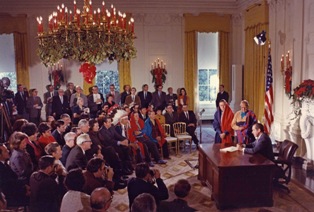
Photo President Richard Nixon signing landmark legislation on Native American sovereignty at the White House, December 15, 1970 by Oliver F. Atkins

ICT Profile on Diana Bob, Northwest Indian Bar Association President

Here.

Available Briefs in Second Circuit Appeal of Constitutional Challenge to IGRA and Seneca Compacts

Here are the appellee briefs in Warren v. United States:

Brief for Federal Appellees

Brief for New York Appellees

Brief for Seneca Nation Amicus

Lower court materials here.

NYTs Review of Tim Egan’s Book on Edward Curtis

Here.

Nixon Administration Redux — Two Papers from the Nixon Era

These two papers — from 1970 and 1974 — are interesting tidbits on the 1970 Nixon message to Congress and perhaps some backgrounds on the 1975 Indian Self-Determination and Education Assistance Act. Miigwetch to Bob Anderson for the 1970 paper, and miigwetch to whomever sent me the 1974 paper (poor form in losing the accompanying docs).

Nixon Indian speech briefing memo 1970

1974 White Paper — At What Level Sovereignty