Here.
We posted all the materials from this case here.
Here are the materials in Binger Operations LLC v. Edwards (W.D. Okla.):
32 DCT Order Granting Motions to Dismiss
An excerpt:
Binger Operations, LLC (“Binger”) filed this interpleader action against Brenda Shemayme Edwards, Phillip M. Smith, and the Caddo Tribal Council, seeking a determination of the respective rights of the defendants in interpleader (“defendants”) to receive oil and gas severance taxes. Both Mr. Smith and Ms. Edwards claim to be the Chairman of the Caddo Nation, and both have purported to file documents on behalf of the Caddo Tribal Council.1 Mr. Smith and, according to his/its motion, the Caddo Tribal Council, have moved to dismiss pursuant to Fed.R.Civ.P. 12(b)(1) for lack of subjectmatter jurisdiction. Ms. Edwards and, according to her/its response, the Caddo Tribal Council, have responded in support of the motion to the extent that it challenges this court’s jurisdiction. Binger has responded, and the motions are at issue.
Here are the updated materials in Federal Trade Commission v. AMG (D. Nev.):
559 DCT Order Adopting MJ Report
Prior post in this part of the litigation is here. The post related to the partial settlement is here. Other posts are here and here.
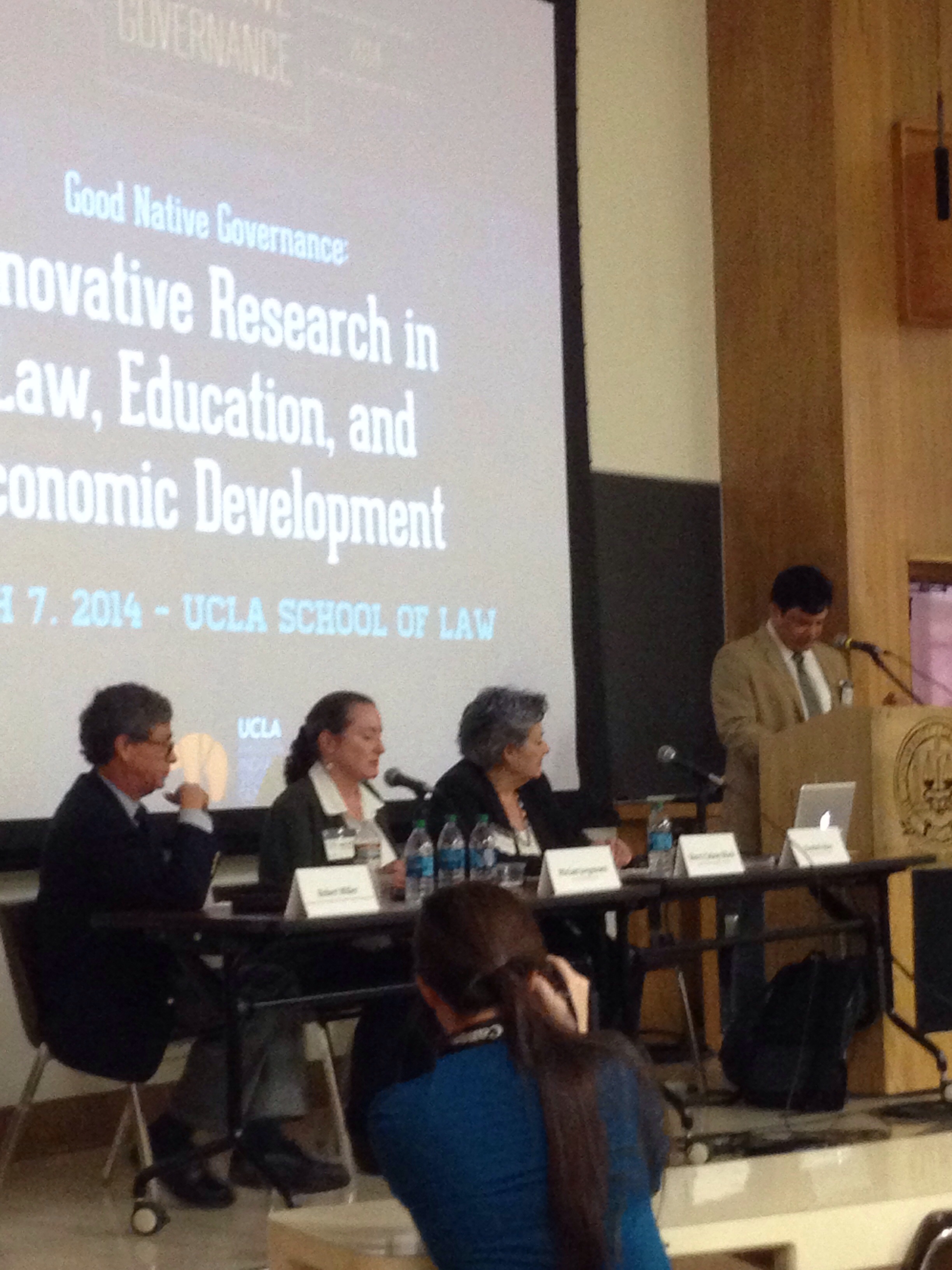
Bob Miller, Miriam Jorgenson, Sherry Black, and Randall Akee
Here:
opening brief of plaintiffs-appellants
addendum to brief of plaintiffs-appellants
The MSU ILPC filed an amicus brief in this matter as well:
Lower court order here:
108 Order Granting Motion to Dismiss
Here are the opening lines of the appellants’ brief:
Appellees engineered and executed a scheme to swindle hundreds of millions of dollars in oil-and-gas lease revenue from Appellants Ramona Two Shields and Mary Louise Defender Wilson and the class of Native Americans they propose to represent. Yet the District Court concluded that Appellants could not, as a matter of law, pursue their North Dakota common-law claims against Appellees simply because Appellees involved the United States in their swindle. Based on that fact alone, the District Court found that Federal Rule of Civil Procedure 19 required dismissal of Appellants’ entire case.
There is a parallel suit against the United States in the CFC.
Anyone who has been watching the news out of Canada is aware that numerous clashes have occurred between First Nations communities and various energy development companies. H/T to a post by First Peoples Worldwide for providing links to two reports released in December 2013 that are specifically about First Nations and resource extraction.
Report one was produced by The Charrette on Energy, Environment and Aboriginal Issues, comprised of a group of 21 leaders from First Nations, the extractive industry, the financial industry, environmental groups, and the Canadian government. The report begins with this quote:
We believe that the responsible development of our energy resources presents a substantial opportunity for Canada; however, virtually all proposed energy resource developments are mired in conflict which threatens that opportunity. We sense a growing frustration with this situation among industry, Aboriginal peoples, the environmental community and Canadians at large. We believe that we are all here to stay and it is imperative that we identify and build on the common ground that exists among us — or the current and future benefits that accrue to Canadians from all forms of energy resource development will be at risk.
Our desire is to change the substance, nature and tone of debates over energy resource development in Canada. We are inspired by the increasing number of innovative approaches being employed across Canada to avert or resolve conflicts or share benefits. Many of these are created outside of the regulatory process by people of goodwill who are trying to secure mutual benefits from energy resource development. It is these types of initiatives which we hope will define the future of energy resource development in Canada.
The report goes on to lay out some of the interests of industry, aboriginal peoples, and environmentalists and proposes some ways to reconcile these varied interests.
Report two was produced by The Fraser Institute. The executive summary of this report says:
It has been estimated that, over the next decade, more than 600 major resource projects, worth approximately $650 billion, are planned for Canada, and First Nations communities have a unique opportunity to benefit from these developments. As this study demonstrates, every oil and gas project currently proposed in western Canada implicates at least one First Nations community, giving them an opportunity to increase employment and eco- nomic prosperity through collaboration in energy development. . . .
Current unemployment rates in First Nations communities suggest that this group has much to gain from development in the energy sector. While the national unemployment rate is 7.1 percent, the unemployment rate for First Nations reserves is a staggering 23 percent. Unemployment rates are particu- larly high (20 percent to over 42 percent) in First Nations communities that are located in areas identified for oil and gas development.
The unique combination of population density in remote, resource-rich areas, a growing and young population, and a high level of unemployment places the First Nations in a unique position to benefit from energy develop- ment in Canada.
The report then goes on to document the geographic locations of First Nations communities close to proposed extractive development projects, unemployment rates, median ages within First Nations communities and the opportunities that this group believes energy resource development projects will bring to the communities.
These reports are important reading for anyone wanting to understand the current conversations going on within Canada regarding energy resource development and First Nations/Aboriginal communities. Like their conclusions or hate them, it is clear that industry and governmental leaders alike are recognizing that extractive industry development cannot move forward without more attention paid to the wishes and needs of these communities.
A question often comes to mind when reading about this issue – what happens if after all of the consultations and discussions and attempts to come to a compromise, a community still says no? What if it doesn’t care about the monetary benefits that may arise and it refuses to give consent under any circumstances? Is a community really free to withhold consent or only to determine some of the conditions under which it gives consent?
Here are the materials in People of the State of California v. MNE:
An excerpt from the opinion:
Applying the arm-of-the-tribe analysis as we directed in Ameriloan v. Superior Court (2008) 169 Cal.App.4th 81 (Ameriloan), the trial court dismissed for lack of subject matter jurisdiction this action by the Commissioner of the California Department of Corporations against five “payday loan” businesses owned by Miami Nation Enterprises (MNE), the economic development authority of the Miami Tribe of Oklahoma, a federally recognized Indian tribe, and SFS, Inc., a corporation wholly owned by the Santee Sioux Nation, also a federally recognized Indian tribe. Because the two tribal entities and their cash-advance and short-term-loan businesses are sufficiently related to their respective Indian tribes to be protected from this state enforcement action under the doctrine of tribal sovereign immunity, we affirm.
A second related opinion from the same court:
An excerpt:
The Commissioner of the California Department of Corporations (Commissioner),1 on behalf of the People of the State of California, sued Ameriloan, United Cash Loans, US Fast Cash, Preferred Cash and One Click Cash for injunctive relief, restitution and civil penalties, alleging they were providing short-term, payday loans over the Internet to California residents in violation of several provisions of the California Deferred Deposit Transaction Law (DDTL) (Fin. Code, § 2300 et seq.). Miami Nation Enterprises (MNE), the economic development authority of the Miami Tribe of Oklahoma, a federally recognized Indian tribe, and SFS, Inc., a corporation wholly owned by the Santee Sioux Nation, also a federally recognized Indian tribe, specially appeared and moved to quash service of summons and to dismiss the complaint on the ground the lending businesses named as defendants were simply trade names used by the two tribal entities and, as wholly owned and controlled entities of their respective tribes operating on behalf of the tribes, they were protected from this state enforcement action under the doctrine of tribal sovereign immunity.
During the course of this litigation on the issue of subject matter jurisdiction, the trial court imposed $34,437.50 in discovery sanctions against the Commissioner after the court denied in substantial part her motion to compel further responses to a second set of requests for production of documents from MNE and SFS. We affirm.
Here is the complaint in WD at the Canyon LLC v. Hwal’bay Ba:J Enterprises Inc. (D. Ariz.):
Articles from the 2013 Arctic Law Symposium held at Michigan State University College of Law have been published in the Michigan State International Law Review. Included in this volume are several articles specifically addressing how Indigenous peoples may be impacted by the current changes and developments in the region including:
Closing the Citizenship Gap in Canada’s North: Indigenous Rights, Arctic Sovereignty, and Devolution in Nunavut
Tony Penikett and Adam Goldenberg
Risk, Rights and Responsibility: Navigating Corporate Responsibility and Indigenous Rights in Greenlandic Extractive Industry Development
Rutherford Hubbard
Legal Questions Regarding Mineral Exploration and Exploitation in Indigenous Areas
Susann Funderud Skogvang
Permanent Sovereignty over Natural Resources from a Human Rights Perspective: Natural Resources Exploitation and Indigenous Peoples’ Rights in the Arctic
Dorothée Cambou and Stefaan Smis
Climate Change, Indigenous Peoples and the Arctic: The Changing Horizon of International Law
Sumudu Atapattu
Link to the the full issue here.
Link to previous coverage here.
 Turtle Talk
You must be logged in to post a comment.