Call for Presentations: 15th National Indian Nations Conference

The Office for Victims of Crime and the Tribal Law and Policy Institute are extending this invitation to participate as a presenter at the 15th National Indian Nations Conference. Workshop presentations should demonstrate methods and strategies to improve safety, as well as promote justice and healing for crime victims through cooperation, and collaboration between Tribal, Federal, State, local and private entities in American Indian and Alaska Native communities. Target Audience: The target audience is all persons interested in assisting victims of crime in Indian country including:

Indian Country Service Providers (Tribal, State, and Federal):

  • Child Advocates
  • Child Protection Case Workers
  • Social Services
  • Elder Services
  • Victim Advocates
  • Medical Personnel
  • Law Enforcement
  • Judges & Prosecutors
  • Probation/Corrections
  • Substance Abuse Counselors
  • Traditional Healers

Tribal Community Members:

  • Tribal Leaders
  • Victims/Survivors of Crime
  • Tribal Elders & Youth
  • Tribal College Faculty & Students

We welcome presentation ideas for all levels of experience/knowledge. Presenters must demonstrate expertise in working with Native American communities. Selection Criteria for Workshops will include:

  • Relevance to the target audience
  • Fits into conference theme/goals
  • Presenters demonstrate expertise in working with Native American communities.
  • Encourages interdisciplinary coordination and cooperation
  • Highlights promising practices
  • Introduces innovative strategies
  • Honors and supports victims of crime
  • Workshop demonstrates clear connection to crime victimization

Workshops must conform to the Conference Theme “Harnessing Our Collective Wisdom: Strengthening the Circle of Safety, Justice and Healing” and one or more of the Conference Goals (below):

  • Honoring & Listening to Victim/Survivor Voices: Creating victimcentered/
    sensitive responses; being inclusive of victim/survivors particularly those from un‐served or underserved populations, including LGBTQ victims; and promoting peer to peer learning opportunities.
  • Promoting Safety, Justice and Healing: Justice for victims/justice for all; understanding jurisdictional issues; exercising tribal sovereignty to promote safety & justice; highlighting the resiliency of spirituality & healing in tribal communities.
  • Honoring the Wisdom of the Past: Understanding historical trauma; enlisting tribal elders as keepers of our tribal histories; and embracing traditional teachings.
  • Promoting Traditional Values: Promoting traditional values and incorporating traditional skills in crime victim services; upholding wellness, mentally, physically, spiritually and emotionally; and framing victim services around tribal traditions.
  • Ensuring Safety, Justice & Healing for Seven Generations of Children: Addressing child sexual abuse & education on developing programs for victims; emphasis on victims within the juvenile justice system; support for keeping youth within.
  • Working in Harmony: Building partnerships with federal agencies; supporting partnerships between tribes; education on the importance of networking and working together in collaboration to strengthen services; supporting multidisciplinary
    teams; and networking with Native men to address domestic violence & sexual assault.
  • Supporting and Educating Tribal Leaders: Educating and supporting efforts of tribal leaders to achieve accountability and responsibility to victims of crime.
  • Sustaining our Legacy: Developing skills and incorporating cultural approaches to enhance sustainability and measurability; increasing the accuracy of victimization research; and developing capacity within victim services.
  • Healing the Healers: Ensuring safety and support for service providers.

Formal Justice Department Conference Approval Pending.

Questions: Tribal Law and Policy Institute, P: 3236505467 ~ F: 3236508149
Email: Conference@TLPI.org, Website: http://www.OVCINC.org

Mailing address:
Tribal Law and Policy Institute
8235 Santa Monica Blvd., Suite 211
West Hollywood, CA 90046
Developments in Carter v. Washburn (Goldwater Litigation)

Here is the latest in the class action lawsuit arguing that ICWA is unconstitutional:

In the past month, the plaintiffs were granted leave to file an amended complaint with new named class representatives. Both the federal and state government again filed motions to dismiss.

Gila River then filed a motion to ask the court to make a decision on their motion to intervene, which the court denied in a particularly aggravating order.

Finally, in one of the strangest and most unprecedented actions in the case, the Ohio AG filed an amicus brief in support of Goldwater and against the Arizona AG’s motion to dismiss. For those who have contacts in their state AG’s offices, we continue to encourage you to be in touch with them and offer to provide information regarding ICWA and this case.

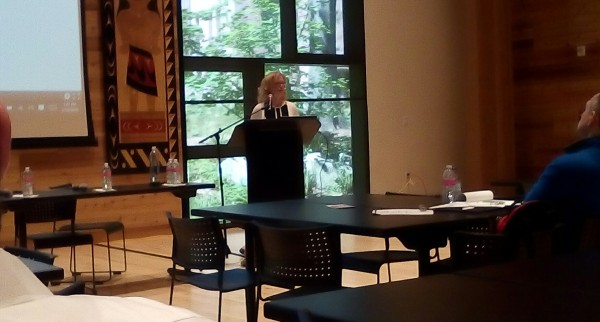
Kate Fort Speaking on Challenges to the ICWA Guidelines

IMG_20160512_173651_138 crop

AFCARS Comments Due May 9

As we previously posted, for the first time, the federal government is proposing to collect data on state ICWA cases. If you, or your employer, or your tribe are willing to let the feds know you think this is a good idea, please submit comments by MAY 9 over here.

Want to submit something but aren’t sure what to write or don’t have time to research all of these acronyms? We have you covered:

Model comment for in-house counsel from MSU

Model comment for tribes from NARF

Model comment for tribes/tribal social services from NICWA.

ICWA Guidelines Presentation to Utah Juvenile Judges

IdahoJudges

Just got to the hard part when they took the picture!

Minneapolis ICWA Law Center Video

One of our very favorite groups we get to work with has a beautiful new video up:

Password: icwa

The Minneapolis ICWA Law Center represents parents in ICWA cases, among other things.

Fletcher & Singel on the Historical Basis for the Trust Relationship between the US and Indian Children

Fletcher & Singel have posted “Indian Children and the Federal Tribal Trust Relationship” on SSRN.

Here is the abstract:

This article develops the history of the role of Indian children in the formation of the federal-tribal trust relationship and comes as constitutional challenges to the Indian Child Welfare Act (ICWA) are now pending. We conclude the historical record demonstrates the core of the federal-tribal trust relationship is the welfare of Indian children and their relationship to Indian nations. The challenges to ICWA are based on legally and historically false assumptions about federal and state powers in relation to Indian children and the federal government’s trust relationship with Indian children.

Indian children have been a focus of federal Indian affairs at least since the Framing of the Constitution. The Founding Generation initially used Indian children as military and diplomatic pawns, and later undertook a duty of protection to Indian nations and, especially, Indian children. Dozens of Indian treaties memorialize and implement the federal government’s duty to Indian children. Sadly, the United States then catastrophically distorted that duty of protection by deviating from its constitution-based obligations well into the 20th century. It was during this Coercive Period that federal Indian law and policy largely became unmoored from the constitution.

The modern duty of protection, now characterized as a federal general trust relationship, is manifested in federal statutes such as ICWA and various self-determination acts that return self-governance to tribes and acknowledge the United States’ duty of protection to Indian children. The federal duty of protection of internal tribal sovereignty, which has been strongly linked to the welfare of Indian children since the Founding, is now as closely realized as it ever has been throughout American history. In the Self-Determination Era, modern federal laws, including ICWA, constitute a return of federal Indian law and policy to constitutional fidelity.

Remedies Brief Filed in Oglala Sioux Tribe v. Fleming (Van Hunnik)

After winning a partial summary judgment (twice, if you count the motions for reconsideration), the plaintiffs in the federal class action ICWA/Due Process lawsuit have filed their brief requesting remedies.

Remedy Brief

The four Defendants in this action are largely ignoring this Court’s summary judgment ruling of March 30, 2015, Oglala Sioux Tribe v. Van Hunnik, 100 F. Supp. 3d 749 (D.S.D. 2015) (hereinafter “Oglala II”),1 in which the Court found that the Defen-dants were violating seven of Plaintiffs’ federal rights. Today, more than a year later, the Defendants continue to commit six of those violations, and only partially halted the seventh. As a result, more than one hundred additional Indian families have suffered the injuries Oglala II intended to prevent, and new families fall victim every week.

***
Mr. Hanna had previously written Judge Robert Mandel, the Seventh Judicial Circuit judge who heard most of the 48-hour hearings in 2015, to see if he would convene a meeting with Mr. Hanna and representatives from the States Attorney’s Office and Dakota Plains Legal Services to discuss how this Court’s summary judgment ruling could be implemented in the Seventh Circuit’s 48-hour hearings. Judge Mandel declined, and attached to his response a telling article entitled: “Federal law in the state courts: The freedom of state courts to ignore interpretations of federal law by lower federal courts.” (This correspondence and the article are attached as Plaintiffs’ Exhibit 2R). To Plaintiffs’ knowledge, in not one 48-hour hearing in 2015 did Judge Mandel incorporate the procedural protections this Court held in Oglala II are required by the Due Process Clause of the Fourteenth Amendment.

Updated List of Designated Tribal Agents for ICWA Notice

Somehow in all of the recent ICWA-related new, we missed the March 16 release of the updated list of designated tribal agents for ICWA notice.

Here, at 81 Fed. Reg. 10887 (March 16, 2016). We did a quick control+F search in the list for “Mohawk,” and the St. Regis Mohawk designated agent for ICWA popped right up. This list should be bookmarked on every state child welfare worker’s computer.

Judge Agrees to Sanctions in Oglala Sioux v. Van Hunnik

Materials in re Oglala Sioux Tribe et. al. v. Van Hunnik et. al. (D. S.D.):

Doc 114 – Plaintiffs’ Motion For Sanctions

Doc 237 – Plaintiffs’ Stipulation to Dismiss Motion for Sanctions

Doc 238 – Order Granting Relief

Link to previous case postings here.