WSJ Article on Asian Carp Issue

From the WSJ via How Appealing:

[SEPARATE]

More than a century ago, this city reversed the flow of its eponymous river, connecting the Great Lakes with the Gulf of Mexico and defining itself as the can-do capital of the American heartland.

Today, that engineering feat is coming under growing scrutiny, as scientists and politicians intensify their battle against a voracious flying fish that has been traveling up the Mississippi for 20 years. Amid signs that Asian carp have breached the last defensive barrier, calls are mounting for a massive do-over.

“We know these barriers aren’t working,” said Joel Brammeier, president of the Alliance for the Great Lakes and the lead author of a 2008 report that laid out how this project might look. “An ecological separation is the only permanent solution.”
Continue reading

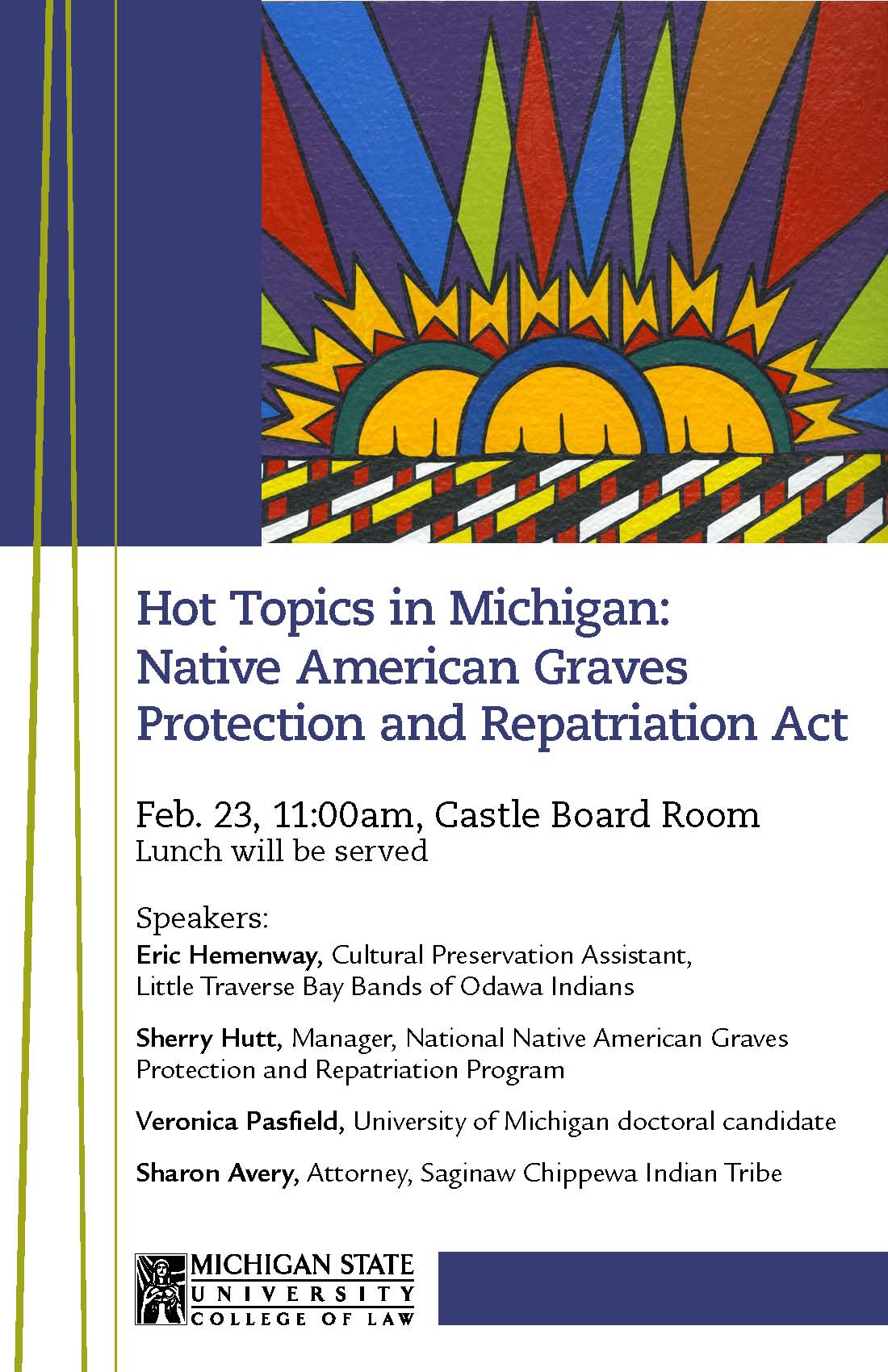
ILPC Event: Hot Topics in Michigan — NAGPRA (Feb. 23)

Fletcher, Fort, and Singel on Michigan Indian Country Cross-Deps

Indian Country Law Enforcement and Cooperative Public Safety Agreements
Michigan Bar Journal, Vol. 89, p. 42, February 2010, MSU Legal Studies Research Paper No. 08-02
Matthew L. M. Fletcher , Kathryn Fort and Wenona Singel

NHBPI Pays Nearly $2M in Revenue Sharing to Local Governments

Wow.

From the B.C. Enquirer (via Pechanga):

Besides its Aug. 5 opening, Friday was arguably the most important date in FireKeepers Casino’s short history, because the community got its share of the profits.

The Tribal Council of the Nottawaseppi Huron Band of Potawatomi, FireKeepers’ owners, on Friday morning presented a check for $1,933,683.41 to the FireKeepers Local Revenue Sharing Board. That money will reimburse local governments for increased costs attributable to the Emmett Township casino or the tribe’s Pine Creek Reservation in Athens Township, and also for revenue lost because tribal land is untaxable.

The money represents 2 percent of the casino’s slot revenue from its Aug. 5 opening to the Dec. 31 close of its fiscal year. The tribe is required to pay that money to local governments through a compact with the state.

The money is more than double what the tribe expected to pay the LRSB.

“We thought for a year we would be presenting $2 million,” said Laura Spurr, Tribal Council chairwoman. “This is for five months.”

“This money is to help us better the entire community,” said Mike Rae, the Calhoun County board chairman who on Friday was elected chairman of the LRSB. He spoke to the board via speakerphone from Florida. Continue reading

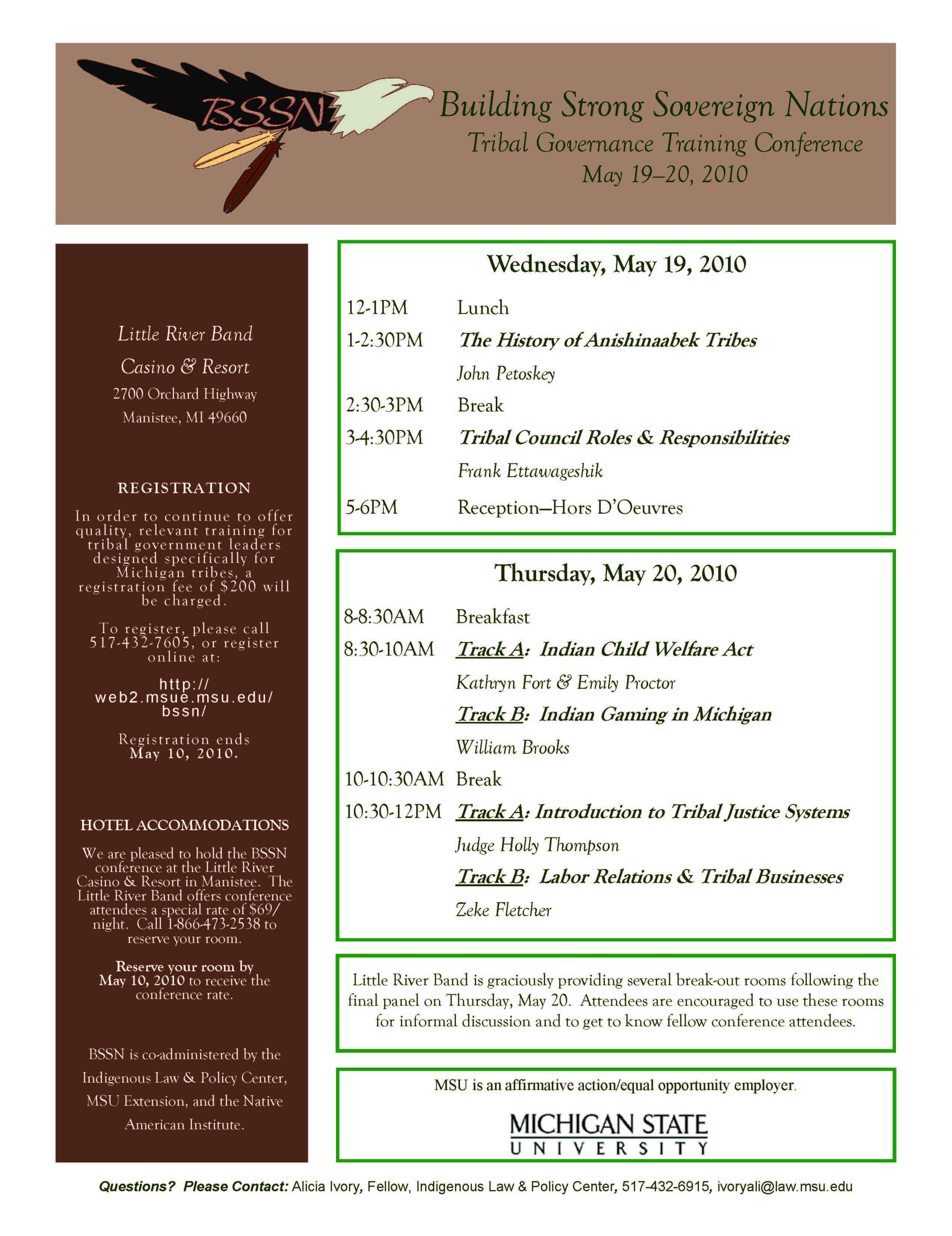
Building Strong Sovereign Nations SAVE THE DATE May 19-20, 2010

Registration here — now open.

Mackinac Bands Constitution Developed

From Indianz:

The Mackinac Bands of Chippewa and Ottawa Indians of Michigan are asking the Bureau of Indian Affairs to be treated as a federally recognized tribe.

The Mackinac Bands are considered a part of the federally recognized Sault Ste. Marie Tribe of Chippewa Indians. But the bands say they are a distinct and self-governing tribe.

The bands wrote a new constitution to reflect their status.

Get the Story:

New Anishinabe Constitution presented (The Cheboygan Daily Tribune 2/12)

U.S. v. Crampton — Former LRB Boxing Commissioner Sentenced for Threatening Tribe

News article here, via Pechanga.

Materials:

Crampton Indictment

Crampton Sentencing Memorandum

Crampton Sentence

Brian Upton Letter re: John Petoskey

From the Traverse City Record-Eagle:

Attorney was valued

I was disappointed that the Grand Traverse Band let go its general counsel, John Petoskey.

It is hard not to believe that this will have negative repercussions for the band. As John Wernet, Gov. Granholm’s deputy legal counsel, recently stated, John Petoskey is a highly regarded attorney.

Under his legal guidance, the band developed a productive and progressive government overseeing crucial economic development initiatives (crucial, since GTB has little land and thus no tax base with which to fund public services).

Having been lucky enough to work closely with John for five years, and having many good friends in the Grand Traverse Band community, I hope that circumstances arise so the band does not lose the resource it has in John.

His ethics and ability to combine street smarts with larger policy considerations, and community realities with the dictates of law, could be why Vine Deloria Jr., one of this country’s pre-eminent (American) Indian scholars, valued his personal and professional relationship with John.

Vine saw something in John that many others of us have also recognized — quality.

I hope the next chapter in this story recaptures the band’s decades-long history of a highly successful relationship with John. Both parties deserve nothing less.

Brian Upton
Missoula, Mont.

Michigan Bar Journal Special Indian Law Issue — UPDATED!

Here:

State Court Administrative Office – Court Improvement Program: Indian Child Welfare Act Forum Remarks, October 6, 2008
by Justice Michael F. Cavanagh

Indian Children and Termination of Parental Rights: Michigan Supreme Court Takes a Step in the Right Direction in In Re Lee
by Angel Sorrells, Cami Fraser, Thomas Myers, and Aaron Allen

Proceed with Prudence: Advising Clients Doing Business in Indian Country
by R. Lance Boldrey and Jason Hanselman

Indian Gaming and Tribal Self-Determination: Reconsidering the 1993 Tribal-State Gaming Compacts
by Zeke Fletcher

Indian Country Law Enforcement and Cooperative Public Safety Agreements
by Matthew L. M. Fletcher, Kathryn E. Fort, and Wenona T. Singel

And I completely missed this article in the same issue (many apologies to the authors!):

In the Law: Keeping Current with American Indian Legal Resources
by Jan Bissett and Margi Heinen

Saginaw Chippewa v. Granholm Update — Court Order on Experts

SCIT Order on Michigan Experts

An excerpt:

Legal scholars have suggested a variety of solutions to the problems associated with evaluating historical testimony, including the use of neutral, court-appointed experts; requiring the judge, or a special master, to evaluate the primary source data personally; and eliminating the “reliability” prong of the Daubert test. See Maxine D. Goodman,Slipping Through the Gate: Trusting Daubert and Trial Procedures to Reveal the ‘Pseudo-Historian’ Expert Witness and to Enable the Reliable Historian Expert Witness–Troubling Lessons from Holocaust-Related Trials, 60 Baylor L. Rev. 824, 861-73 (2008). Perhaps some of those solutions would provide for more nuanced and reliable historical testimony. In this case, however, a neutral expert was not requested or appointed, the demands of the Court’s docket make independent primary-source research impracticable, and development of a new test for admissibility of historical testimony seems unnecessary. More importantly, the expert opinions provided, while perhaps flawed in some respects, are reasonably reliable and will be helpful in determining the ultimate issue in this case. Consequently, they are admissible under Rule 702, and will be considered and weighed appropriately.