Release: Third Collective Bargaining Agreement Signed at Little River Band of Ottawa Indians

Third Collective Bargaining Agreement Signed under Tribal Law

The Little River Casino Resort and the United Steelworkers Union have entered into a collective bargaining agreement covering the Resort’s EVS Bargaining Unit.  This is the third collective bargaining agreement entered into by the Resort and the Union under tribal law.

“We are proud of our Tribe’s success in governing labor and employment relations,” said Larry Romanelli, the elected Ogema of the Little River Band of Ottawa Indians.  “These three collective bargaining agreements between the Resort and the USW are concrete examples of tribal sovereignty at work.”

In 2007, the Band enacted a law governing labor unions and collective bargaining modeled on public sector labor relations laws.  The law allows collective bargaining within the Band’s public sector, which includes its gaming operations at the Little River Casino Resort.  It requires unions to hold a license from the Band, and it provides a structure for union elections, bargaining rules, and the resolution of unfair labor practice charges.  “We found much to learn from the way state governments regulate collective bargaining,” said Stephen Parsons, the elected Speaker of the Band’s Tribal Council, which enacted the law. “In the end, however, this law reflects the unique values of our Ottawa community.”

Few Indian nations have laws governing collective bargaining. The short list includes the Navajo Nation and the Mashantucket Pequot Tribal Nation.
Federal Court Denies Motion to Remand Serial DV Case to Tribal Court

Here are the materials in United States v. Pego (E.D. Mich.):

DCT Order Denying Motion

Pego Indictment

Pego Superceding Indictment

US Opposition to Pego Motion


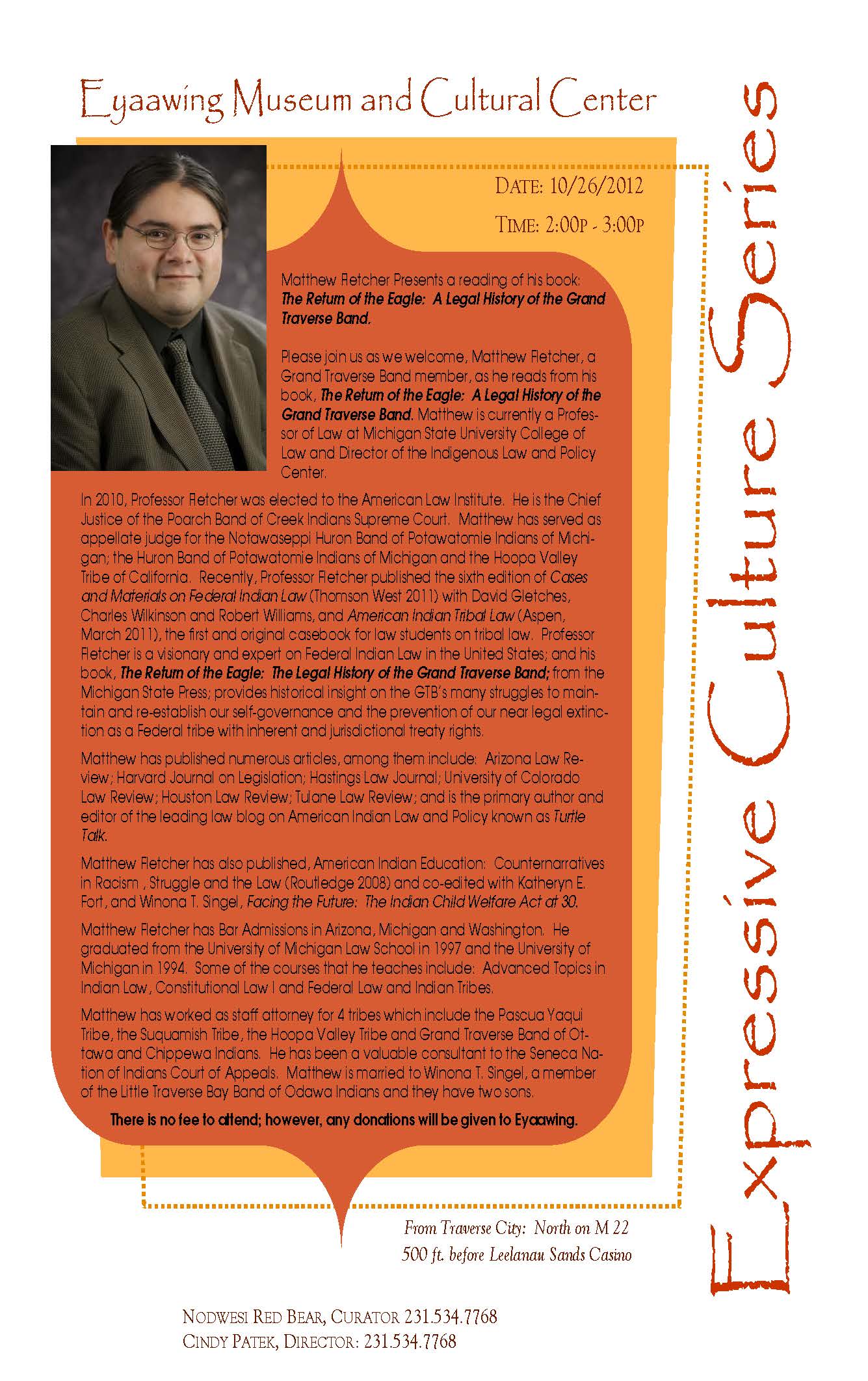
Fletcher Talk (“The Eagle Returns”) at Eyaawing Museum and Cultural Center FRIDAY

Here is the My North notice:

Eyaawing Museum and Cultural Center Presents GTB Member and Author Matthew Fletcher in Peshawbestown

Time: October 26, 2012 from 2pm to 3pm
Location: Eyaawing Museum & Cultural Center
Street: 2304 North West Bay Shore Dr.
City/Town: Peshawbestown
Phone: 231.534.7768
Event Type: literary
Organized By: Grand Traverse Band of Ottawa and Chippewa Indians

Michigan COA Applies Victimless Crimes Exception to Exclusion of State Criminal Jurisdiction in Indian Country

In other words, the Michigan COA held that the state may prosecute non-Indians for engaging in drug-related criminal activity inside the Hannahville casino. Here is the opinion in People v. Collins:

Collins Opinion

Our previous post on this case is here.

Michigan Files Cert Petition in Dispute over BMIC’s Vanderbilt Casino

Here is the petition:

Petition for a Writ of Certiorari MI v BMIC

Better pdf here: Michigan v Bay Mills Cert Petition

Questions Presented:

1. Whether a federal court has jurisdiction to enjoin activity that violates IGRA but takes place outside of Indian lands.

2. Whether tribal sovereign immunity bars a state from suing in federal court to enjoin a tribe from violating IGRA outside Indian lands.

Sixth Circuit materials here.

My earlier views on why this petition isn’t going anywhere are here. I would add now that since Bay Mills, as I understand it, hasn’t re-opened the casino, and since the State filed an amended complaint way back when, there doesn’t seem to be much pressure to grant this particular petition. Also, if this is really an IGRA fight over an allegedly illegal casino, it’s really the federal government’s fight. In fact, NIGC already referred the matter to the federal prosecutors … a while back. Michigan is trumping up an alleged compact violation that might not even exist. There might be a compact violation, or not, but the State in its petition doesn’t even point to which provision in the compact BMIC is violating (maybe they did, but I didn’t see it).

First Panel: Gaming Landscape in Michigan

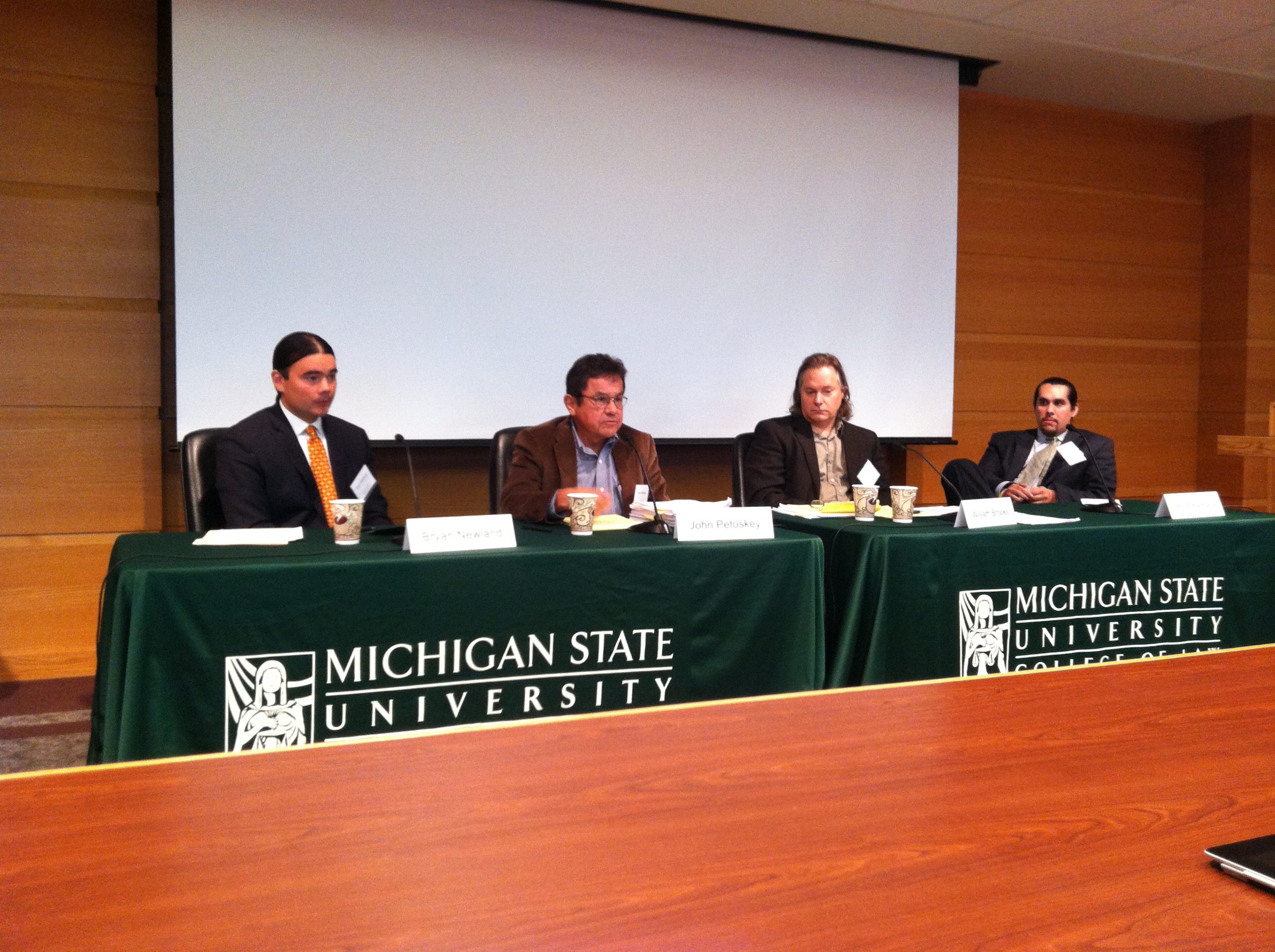
L-R, Brian Newland, John Petoskey, Bill Brooks, and moderator John Simermeyer

State News Article on MSU Indigenous Students

Here.

An excerpt:

As one of 131 American Indian students enrolled at MSU, French senior Sean Patrick works four jobs, pays his own bills and faces the looming payback of student loans after graduation.

“I am completely on my own,” said Patrick, who is not officially recognized by an American Indian tribe, but is co-chair of the North American Indigenous Student Organization, or NAISO. “When friends ask, I say, ‘No, I don’t receive any aid.’”

Today marks Indigenous People’s Day, an unofficial holiday observed as a counterweight to Columbus Day — a day to clear up some misconceptions about the heritage of American Indians.
For students with indigenous ancestry, securing financial aid can be a challenge.

US Army Corps on Great Lakes Treaty Subsistence Fishing

Last summer, the US Army Corps published a report titled “Treaty Rights and Subsistence Fishing in the U.S. Waters of the Great Lakes, Upper Mississippi River, and Ohio River Basins.” It’s well worth a read, especially for those tribes that did not respond to the Corps’ efforts to contact them. The authors wrote whatever they found online in  such cases, and we wonder how accurate those descriptions are.

For example, Menominee Tribe is listed as a non-treaty tribe. For all we know, this may be accurate. But this 1968 Supreme Court case suggests that it is not accurate.

An excerpt from the report:

The U.S. Army Corps of Engineers (USACE), in consultation with other state and federal agencies and Native American tribes, is conducting the Great Lakes and Mississippi River Interbasin Study (GLMRIS) pursuant to the Section 3061(d) of the Water Resources Development Act of 2007. GLMRIS will explore options and technologies, collectively known as aquatic nuisance species (ANS) controls that could be applied to prevent ANS transfer between the Great Lakes, Mississippi River, and Ohio River Basins through aquatic pathways. As defined in the Nonindigenous Aquatic Nuisance Prevention and Control Act of 1990, 16 U.S.C. § 4702(1), ANS are nonindigenous species that threaten the diversity or abundance of native species; or the ecological stability of infested waters; or commercial, agricultural, aquacultural, or recreational activities that depend on such waters. In support of GLMRIS, the USACE GLMRIS Fisheries Economics Team is conducting baseline studies of fisheries in the Great Lakes, Mississippi River, and Ohio River Basins. This study focuses on a unique sector of the fisheries — the subsistence fishery undertaken by Native American tribes under treaty rights.

Keweenaw Bay Indian Community Release on UN Special Rapporteur Recommendations re: Eagle Rock

Here is the release:

Media Release_KBIC 9-26-12

Above is the media release from the Keweenaw Bay Indian Community in regards to a recent report released by the United Nations.The full report is available at here. A UN news release is available here.

IPR: LTBB Plans Casino In Mackinaw City

Here. Hey, imagine that. An Indian tribe staying within its traditional territory to engage in gaming.