Here.
Update on Proposed Rescission of Roadless Rule: pdfs of all 2025 Tribal comments are available in Vol. III of the EIS
Here.
Here.
On August 20, 2026, USDA published a proposed rule to rescind the 2001 Roadless Area Conservation Rule, which has restricted road construction, road reconstruction, and timber harvesting across approximately 44.7 million acres of National Forest System lands for the past quarter century. The proposal would replace the existing rule’s nationwide layer of protection and return more decisions about roadless areas to individual forest plans and project-level review.
Alongside the proposed rule, USDA released a 333-page Draft Environmental Impact Statement, a cost-benefit and regulatory-flexibility analysis, and a Tribal Summary Impact Statement. (Links to these documents are below.)
Comments on the proposed rule are due September 21, 2026. The docket is FS-2025-0001.
This isn’t the first time Tribes have weighed in. USDA’s August 2025 Notice of Intent opened a scoping comment period that drew more than 220,000 comments, with about 99% opposed to the rescission. Based on the ILPC’s analysis, the comments included 42 written submissions from 38 distinct Tribal governments and organizations. Scoping comments, however, only shape what an agency studies, and a court asked to review the eventual final rule will look at the record as it stands when the agency acts. As a result, the current 30-day comment period is fundamentally different from the one in 2025, since it’s the last opportunity to place Tribe-specific evidence, legal argument, and disagreement with USDA’s reasoning into the administrative record before the rule is finalized.
The ILPC is sharing four documents to help Tribes and their staff and counsel use that opportunity
a. The first document is a list of tribal comments submitted during the fall 2025 window and found by the ILPC in response to the Notice of Intent. The document includes links to each tribe or tribal organization’s comments.
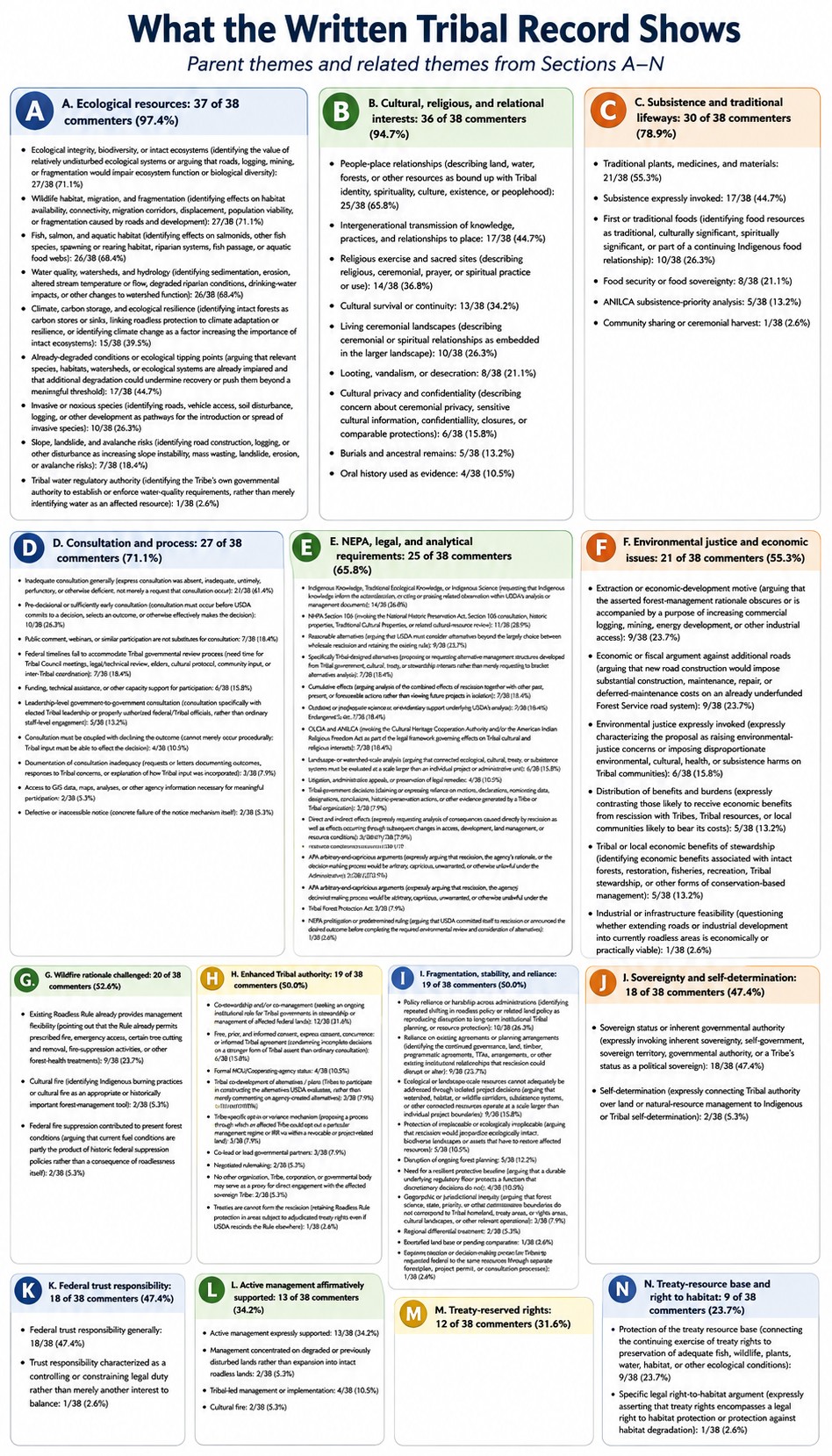
b. The second document, The Tribal Administrative Record on the Roadless Rule, is an ILPC independent empirical review of the 38 distinct Tribal comments filed in 2025. Rather than starting from USDA’s own categories, the ILPC coded the submissions and measured how often fourteen recurring themes appear, from near-universal concerns about ecological resources (94.7%), and cultural and religious interests (94.7%), to concerns raised by roughly half of commenters about consultation adequacy and enhanced Tribal governmental authority beyond ordinary consultation. It then compares that record against USDA’s 2026 Draft EIS line by line. Our finding: USDA’s Draft EIS rhetorically recognizes Tribal sovereignty, treaty rights, and trust obligations. It also concludes that full rescission, the alternative it proposes, would create the greatest potential for adverse effects on Tribal rights and interests of any alternative it studied. The gap this record exposes isn’t whether USDA heard Tribes. It’s what the agency did about what it heard.
b. The third document, Strategic Considerations for Tribal Nations in the 2001 Roadless Rule Rescission Comment Period, moves to strategy. It walks through the administrative law tools a comment filed now can use, including arbitrary and capricious review, record preservation and issue exhaustion doctrine, NEPA’s alternatives requirement, NHPA Section 106, and treaty rights claims where they apply, and explains why the strongest comments this round will do more than restate 2025 positions. The most impactful comments submitted now will name an impact, identify USDA’s specific response in the documents it published in the docket on August 20, and explain concretely why that response does or doesn’t hold up. The memo also addresses the administration’s simultaneous move to weaken the protections of NHPA Section 106 through a proposed rule that is expected to be published soon. If NHPA 106 protections are administratively weakened, Tribes will face a multiplication of interventions as decision-making is returned to the land management planning process at the individual national forest level, on top of diminished leverage under a weakened 106 regime.
The strategic considerations memo also flags a separate problem ILPC ran into directly. USDA’s Tribal Summary Impact Statement rests heavily on 29 completed (and 34 scheduled) government-to-government consultations (out of 64 Tribal requests for consultation), but the underlying consultation records aren’t in the public docket, and ILPC couldn’t locate any posted log of them. After an August 28 letter to the Forest Service’s Office of Tribal Relations went unanswered, ILPC filed a formal FOIA request the same day. Because of FOIA’s ordinary processing timeline, that request may not be resolved before the comment period closes. As it stands, Tribes and the public are being asked to evaluate USDA’s account of what it heard in consultation without being able to see the records that account is based on. That timing problem is itself worth putting directly into a comment.
Below is a full set of links to the docket, including the proposed rule, the complete Draft EIS, the Tribal Summary Impact Statement, the economic analysis, and the ILPC-generated documents referred to above.
Additional Resources
Link to the Docket for the 2001 Roadless Rule Rescission
List of Tribes with Comments Submitted Fall 2025 (with links) UPDATE: pdfs of all Tribal comments are included in Vol. III of the EIS.
ILPC Memo: The Tribal Administrative Record on the Roadless Rule
ILPC Graphic: Chart of Tribal Comments Grouped by Theme
ILPC Memo: Strategic Considerations for Tribal Nations in the 2001 Roadless Rule Rescission Comment Period
ILPC Email to FS OTR for Consultation Records
ILPC FOIA Request to FS OTR for Consultation Records
NCAI Resolution Opposing the Legislative Repeal of the 2001 Roadless Area Conservation Rule and Supporting its Retention
Roadless Rule Tribal Hub : “The Tribal Hub is an informational platform created to support Tribal leaders, staff, and community members in responding to the proposed rescission of the 2001 Roadless Rule. Our goal is to ensure that Tribes have timely access to resources, information, and tools to protect sovereignty, treaty and reserved rights, and cultural lifeways throughout this federal rulemaking process.”
Tribes aren’t alone in warning that the Commodity Futures Trading Commission is exceeding its authority with its proposed rule. Criticism of the rule is also raised in comments submitted by former Senator Chris Dodd, co-author of Dodd-Frank, the legislation that amended the Commodities Exchange Act provisions at the heart of CFTC’s proposed rule; Timothy Massad, a former CFTC chair; 44 state attorneys general; and leading gaming and derivatives interests.
This is the third and final post in a series (first post; second post) on the CFTC’s proposed rule governing prediction market “event contracts.”
Former Sen. Chris Dodd, co-author of Dodd-Frank, says Congress did not authorize this
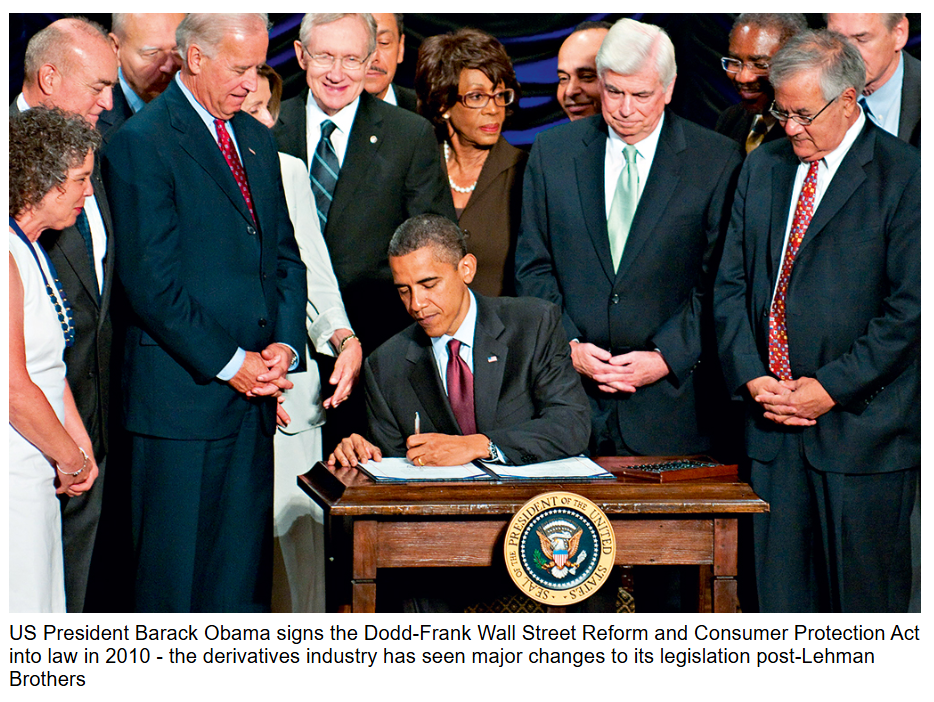
Former Senator Christopher Dodd submitted a comment stating:
The proposed regulatory amendments contradict the language and intent of the Dodd-Frank Act and promote public policies opposing what Congress clearly intended.
These amendments could well endanger consumers and promote speculation. These proposed amendments undermine the traditional police powers of states and also functionally amend the Indian Gaming Regulatory Act (IGRA), which could diminish tribal sovereignty.
A former CFTC chair says the agency has “lost its way”
Former CFTC Chair Timothy Massad opened his comment with an unusually direct statement:
“The Commodity Futures Trading Commission has lost its way . . . . Although I have not submitted comments on any rule proposal since leaving the agency, I feel it is important to do so here because the agency has lost sight of its mission and the limits of its own authority.”
Forty-four state attorneys general raise objections
A bipartisan coalition of 44 state attorneys general, led by Ohio Attorney General Andy Wilson, likewise argues:
“The CFTC in the Proposed Rule goes well beyond its statutory authority. . . . it violates both the major-questions doctrine and the federalism canon . . . . [and] clashes with the CEA’s plain text, structure, and purpose.”
Comments from the American Gaming Association and CME Group
The American Gaming Association, whose members include commercial and Tribal gaming operators, states in its comments:
The proposed rule concedes that sports event contracts involve gaming, yet creates a permissive framework designed to allow them. That approach conflicts with congressional intent, 15 years of regulatory precedent, state and federal law, and the CFTC’s own regulations. It would also displace state and tribal authority while exposing consumers and sports competitions to wagering activity without comparable licensing, geolocation, responsible gaming, integrity monitoring, or enforcement safeguards.
The CFTC is a financial markets regulator, not a national gaming commission. It lacks both the expertise and resources to replace the more than 8,400 state and tribal regulators who oversee legal gaming today. The Commission should withdraw the proposed revisions to Rule 40.11, enforce the existing prohibition on gaming event contracts, respect tribal sovereignty and states’ rights, and put an end to the unlawful nationwide expansion of sports wagering through prediction markets.
CME Group, one of the world’s largest derivatives market operators, also submitted comments, stating that “the Commission’s authority on this score is ambiguous at best, [and] deferring to Congress would be advisable.”
Each of these comments challenge the CFTC’s authority to create a nationwide market for products that function as sports betting while bypassing the federal, Tribal, and state laws that otherwise govern gaming.
The Oklahoma Indian Gaming Association’s Wins Award for Longest Comment
A final note: OIGA’s comment was the most detailed submission to the CFTC, totaling 50 pages and including 291 footnotes.
Last Friday we posted on the Advisory Council on Historic Preservation’s move to weaken Section 106’s consultation requirements. We emphasized that the proposed rule, which hasn’t yet been published in the Federal Register, may include a short window of 30 days for submission of comments.
Likely Problems with an Anticipated Short 30-Day Comment Window
Thirty days is notably short, not consistent with best practices identified by EO 13563(2)(b) and EO 12866(6)(a)(1), and unlikely to afford sufficient opportunity for meaningful Tribal participation. Once the NPRM is published, Tribes will need to share the draft with their THPOs, legal counsel, natural resources and cultural staff, executive leadership, and Tribal Council before submitting their comments. The process for Tribal government preparation of comments is profoundly different than national industry associations and corporations, which have dedicated regulatory counsel whose jobs are dedicated to monitoring and immediately responding to federal rulemaking. If ACHP publishes the notice of proposed rulemaking with only 30 days for comments, Tribes and their advocates could consider immediately requesting an extension to at least 60 or even 90 days. The argument would be that given the breadth of the proposed revisions and the consultation and internal review required for affected Tribes, a longer period is necessary to provide a meaningful opportunity for informed comment.
Tribes Can Request a Meeting with OIRA within OMB to Address Changes to Section 106 Now
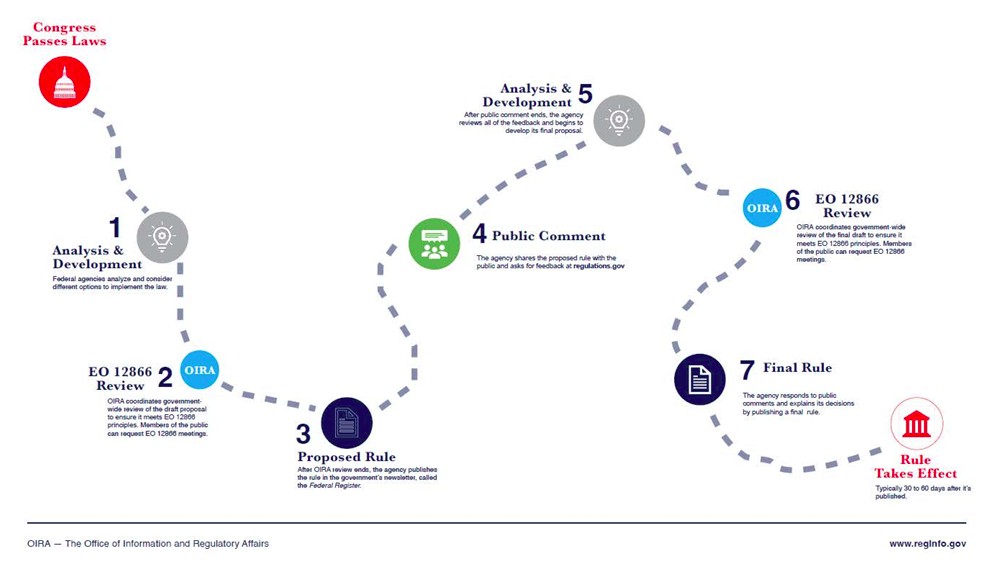
Tribes and other interested parties don’t have to wait for the comment period to engage. They can weigh in now by requesting a meeting with the Office of Information and Regulatory Affairs (OIRA) within OMB. OIRA review isn’t just an internal federal process conducted behind closed doors. Interested parties, including Tribes, can request meetings while regulatory actions are under review. Regulated industries routinely use these opportunities, and Tribes should know that the same opportunity is available to them. All Tribes should know that they don’t have to wait until the proposed rule is published in the Federal Register to make their concerns known.
The link to request a meeting is here. To request a meeting, you’ll need to provide the Regulatory Identification Number (RIN) for OIRA’s current review of amendments to the Implementing Regulations for Section 106. The RIN is 3010-AA10. OIRA’s role in the rulemaking process is described in EO 12866.
There are no OIRA meetings currently scheduled with Tribes or Tribal organizations regarding its consideration of changes to Section 106 regulations, although the National Association of Tribal Historic Preservation Officers (NATHPO) reports that they submitted a request for a meeting on August 11. So far, OIRA met with Edison Electric Institute on August 13, and it has meetings scheduled for the Society for American Archaeology, the Wisconsin SHPO, the WA Dept of Archaeology and Historic Preservation, Agora Consulting LLC on behalf of the American Cultural Resources Association, and the National Conference of State Historic Preservation Officers.
A How To Guide for EO 12866 meetings (Meetings on a Regulatory Action under Review with the Office of Information and Regulatory Affairs) is available on the OIRA website here.
The Advisory Council on Historic Preservation voted 16–5 on July 24 to advance a Notice of Proposed Rulemaking that would substantially rewrite 36 C.F.R. Part 800, which implements Section 106 of the National Historic Preservation Act. Section 106 is a cornerstone provision of NHPA that gives Tribes a formal role in ensuring that federal agencies consider impacts to sacred places, ancestral landscapes, and other historic properties of religious and cultural significance before making decisions that may affect them.
The proposal isn’t yet published in the Federal Register since it’s under OMB/OIRA review, so the formal comment period hasn’t opened. A 30-day comment period is anticipated once the NPRM is published. But a draft redline is available on the War Room page of Cultural Heritage Partners, a law firm that specializes in historic and cultural heritage protection.
The National Association of Tribal Historic Preservation Officers has identified the following areas of preliminary concern on its page dedicated to the planned revisions to Section 106:
Narrowing what qualifies as an undertaking. The proposal would exclude certain state, Tribal, and local actions carried out under delegated federal authority. Other provisions would provide additional grounds for agencies to conclude that federal funding, approval, assistance, or involvement does not trigger Section 106 review. When an activity is treated as outside the definition of an undertaking, the agency generally has no obligation under Section 106 to identify historic properties, consult with affected Tribal Nations, assess effects, or consider ways to avoid or address harm.
Excluding certain natural and cultural places from the definition of historic property. The proposal would generally require a place to be geographically compact and connected to tangible human improvements or specific human activities. It further states that “noncompact, unimproved natural features such as mountains, valleys, bodies of water, or landscapes, including ethnographic landscapes, do not qualify as property” for Section 106 purposes. This could exclude places whose significance arises from continuing religious and cultural practice, subsistence, oral tradition, place names, cultural responsibility, ceremony, and enduring relationships among Tribal people, ancestors, land, water, plants, and animals.
Not every Tribal cultural place can be reduced to a tightly bounded parcel or identified through buildings, archaeological deposits, or other visible physical remains. Some places are understood through relationships among multiple locations, waterways, mountains, gathering areas, travel routes, viewsheds, and ceremonial settings. The absence of tangible human improvements does not make those places less sacred, less culturally significant, or less deserving of consideration.
Reducing Tribal and THPO participation. The draft removes provisions that give Tribes a reasonable opportunity to identify concerns, advise agencies on the identification and evaluation of historic properties, explain how an undertaking may affect those properties, and participate in resolving adverse effects. It also reduces THPO involvement at several stages, shifts more findings and decisions to the agency official, and moves the role of consulting parties toward commenting on an agency-prepared report.
Consultation is not meaningful when a Tribe is presented with a substantially completed agency analysis and given only a limited opportunity to respond. It must begin early enough for Tribal knowledge, concerns, and recommendations to influence identification, evaluation, effects analysis, project alternatives, and the resolution of harm.
Removing recognition of Tribal expertise and legal context. The draft deletes language recognizing the special expertise of Indian Tribes in assessing the eligibility of properties of religious and cultural significance. It also removes express references to the government-to-government relationship, Tribal sovereignty, treaty rights, and the fact that culturally significant places are often located on ancestral, aboriginal, or ceded lands.
Tribal Nations are sovereign governments, not members of the general public or sources of supplemental cultural information. General assurances that the regulations do not alter Tribal sovereignty or treaty rights do not resolve the concern if the operative provisions reduce Tribal involvement or disregard Tribal expertise.
Narrowing the effects considered. The proposal would remove references to indirect and cumulative effects and limit adverse effects to “only those reasonably foreseeable effects that have a reasonably close causal relationship to the undertaking.” It would also remove specific recognition of changes to a property’s use or setting and the introduction of visual, atmospheric, or audible elements as potential adverse effects.
These changes are especially significant for sacred places and cultural landscapes. A place may be harmed through changes to access, setting, privacy, sound, visibility, water, vegetation, ceremonial conditions, or the ability of Tribal citizens to continue religious and cultural practices. Those effects can be profound even when a project does not excavate, demolish, or physically alter the place itself.
Expanding agency control over the process. The draft provides that an agency official “may alter any deadline in this part, to be shorter or longer.” Agencies would also have greater control over the area of potential effects, the scope of identification, agency findings, and the consideration of comments from consulting parties.
The proposal would allow an agency to prepare a consolidated Section 106 report containing its identification, effects analysis, and proposed response before circulating that analysis for comment. This risks transforming consultation from a collaborative planning process into an opportunity to react to conclusions the agency has largely developed on its own.
The draft would also allow an agency official to treat matters addressed only briefly or left unaddressed as intentionally omitted because the agency considered them “comparatively unimportant or frivolous.” That is especially concerning where an agency does not understand or gives insufficient weight to Tribal knowledge, cultural values, or effects identified by a Tribe.
Replacing negotiated outcomes with agency decisions. The proposal would move away from memoranda of agreement and toward agency-issued memoranda of decision. The agency could determine how it will address effects or conclude that “other considerations outweigh” historic preservation concerns. This would allow the agency to consult, decline to secure agreement on how adverse effects will be addressed, and document its own decision to proceed.
Expanding exemptions and procedural off-ramps. The proposal encourages broader use of exemptions and other mechanisms through which categories of undertakings or programs could avoid full Section 106 review. The accompanying notice describes an intent to create additional “on- and off-ramps” and make Section 106 exemptions function more like categorical exclusions under the National Environmental Policy Act.
Section 106 and NEPA serve different statutory purposes. A determination that an activity has no significant environmental effect under NEPA does not establish that it cannot affect a historic property or a place of religious and cultural significance to a Tribal Nation.
Making public participation discretionary. The proposal characterizes public comment as “optional, not mandatory” and would largely leave the decision whether to seek public input to the agency official. This would reduce opportunities for affected communities, local governments, preservation organizations, and members of the public to identify properties, raise concerns, and inform agency decisions.
For further reaction and analysis: Earthjustice’s statement calls the proposal a “federal attack” on one of the few laws requiring the government to consult tribes before approving projects; Holland & Knight’s summary walks through the regulatory mechanics and what happens next.
Here is the complaint in Swinomish Indian Tribal Community v. National Marine Fisheries Service (W.D. Wash.):

Here:
Here.
From the site:
Federally recognized Tribal governments maintain inherent sovereignty, treaty and reserved rights, and ancestral connections to approximately 44.7 million acres of inventoried roadless areas across 36 states now threatened by the USDA’s proposed rescission of the 2001 Roadless Area Conservation Rule. Tribal Nations’ traditional territories, sacred sites, and subsistence resources within these lands predate the existence of the Forest Service itself. The federal government’s failure to conduct prior consultation violates Executive Order 13175, USDA Departmental Regulation 1350-002, and trust responsibilities.This hub provides Tribal governments with a central source of comprehensive resources, template documents, and strategic tools.



You must be logged in to post a comment.