Here is the opinion in Merit Energy Company LLC v. Haaland.
Briefs:

Here is the report.
From the press release:
The Department of Justice announced today that it found reasonable cause to believe that the State of Alaska violates the Americans with Disabilities Act (ADA) by failing to provide community-based services to children with behavioral health disabilities, relying instead on segregated, institutional settings — specifically, psychiatric hospitals and psychiatric residential treatment facilities. This finding comes at the conclusion of the department’s investigation into whether Alaska subjects children with behavioral health disabilities to unnecessary institutionalization in violation of Title II of the ADA.
“Each year, hundreds of children, including Alaska Native children in significant number, are isolated in institutional settings often far from their communities,” said Assistant Attorney General Kristen Clarke of the Justice Department’s Civil Rights Division. “Most of these children could remain in family homes if provided appropriate community-based services. We look forward to working with Alaska to bring the State into compliance with federal law and prevent the unnecessary institutionalization of children.”
Children who are segregated in psychiatric residential treatment facilities commonly stay there longer than six months, and some of them are sent to states as distant as Texas and Missouri, thousands of miles from their families.
The department’s investigation found that Alaska’s system of care is heavily reliant on institutions and that key community-based services and supports needed to serve children with behavioral health disabilities in family homes, such as home-based family treatment, crisis services and therapeutic treatment home services, are often unavailable. As a result, many children with behavioral health disabilities, including a substantial number of Alaska Native children, are forced to endure unnecessary and unduly long admissions to psychiatric hospitals and psychiatric residential treatment facilities both within Alaska and in states across the country.
With today’s announcement, the department has concluded its third investigation in 2022 involving the unnecessary institutionalization of children with behavioral health disabilities.
On November 18, 2022, the Hopi Tribe, Navajo Nation, Ute Mountain Ute Tribe, and the Pueblo of Zuni moved to intervene in two lawsuits in the U.S. District Court for the District of Utah regarding the Bears Ears National Monument. The Court granted the motions to intervene.
Order granting intervention here:
Motions can be seen here and here.

Bears Ears at Sunset. Photo credit: Tim Peterson.
Here are the new materials in Alabama-Quassarte Tribal Town v. First National Bank and Trust (E.D. Okla.):
Prior post here.
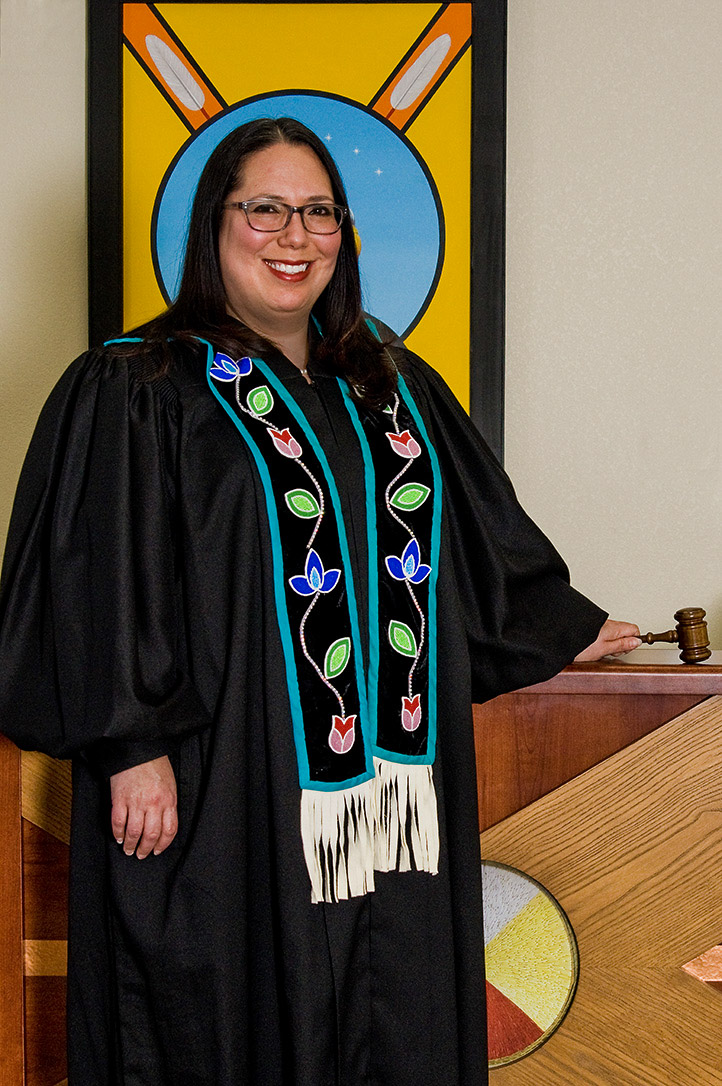
Judge Allie Greenleaf Maldonado will be the first Native person to serve on the Michigan Court of Appeals. The historic appointment was announced by Governor Gretchen Whitmer today during the annual Michigan Tribal Summit in Sault Ste. Marie. Congratulations to Judge Maldonado!!
Judge Maldonado currently serves as the Chief Judge of the Little Traverse Bay Bands of Odawa Indians Tribal Court. Prior to her service as Chief Judge, she served as assistant general counsel for LTBB from 2002-2012. Judge Maldonado also worked as a lawyer for the Indian Resources Section of the U.S. Department of Justice’s Environment and Natural Resources Division. Maldonado earned her JD from the University of Michigan Law School, and she holds a Bachelor of Science in Business from the City University of New York. She’s a nationally recognized expert on the Indian Child Welfare Act.
“I am humbled and honored to be trusted by Governor Whitmer for this appointment to the Michigan Court of Appeals,” Judge Maldonado said in a statement. “I look forward to taking all of my professional experience and diligently applying it to the work ahead of me. This is a moment of importance not just for me but for all of Indian Country, as the Governor’s wisdom in this appointment sends a message about the critical importance of the work of tribal courts. I am grateful to the Governor and her team, and I look forward to giving all of Michigan my best.”
Judge Maldonado’s appointment fills a partial term following the retirement of Judge Amy Ronayne Krause. Judge Maldonado’s term will begin January 9, 2023 and expire on January 1, 2025. If she wishes to continue to serve on the Michigan Court of Appeals after that date, she would be required to run for reelection in November of 2024.
This case is about whether the Montana Human Rights Bureau can enforce state law on Blackfeet Nation land. Here is the brief in support of the motion to intervene.
And here is the order granting intervention.
More on the case here.
Here is the Complaint.

Here are newish materials in Pakootas v. Teck Caminco Metals (E.D. Wash.):


 Turtle Talk
You must be logged in to post a comment.