Here are the materials in Blue Lake Rancheria v. Morgenstern (E.D. Cal.):
Blue Lake had prevailed in the Ninth Circuit before.
Here are the materials in Blue Lake Rancheria v. Morgenstern (E.D. Cal.):
Blue Lake had prevailed in the Ninth Circuit before.
Here.
Here, NWS purposefully targeted the Oklahoma cigarette market and reaped the economic benefit of selling cigarettes in Oklahoma. Defiantly, NWS continued to import and distribute contraband Seneca cigarettes into Oklahoma and reap millions of dollars from the sale of the contraband cigarettes to Oklahoma consumers for more than two years after Oklahoma’s chief law enforcer filed this suit. NWS may not evade the public policy embodied in the MSA, the Escrow Statute, and the Complementary Act and thereby shift the burden of tobacco-related health care costs to the State. Disgorging gross receipts that NWS, a cigarette importer and distributor, received when it intentionally distributed contraband cigarettes into the Oklahoma market in violation of the Complementary Act is no more excessive than seizing and forfeiting contraband cigarettes from a cigarette distributer or wholesaler.22 NWS’ claim to Eighth Amendment protection minimizes the egregiousness of its flagrant disrespect for Oklahoma, our laws, and our citizens.
¶38 NWS had gross receipts that totaled at least $47,767,795.20 from the sale of contraband Seneca cigarettes for resale in Oklahoma from August of 2006 to August of 2010. Based upon the Complementary Act, the settled law of the case, and the undisputed material facts on summary judgment, the summary judgment was proper, and the district court did not abuse its discretion in denying NWS a new trial.
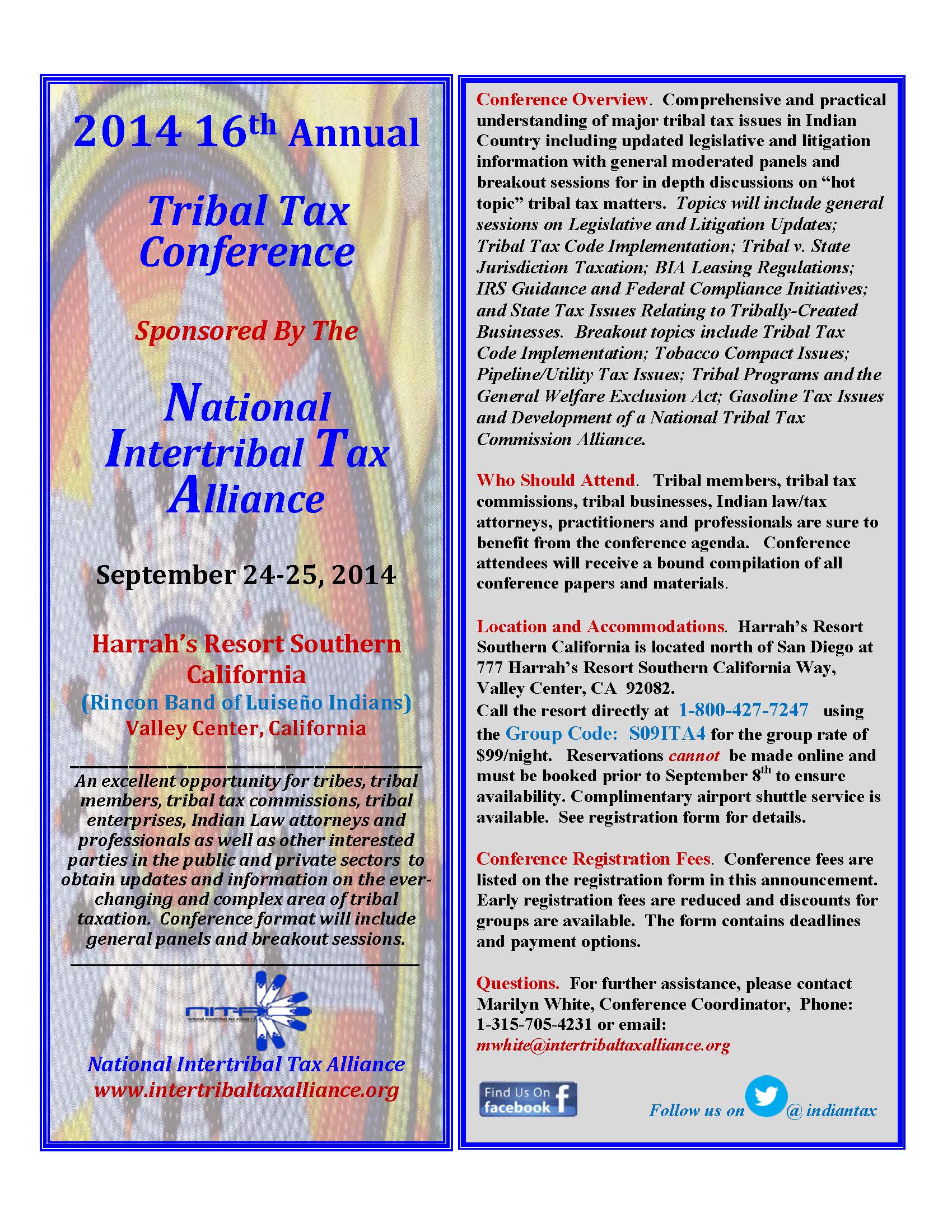
Here, with agenda, (PDF):
Decision here.
Briefs here.
Lower court briefs and decision here.
For various reasons, this might be a good case for en banc review by the 11th Circuit. First, one of the three judges deciding this was from the D.C. district court, sitting by designation. Second, the decision is based on an issue not briefed (which leads to a broader research question we have about federal Indian law generally–how often this happens). Third, and perhaps most importantly, the Court’s analysis of Ex Parte Young an issue of broader, national, concern.
The Court’s issues with equitable relief, and characterizing the relief should the Tribe win as a continued “damages” against the state because of the state’s collection regime is strange.
A declaratory judgment exempting the Tribe from the tax is the functional equivalent of ordering recurring payments of money damages. The Tribe points to no other way around the alleged constitutional violation other than a recurring refund paid to the Tribe from the Department after it precollects the tax from the fuel suppliers.
***
Unlike the tax regimes in those appeals, the only relief available to the Tribe under Florida law is a refund of taxes it will already have paid, and state sovereign immunity bars that relief. See Ford Motor Co., 323 U.S. at 463–64, 65 S. Ct. at 350.
As Judge Jordan in the dissent writes:
The majority’s opinion, as I read it, apparently would allow a state to shield the enforcement of any tax, no matter how constitutionally untenable, from challenge in federal court simply by enacting a precollection procedure.
Here are the materials in United States v. Puyallup Tribe of Indians (W.D. Wash.):
20 US Cross Motion for Summary J
21 Puyallup Cross Motion for Summary J
24 DCT Order Granting Tribe’s Motion
An excerpt:
The Government contends that, based on custom and practice, the per capita payments were fixed and determinable. The Government admits that “this is a matter of first impression” (Dkt. 22 at 16), and the Court declines to adopt the Government’s proposition that the rule that levies may attach to discretionary, yet customary payments. Just like there is no guarantee that a subsequent deposit will be made to a levied bank account, there is no guarantee that Turnipseed will receive another per capita payment. While the Tribe strives to provide for its members, it still makes a discretionary monthly decision whether it shall do so. Moreover, the fact that a payment is likely is the same as classifying a sale of personal property as likely. But, according to the regulations, a levy cannot attach until the individual has actually sold the item. Therefore, the Court concludes that the levies in question did not attach to Turnipseed’s per capita payments.
Here.
From SCOTUSblog:
13-838Issue: (1) Whether under circumstances in which a state is admittedly precluded from regulating an Indian it is also precluded from regulating a corporation wholly owned by an Indian and organized under the laws of a federally recognized tribe; (2) whether, under a state law that purports to give the attorney general power to “approve” all cigarettes before they may be imported into Idaho, the State of Idaho can prohibit an Indian-owned business on the Coeur d’Alene reservation from importing into that reservation cigarettes that are sold “FOB Seneca Nation” by a company wholly owned by a member of the Seneca Nation and licensed by the Seneca Nation to carry on such trade; (3) whether the State of Idaho’s cigarette-sale statutes are preempted to the extent that they are enforced in a manner that prohibits Native Wholesale Supply Company (“NWS”) from trading with Warpath Inc. (“Warpath”); and (4) whether the State of Idaho can constitutionally exercise personal jurisdiction over NWS, an Indian-chartered entity located on Seneca Nation of Indians Land, situated within the geographic boundaries of the State of New York, where NWS sells the tobacco products “FOB Seneca Nation” to Warpath, and the products are then transported to Warpath’s place of business on the Coeur d’Alene reservation.
The Court declined to review Quantum Entertainment Ltd. v. Dept. of Interior. Order list here.
Lower court materials here.
Cert stage briefs:
Quantum Entertainment Cert Petition
 Turtle Talk
You must be logged in to post a comment.