Here is “AVCP aims to establish tribal court in every YK village” from Alaska Public Media.
The article features the great Monique Vondall-Rieke!
Here is “AVCP aims to establish tribal court in every YK village” from Alaska Public Media.
The article features the great Monique Vondall-Rieke!
“Petitioners are the non-Indian operators of a
business on a tribal reservation. Respondent Doe is a
member of the tribe. Doe seeks to hale petitioners
into his tribal court, asking the tribe to award him
millions of dollars in damages (including punitive
damages) for an alleged violation of unwritten tribal
tort law by one of petitioners’ employees.”
Additional Briefs HERE
Spartans
Wolverines

At Bahweting 


Here is the order in FMC Corp. v. Shoshone-Bannock Tribes (D. Idaho):
43 DCT Order Denying Discovery
An excerpt:
To allow a litigant to conduct full-blown discovery here, after he failed to conduct discovery in the tribal court litigation, would ignore National Farmers and Iowa Mutual. Those cases directed that all issues be fully presented to the tribal court so that it might cure any problems and give the federal court the benefit of its expertise. If a due process issue like judicial bias is not fully developed through discovery before being presented to the tribal court – and the litigant simply sits on his discovery rights until he gets into federal court – the tribal court never gets a chance to review the discovery, apply its expertise, and cure any unfair judicial bias revealed by the discovery. That is antithetical to the analysis of National Farmers and Iowa Mutual.
Here is the order in Alexander v. Confederated Tribes of Grand Ronde:
Back in April 2015….
Here are the materials in Corabi v. ENPIC Inc. (D. N.M.):
Here:
Blurbs:
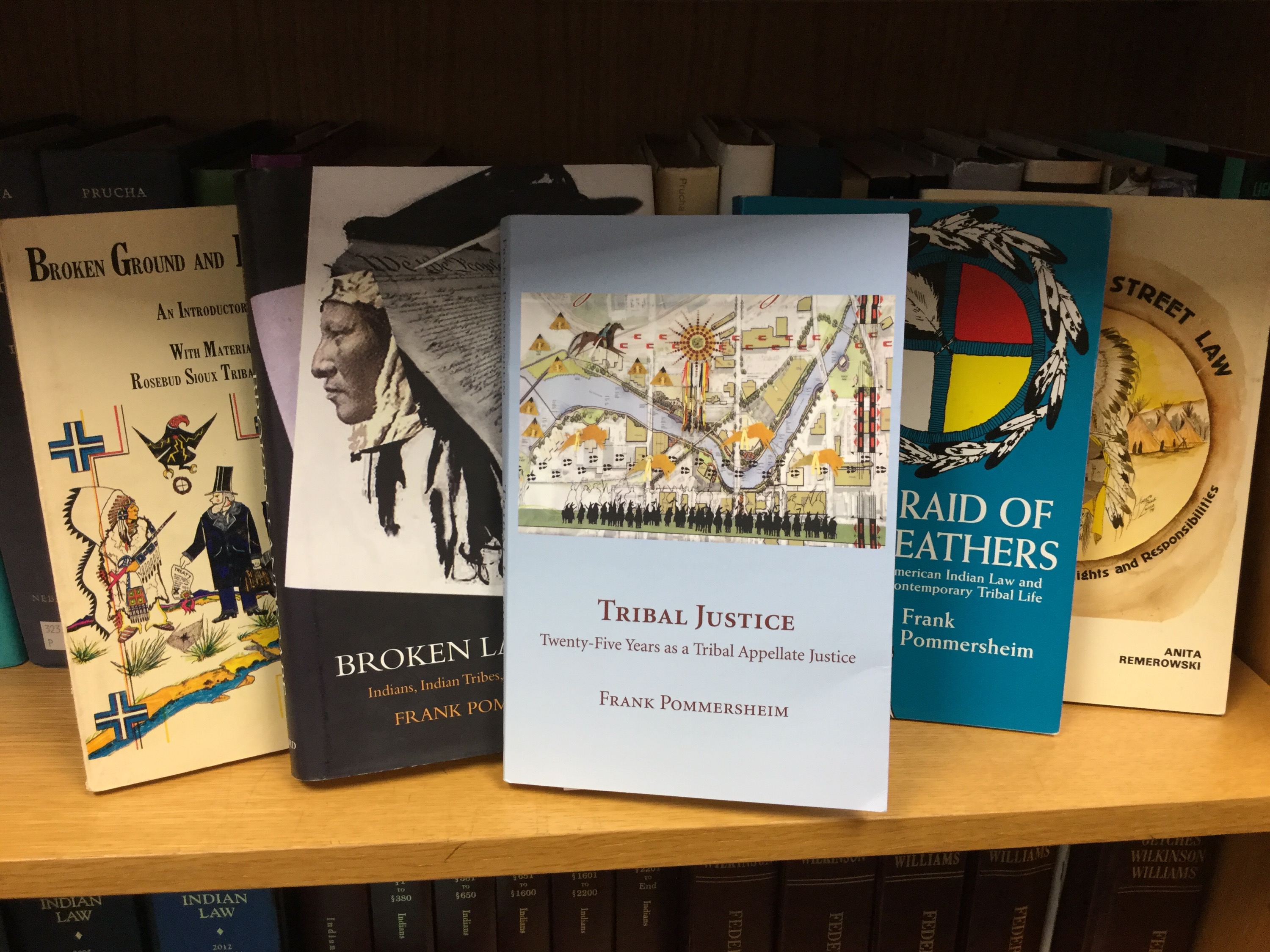
“Frank Pommersheim is the modern apotheosis of Ksa, Nanaboozhoo, Quetzalcotl, Athena, John Marshall, and the Buddha—all legends of judicial wisdom. Tribal Justice is a powerful culmination of his career work so far, and gives us all hope for another quarter century of his judgment, experience, and calm thoughtfulness. As the Buddha (probably) said, Pommersheim ponders from the stars and judges from the sky, yet speaks from the heart and writes for the land.” — Matthew Fletcher, Professor of Law, Michigan State University College of Law
“Every Tribal Judge should read this book. Written from the perspective of an able and seasoned Tribal Appellate Justice, it shares judicial perspective that is unique to members of the Tribal Judiciary. Justice is sacred. Native Justice is rooted in a world view that is starkly different than that of dominant society. We serve in Tribal communities but must deal with misguided federal law. This writing gives us guidance. Miigwetch, Frank!” — Michael Petoskey, Chief Judge, Pokagon Band of Potawatomi
“Professor Pommersheim’s new book […] is a soul-searching and compelling look at the importance of tribal courts of appeals in the development of a body of tribal law that is responsive both to the needs of tribal citizens, who adhere to traditional notions of justice, and the non-Indian community, with well-reasoned court decisions that lay out clear parameters for law and order in tribal communities. By examining individual cases from several different tribal communities, one of which was examined by the US Supreme Court and one which is about to be critiqued, Professor Pommersheim demonstrates himself to be an indispensable player in the advancement of tribal justice in numerous communities. Having been involved in some of the cases chronicled in the book, and having served with Professor Pommersheim on appellate courts for approximately 18 years, I have seen first-hand Professor Pommersheim’s commitment to ensuring that tribal appellate courts serve the needs of all litigants in tribal courts.” — BJ Jones, Chief Judge Sisseton-Wahpeton Oyate Tribal Court; Director Tribal Judicial Institute, University of North Dakota School of Law
“Only a poet could so seamlessly intertwine memoir, practical how-to, and grand vision in one remarkable book about law and life in Indian country. Tribal Justice is deeply compelling, taking the reader on a more than quarter-of-a-century ride through an extraordinary career devoted to tribal law and the people from which it springs.” — Angela Riley, Professor of Law, UCLA School of Law
“Professor and Justice Frank Pommersheim has once again written an inspiring book […] to be read and reread. His current writing and appellate opinions provide an essential guide to understanding tribal courts, specifically appellate courts. Justice Pommersheim’s book is a must read by all legal and judicial practioners and tribal, federal and state leaders to understand the importance of the Tribal judiciary in protecting and enhancing the sovereignty of tribal nations. Respectfully, he shares his life with Indian people in a most graceful, intellectual, and poetic manner and emphasizes that justice, freedom and equality is for all.” — Cheryl Demmert Fairbanks (Tlingit-Tsimpshian), Esq., Justice for the Inter-Tribal Court of Appeals for Nevada and White Earth Nation; Visiting Professor of Law, University of New Mexico’s Southwestern Indian Law Clinic
Here are materials in Dillon v. BMO Harris Bank NA (M.D. N.C.):
162 Dillion Motion to Compel re Generations
165 Bay Cities Bank Opposition
166 Generations Community FCU Opposition
An excerpt:
Using the Heldt analysis, however, Plaintiffs’ logic can be used to assert a colorable claim of tribal jurisdiction, because some of Defendants’ actions involved alleged tribal entities and/or tribal members.”). Operating against that backdrop, these courts mandated tribal exhaustion where the record did not establish (i) the nature of the payday lenders’ relationship to each other and/or the tribe; (ii) the unavailability of the specified tribal arbitral forum; and (iii) for purposes of the Western Sky agreement, (A) who constitutes an “authorized representative of the Cheyenne River Sioux Tribal Nation” and (B) whether any such authorized representative “is a JAMS or AAA arbitrator,” Heldt, 12 F. Supp. 3d at 1193 (internal quotation marks omitted).See id. at 1184-87, 1190-93; see also Brown, 84 F. Supp. 3d at 480-81 (following Heldt).
As discussed below, Dillon bases his Requests and Motions to Compel in significant part on a need to develop a factual record sufficient to overcome the concerns in the Heldt line of cases. (See, e.g., Docket Entry 162 at 1-2; Docket Entry 162-2 at 4-6.).
We posted on this Rule 19 portion of this case here.
 Turtle Talk
You must be logged in to post a comment.