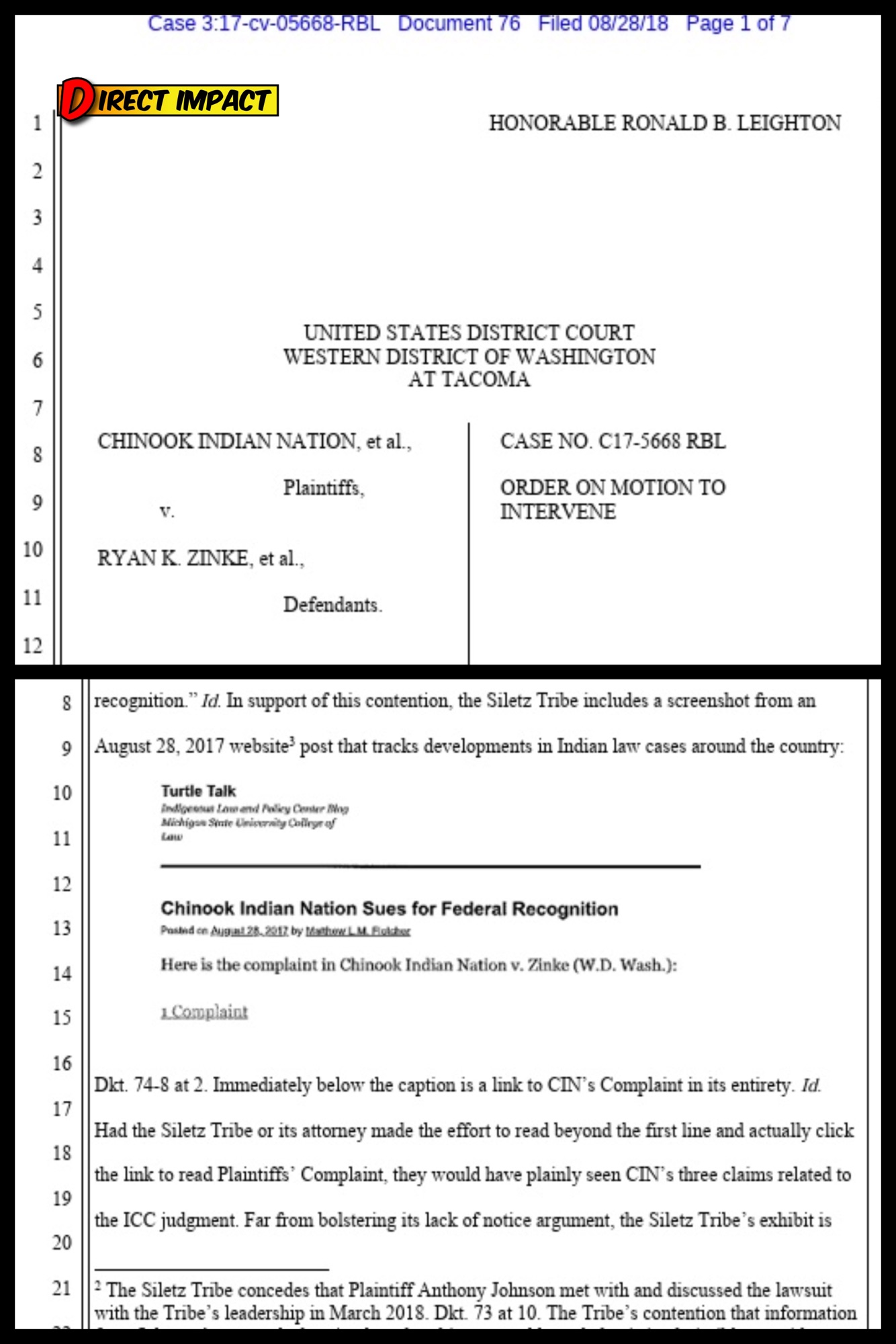
Here are the materials in Mundo v. Vandever (D.N.M.):

Here are the materials in Mundo v. Vandever (D.N.M.):


The National Native American Law Students Association (NNALSA) is excited to announce that its 34th Annual NNALSA Moot Court Competition will be hosted by Northwestern Pritzker School of Law. The Competition will take place on February 13-14, 2026, at Northwestern Law in Chicago, IL.
NNALSA was founded in 1970 to support law students who are interested in federal Indian law, tribal law, and traditional forms of governance. Each year, NNALSA sponsors a moot court competition for law students who have a passion for Indian law and litigation.
We ask for your support and invite you to be part of this exciting event by contributing as a volunteer judge. Please fill out this link to share your interest and availability. Ahehee’ (Thank you)!
If you have any questions or comments, please email Colin Tompson at mootcourt@nationalnalsa.org.
If you have a new announcement, please share it with us by uploading the information requested on this Google Form. If you have any questions, please email the MSU College of Law Indigenous Law & Policy Center at indigenous@law.msu.edu.
Water Protector Legal Collective, Remote
Develop and manage a litigation and advocacy docket that advances WPLC’s mission on behalf of Indigenous Peoples, the Earth, and climate justice movements, in close collaboration with other staff attorneys, non-attorney staff, volunteers, and grassroots community partners.
Provide high-quality representation for Water Protectors and human rights defenders, and/or recruit, coordinate, and support cooperating attorneys to ensure representation needs are met.
Movement support and community engagement: Conduct outreach to Indigenous movements and Peoples across Turtle Island to assess legal needs, develop and present CLEs, webinars, legal trainings, document human rights violations, create systems for legal support and mass defense; and provide legal research.
Supervision of interns and volunteers: In coordination with the Executive Director, recruit and supervise law student interns, law clerks, and legal worker volunteers on relevant legal work. Coordinate with cooperating attorneys and contract counsel as needed.
Public Education & Communications: Work to increase awareness of WPLC legal cases and campaigns. When appropriate, engage in public speaking, media, and movement-facing communications on behalf of the organization. Provide edits or pre-publication review to press releases or other public communications as needed.
Required Qualifications:
Indigenous Peoples, frontline communities, and grassroots movement partners
Peoples, including settler colonialism, pressures of domestic and international legal systems, impacts of extractive industry and corporate violence
Preferred Qualifications:
Knowledge of one or more of the following areas:
Federal Indian Law
Civil litigation or impact litigation
Criminal defense and/or mass defense
Environmental law
Water law
International human rights
International Indigenous rights
Administrative law
Experience working with Indigenous communities, Tribal governments, or grassroots organizations
Experience with community legal education, popular education, or movement training
Additional language skills relevant to communities we serve (i.e., Indigenous languages, Spanish, Portuguese, French)
This is a full-time, exempt position with a salary of $65,000 – $82,500 per year DOE. WPLC is committed to investing in the education and training, including opportunities for learning and professional development wherever possible, consistent with budget and organization capacity. Closes December 5, 2025
Submit 1) a cover letter and 2) an updated resume or CV to jobs@waterprotectorlegal.org by December 5, 2025 with the subject line: “Staff Attorney Application – Your Name.
https://www.waterprotectorlegal.org/opportunities
Bristol Associates, Inc., Washington
Our executive search firm, Bristol Associates, is assisting a federally recognized Native American Tribe seeking an ambitious and dedicated Associate Attorney to provide legal assistance for their organization. This position provides legal assistance in the form of contract review, legal research as well as advising on various business initiatives. This role provides a broad range of legal services on matters including, but not limited to, contract law, hospitality law, gaming law, employment law, administrative law, and tribal law.
Minimum Qualifications:
– Juris Doctor degree from an ABA accredited law school
– If not licensed with the WA State Bar, must be willing to gain licensure within 6 months of employment
– At least five (5) years of transactional experience, specifically in corporate, finance, intellectual property, or other related areas
– Working knowledge of contractual agreement preparation and review, compliance, and employment law
Preferred Qualifications:
– Experience working for or with tribal governments, law firm specializing in tribal &/or gaming law, or graduate of an Indian law program preferred
– Previous experience in regulations and compliance and contract review as well as applicable compacts and regulations governing gaming preferred
– Working knowledge of federal Indian law, Washington State law, and other relevant Federal and state regulations and policies that apply to tribal communities preferred
Salary: $122,000 – $160,000 + Bonus Open until filled. https://www.linkedin.com/jobs/view/4321094229/
Here are the briefs so far in Webber v. Department of Homeland Security:

Here is the amended complaint in Rourke-Rodriguez v. McMahon (N.D. N.Y.):

Here are the new materials in Muscogee (Creek) Nation v. City of Henryetta (N.D. Okla,):
Prior post here.

M. Alexander Pearl has published “Corporeal Property and the Limits of NAGPRA” in the Fordham Law Review.
Here is an excerpt:
The Native American Graves Protection and Repatriation Act represents a pivotal but incomplete legislative effort to confront the enduring legacy of colonialism in the United States. NAGPRA addresses a specific and deeply troubling consequence of colonialism: the unlawful appropriation of Native American ancestors and cultural items by federal and federally funded institutions. Although it lays a critical foundation for repatriation and a sense of cultural justice, NAGPRA’s effectiveness is constrained by its grounding in Western legal traditions—especially its emphasis on corporeal, material property. To redress a wider range of harms suffered by Native communities, we must look beyond the statute’s current framework and embrace an expanded understanding of property, one that includes intangible rights based
in cultural harms and rights.

You must be logged in to post a comment.