Here is the order in Sault Ste. Marie Tribe of Chippewa Indians v. Haaland (D.D.C.):
Briefs here.
Here is the order in Sault Ste. Marie Tribe of Chippewa Indians v. Haaland (D.D.C.):
Briefs here.
Here is the opinion in Northern Arapaho Tribe v. Beccera.
Briefs:
Lower court materials here.

Here: https://cherokee.org/families-are-sacred-summit/
April 18-20
The “Families Are Sacred Summit” will bring together tribal nations along with federal, state, and local law enforcement, prosecutors and service providers to share best practices on delivering safe and effective services for survivors of domestic violence and their families. We hope the ideas shared will increase successful prosecutions, and reduce crime across all tribal reservations.
Tribal governments, as well as federal, state, and local entities have all been impacted by changes to our legal and law enforcement systems following the McGirt decision by the United States Supreme Court. Now more than ever, it is critically important that we all work together for increased safety across Native lands.
Here are the materials in United States v. Blue Bird (D.S.D.):

Seth E. Montgomery has published “ICRA’s Exclusionary Rule” in the Boston University Law Review.
The abstract:
The Fourth Amendment does not limit the actions of the 574 federally recognized Indian tribes. In an affront to tribal sovereignty, Congress enacted the Indian Civil Rights Act (“ICRA”) in 1968. The ICRA provides limitations on tribal governments that parallel the Bill of Rights. For example, the ICRA provides that no Indian tribe shall “violate the right of the people to be secure . . . against unreasonable search and seizures.”
But the ICRA—like the Fourth Amendment—does not state what happens when police obtain evidence from an unreasonable search or seizure and prosecutors seek to introduce that evidence in a criminal trial. Federal courts have developed an exclusionary rule for evidence obtained in violation of the Fourth Amendment: subject to myriad exceptions, if police obtain evidence unconstitutionally, then that evidence may not be introduced in a criminal trial. This Note asks whether the ICRA’s search-and-seizure provision incorporates such an exclusionary rule.
This Note advances an interpretation of the ICRA based on the statute’s 1968 meaning: the ICRA’s text compels an exclusionary rule, conditioned on deterring tribal police misconduct, but not subject to the myriad exceptions that apply in the Fourth Amendment context. And, with important qualifications, this Note explains why a court applying this interpretation should turn to tribal law. A deterrence-based exclusionary rule requires courts to consider whether exclusion deters police misconduct, how to measure the benefits of deterrence against the harms of excluding probative evidence, and how much deterrence is necessary for exclusion. Comity, self-determination, and federalism all compel deference to tribal law in answering these questions. Thus, tribal law can and should guide the application of the ICRA’s search-and-seizure provision in a criminal prosecution.
This Note contributes to the legal and academic landscape in three ways. First, it adds to an ever-growing body of literature advocating for federal and state deference to tribal law. Second, this Note fills a gap in the literature by addressing a remedy that the ICRA does not expressly provide—namely, exclusion. Most academics and courts describe federal habeas review as the ICRA’s only available remedy outside of tribal courts. Finally, this Note provides a roadmap for litigants arguing for or against a suppression motion based on an ICRA violation. Only a limited number of reported cases address whether the ICRA incorporates an exclusionary rule, and even fewer provide a full analysis. This Note thus answers an open question in a way that harmonizes constitutional criminal procedure with deference to tribal legal precedent.
To post an open Indian law or leadership job to Turtle Talk, send all of the following information to indigenous@law.msu.edu
In the email body:
A typed brief description of the position which includes
Assistant Attorney General. Alpine, CA. The Assistant Attorney General will work in the Office of the Attorney General under the direct supervision of the Attorney General for the Viejas Band. The Assistant Attorney General will work with the Attorney General and Deputy Attorneys General to render legal services to the Viejas Band, including its government departments, enterprises, and elected officials. Competitive salary depending on experience and comprehensive benefits. Open until filled.
Request for Proposal – Contract Counsel to the Office of the President and Vice President. Window Rock, AZ. Assist the Navajo Nation Office of the President and Vice President in providing day-to-day legal services. Closing Date: March 10, 2023.
Assistant Computer Systems Administrator. Albuquerque, NM. The Federal Public Defender for the District of New Mexico is seeking a full-time Assistant Computer Systems Administrator specializing in Desktop Support for our Albuquerque office. The mission of our office is to provide high quality, effective, and ethical legal representation to our clients charged with federal crimes. We are an equal opportunity employer. We seek to hire individuals who will promote the diversity of the office and federal practice. Closing date for posting is 3/19/2023.
Tribal Prosecutor. Wellpinit, Washington. The Tribal Prosecutor represents the Spokane Tribe of Indians in criminal prosecutions, youth in need of care (dependency) actions, exclusion proceedings, truancy filing and certain civil code violations. The Tribal Prosecutor also advises certain Tribal Departments, including Law Enforcement and the Department. Candidate must be licensed to practice law in Washington State or be licensed to practice law in another state and become licensed to practice law in Washington State within six months of hiring. Open until filled.
Staff Attorney. Choctaw, MS. Under the direction of the Tribe’s Attorney General, the Staff Attorney is responsible for providing general legal services to the tribal government. Please see position description for more information. This position is open until filled.
Attorney-Adviser. Albuquerque, NM. The incumbent will provide legal support primarily to the Bureau of Reclamation, as well as to other bureaus within the Department of the Interior. The incumbent will provide oral and written legal advice and counsel, will be responsible for administrative litigation, and will assist the Department of Justice on judicial litigation on a variety of matters. The incumbent will focus on water rights matters, water quality regulation, the Reclamation Act, Indian water rights, realty and land title, the National Environmental Policy Act, the National Historic Preservation Act, the Endangered Species Act, and other federal and state laws. The incumbent should have a strong background in federal Indian law. The incumbent may also provide legal support on matters involving general law such as contracts, cooperative agreements, and FOIA; and other matters as assigned. Closing date: March 15, 2023.
Legislative Policy Advisor. Washington, DC. Hobbs, Straus, Dean & Walker, LLP is looking for a motivated, energetic individual to join its legislative and health policy team in its Washington, DC office. Hobbs Straus is a national law firm dedicated to promoting and defending the interests of Indian tribal governments and organizations. This position is open until filled.
RFP. Remote. Soliciting proposals from qualified companies to provide investment management services, investment advice services, and/or record keeping services related to its employee retirement plans: a 401(a) Plan with profit sharing and matching contributions and a 403(b) Plan (currently a group annuity contract). Retirement Plan Providers who submit proposals must be able to provide investment management services to ensure AVCP employees have available an appropriately diversified mix of justifiably priced investments. Deadline for receipt of intent to bid acknowledgment form: 3/31/2023.
Assistant Vice President – Community Development & Engagement. Minneapolis, MN. The Community Development and Engagement Department (CDE) at the Federal Reserve Bank of Minneapolis is looking for an assistant vice president (AVP) to lead a team of policy analysts and contribute to the overall strategic direction of the department, build external networks and partnerships, and inform senior Bank leadership on economic and community development issues and opportunities. Open until filled.
Chief Judge. Gardnerville, NV. The Chief Judge of the Tribal Court shall have the duty and power to conduct court proceedings, and issue all orders and papers incident thereto, in order to administer justice in all matters within the jurisdiction of the Tribal Court. If interested we ask that you submit a letter of intent, resume, copies of certifications, and other relevant documentation supporting your intent to become the Washoe Tribe’s Chief Judge. Letters of intent must be received (not postmarked) no later than 4:00 pm (PST) on Wednesday March 10, 2023.
Click here for last week’s job announcements!
The ABA Section of Environment Energy & Resources Native American Resources Committee is hosting a free Upcoming Community Conversation: “Utility or Futility? REDD+, Carbon Credits, and Indigenous-led Forest Protection” on Apr 25, 2023 12:00 PM CT.
Register: https://americanbar.zoom.us/meeting/register/tJUpduuuqzspEtYhXEbSfKtwqi-zEzpt6BqP
Reducing Emissions from Deforestation and forest Degradation (REDD+) and other programs aim to protect forest areas and prevent deforestation while benefitting Indigenous and local communities. But just how effective are these programs, particularly when it comes to respecting the principles of Free Prior and Informed Consent (FPIC)? Join this roundtable discussion to pinpoint the policy aspirations surrounding the protection of forest areas and to ascertain from multiple points of view whether these “carbon credit” programs are effective, particularly for Indigenous communities whose traditional lands overlap the areas targeted for projects. The discussion aims to result in a Report and Recommendation in support of an ABA Resolution to be submitted for approval by the ABA’s House of Delegates at the ABA’s annual or mid-year meeting.
Relevant questions for debate and discussion will include: Are these programs effective in the first place? Do they achieve what they intend to do, including benefitting Indigenous and local communities? Are they consistent with the goals outlined in COP meetings? Do they engage all relevant Indigenous governments and stakeholders?
This first Roundtable will be moderated by Tom O’Keefe, Co-Chair of the ABA International Law Section’s International Energy & Environmental Law Committee, and facilitated by Altamush Saeed and Bryan Van Stippen.
The following short news articles will be the basis for the discussion but the facilitators welcome any and all knowledge holders from any perspective on the subject. Article 1: [https://features.propublica.org/brazil-carbon-offsets/inconvenient-truth-carbon-credits-dont-work-deforestation-redd-acre-cambodia/] Article 2: [https://news.mongabay.com/2021/09/forest-finance-expected-to-advance-under-new-trees-standard-and-leaf-coalition/]
The Tribal Law Journal at the University of New Mexico School of Law is currently accepting abstracts addressing the impacts of Johnson v. M’Intosh on Native communities and tribal governments. The deadline is March 15, 2023. See below for more information.
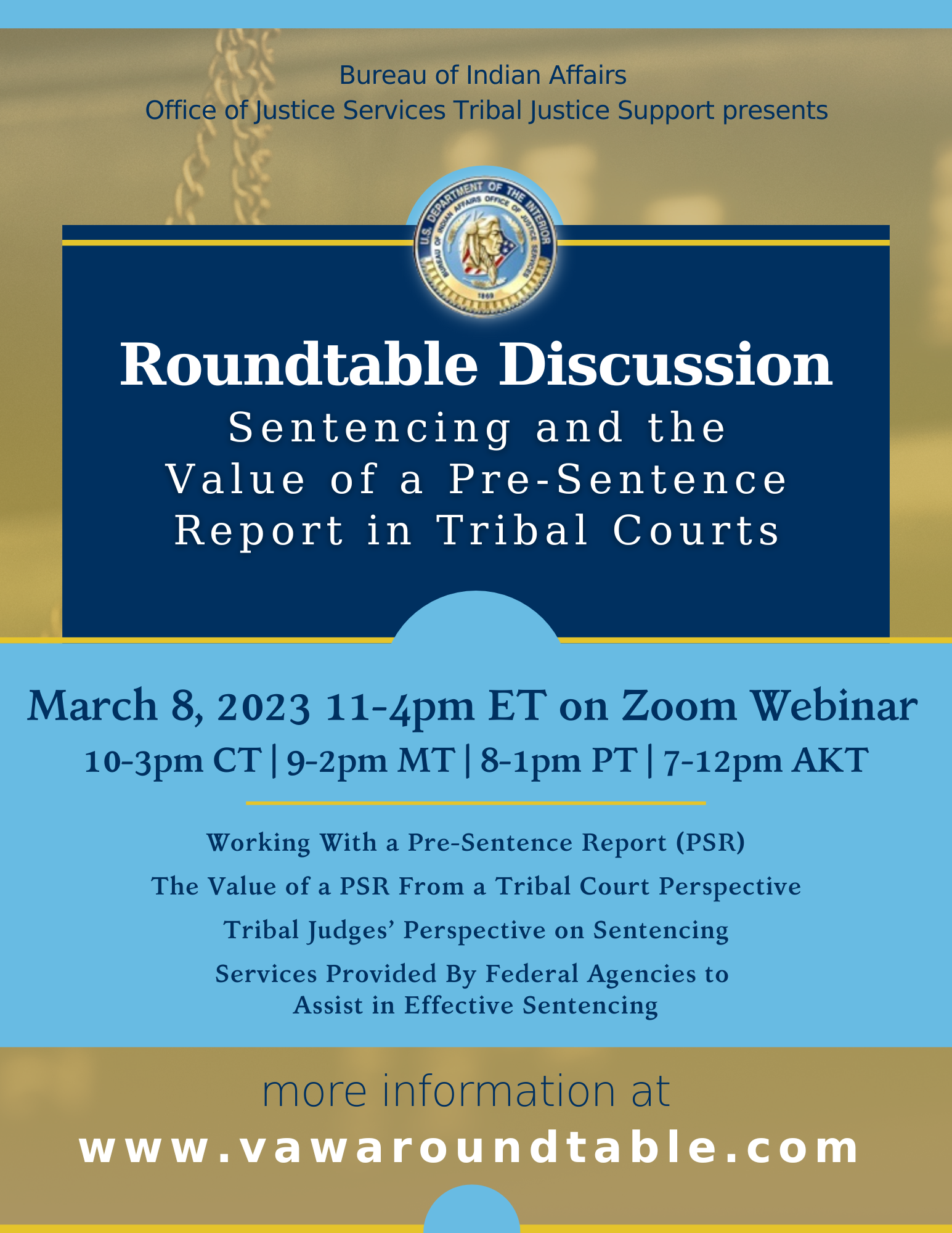
Register and join the webinar Wednesday, March 8 11-4pm ET here.
Port Authority’s Motion for a Preliminary Injunction and TRO:
On February 10, the Blackfeet Nation filed a Response in Support of the Plaintiff’s Motion for Preliminary Injunction and Temporary Restraining Order:
Brief in Response:
The Blackfeet Nation intervened in the case, arguing that the State of Montana does not have the authority to enforce state law on the Reservation.

 Turtle Talk
You must be logged in to post a comment.