Student Note on Native Voting Rights

Noelle N. Wyman has published “Native Voting Power: Enhancing Tribal Sovereignty in Federal Elections” (PDF) in the Yale Law Journal. Here is the abstract:

Members of tribal nations are disproportionately burdened by barriers to voting, from strict voter identification and registration requirements to inadequate language assistance and inaccessible polling locations. Restrictive voting laws are on the rise, while the avenues for challenging them under the prevailing model of voting rights are narrowing. This Note advocates for a different approach to conceptualizing and combatting Native American voter suppression.

First, it advances a new jurisprudential theory centered on tribal sovereignty: suppressing the Native vote not only denies rights to individual citizens but also denies sovereign power to tribes. Historically, states required Native American people to renounce tribal membership, culture, and lands to vote. Today, states and localities continue to denigrate tribal sovereignty in the administration of elections, such as by rejecting tribal-issued IDs and interfering with tribes’ organization of their own political communities. Apart from securing the fundamental rights of individual Native citizens, Congress has a substantive duty to secure tribal sovereignty in federal election administration that is rooted in its trust obligation to tribes.

Second, this Note proposes a new legal framework for enhancing Native voting power: Congress should require states and local election officials to negotiate with federally recognized tribes toward the formation of tribal-state compacts governing federal election administration in Indian Country. This framework would relieve tribes of the burdens that they currently carry to initiate collaboration with local election officials, fill gaps in voter assistance, and challenge unlawful voting restrictions in court. Meanwhile, it would involve tribes in the process of lawmaking and regulation, enabling them to exert a measure of sovereign power over federal elections in Indian Country.
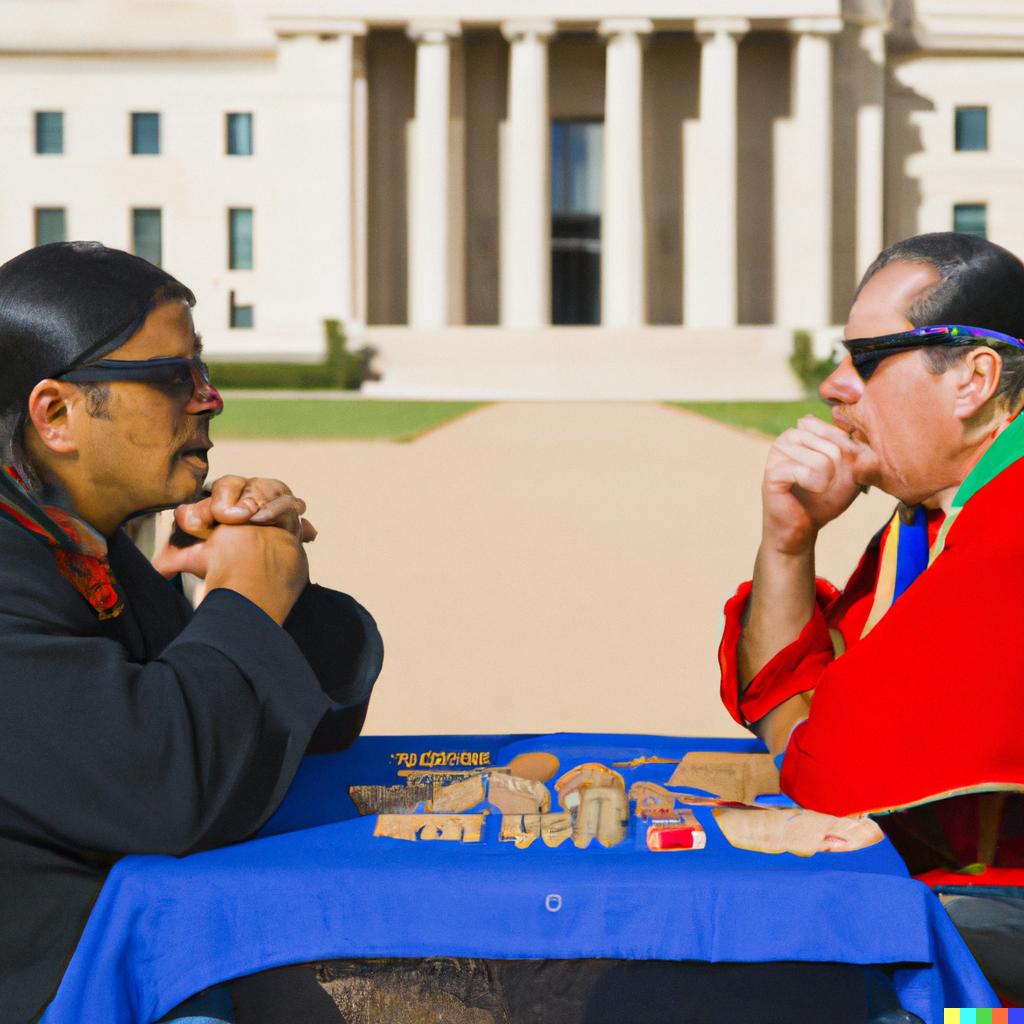
Interview with Fletcher and Rebecca Tsosie on Indian Law

Here, on Prism, is “Supreme Court Rulings Undermine Indian Law.”

An excerpt:

Levy Uyeda: What is sovereignty, and how has its definition changed over time?

Fletcher: Sovereignty, I suspect, is not really an Indigenous principle. It comes from the notion that there is an all powerful sovereign entity like a king that has an absolute monopoly on violence, over lands, and over the people on those lands, who typically are called subjects. By offering individual rights to people in the U.S. we’ve papered over some of the difficult aspects of that understanding of sovereignty. On one hand, when tribes assert sovereignty, it means tribes are saying that there is a hierarchical group of people and an elite that makes decisions for all others beneath them. 

Tsosie: I do agree that the terminology of “sovereignty” is problematic because Anglo-American law and jurisprudence does give that hierarchical meaning that comes out of English tradition. 

I tell my students that the term “property,” which also has that Western meaning, along with “sovereignty,” are both modes of discourse. If you think about these terms in the context of a treaty, the treaty is designed to be a contract between sovereigns.

News on Proposed State ICWA Laws

Over the past few weeks, a number of states have been considering state ICWA laws. I’m keeping the bills updated here, along with their current status when I’m notified of it. https://turtletalk.blog/icwa/comprehensive-state-icwa-laws/

Today the AP had news coverage of the bills here

Finally, here is a link to the testimony that took place yesterday in the Minnesota Senate.

This bill is supported by the ICWA Law Center, one of the only organizations that provides direct, trial level legal services to Native families, and they do it very well. They are currently holding a fundraiser with Heart Berry:

And listen, I’m not responsible if you follow that link and then get sucked into buying a whole bunch of stuff from Heart Berry because it’s basically impossible not to. I don’t make the rules.

Tribe and State Offer Additional Evidence in Line 5 Matter before Michigan Public Service Commission

Here are the new materials:

Emergency Hearing Standards Case from Montana [ICWA]

A.J.B. and O.F., Petitioners, v. MONTANA EIGHTEENTH JUDICIAL DISTRICT COURT GALLATIN COUNTY (2023) FindLaw

I won’t lie, guys, I had to read this one multiple times to figure out what was going on. Essentially the Montana legislature passed a law without understanding the difference between hearings that fall under 1912(a) and 1922. 1912 governs foster care proceedings and requires notice, active efforts, qualified expert witness testimony, etc. 1922 governs emergency proceedings (1922 has language that all states essentially read out of the statute to achieve this jurisdiction, which only makes sense to ICWA practitioners and no one else). Emergency proceedings do not require notice and the other 1912 protections, but it has a higher standard for removal (imminent physical damage or harm). The Montana statute denied parents of Indian children a faster emergency hearing because of the belief that 1912 standards (specifically notice) had to be hit before there could be a reason. The Court overturned this language.

Also interesting is the issue of trying to appeal proceedings that are emergency/shelter care/24 hour/48 hour/preliminary hearings in child protection proceedings. There’s often not a final order coming out of those hearings, and no way for a parent or tribe to appeal an emergency decision (this was an issue in the In re Z.J.G. case in Washington as well). Here, the District Court argued there was no way for the appellate court to hear the case because of the nature of the hearings.

Finally, the District Court argues this matter does not meet the threshold criteria for a writ of supervisory control because no urgent or emergency factors make appeal an inadequate remedy. The court alleges that in this case, it was later determined that O.F. is not an Indian child, and A.J.B. and O.F. have been “conditionally reunited.” However, as A.J.B. asserts in her petition, she does not appear to have any remedy on appeal for the denial of her right to an EPS [emergency] hearing, and the potentially erroneous loss of the right to parent, even for a short time, is a matter of great urgency.

Here the appellate Court heard the case anyway and overturned the statute.

Of course, you may also remember the federal case in South Dakota attempting to remedy emergency hearing practices there in ICWA cases that was dismissed on appeal because the federal court stated there were Younger abstention issues.

Save the Date! Implementing VAWA in Tribal Courts, hosted by the Tule River Indian Tribe of California

SCOTUS Sets Oral Argument Dates for Navajo and LDF Cases

Arizona v. Navajo will be argued on March 20, 2023.

LDF v. Coughlin will be argued on April 24, 2023.

California Federal Court Decides Lexington Insurance Co. v. Mueller [Cabazon Band of Mission Indians]

Here are the materials in Lexington Insurance Co. v. Mueller (C.D. Cal.):

Ray Cross and Alex Skibine Walk On

It’s been a terrible last few weeks in Indian law — two of the most accomplished, passionate, and delightful Native men I have ever met have walked on. More when I gather myself.

Here is the notice for Ray Cross, who died on January 24, 2023.

Here is the notice for Alex Skibine, who died on February 4, 2023.