51 Years of Service April 7 -8, 2022 Sandia Resort – Albuquerque, NM
Who We Are:
The National Native American Law Students Association was founded in 1970 to support law students who are interested in the study of Federal Indian Law, Tribal Law, and traditional forms of governance. Our organization is led by a board of Indigenous law students from across the country and our membership consists of local NALSA chapters, individual Native law students, Native attorneys, and allies.
Annual Conference:
The Annual Conference will take place in conjunction with the Federal Bar Association’s Indian Law Conference on April 7 and 8th 2022 at the Sandia Resort & Casino located in Albuquerque, New Mexico. The Annual Conference is a time for our board and membership to unite, celebrate one another, network with professionals, and form lasting bonds of friendship with one another.
Whether a court can invalidate an agreement to have an arbitrator resolve questions of arbitrability (a “delegation clause”) based on the court’s interpretation of a separate choice-of-law provision.
Whether sovereign immunity bars private plaintiffs from suing tribal government officials, in their official capacities, for alleged violations of state law
Can a federal court refuse to enforce the delegation clause of an arbitration agreement on the ground that a choice-of-law provision applicable to the arbitration agreement as a whole prospectively waives federal rights?
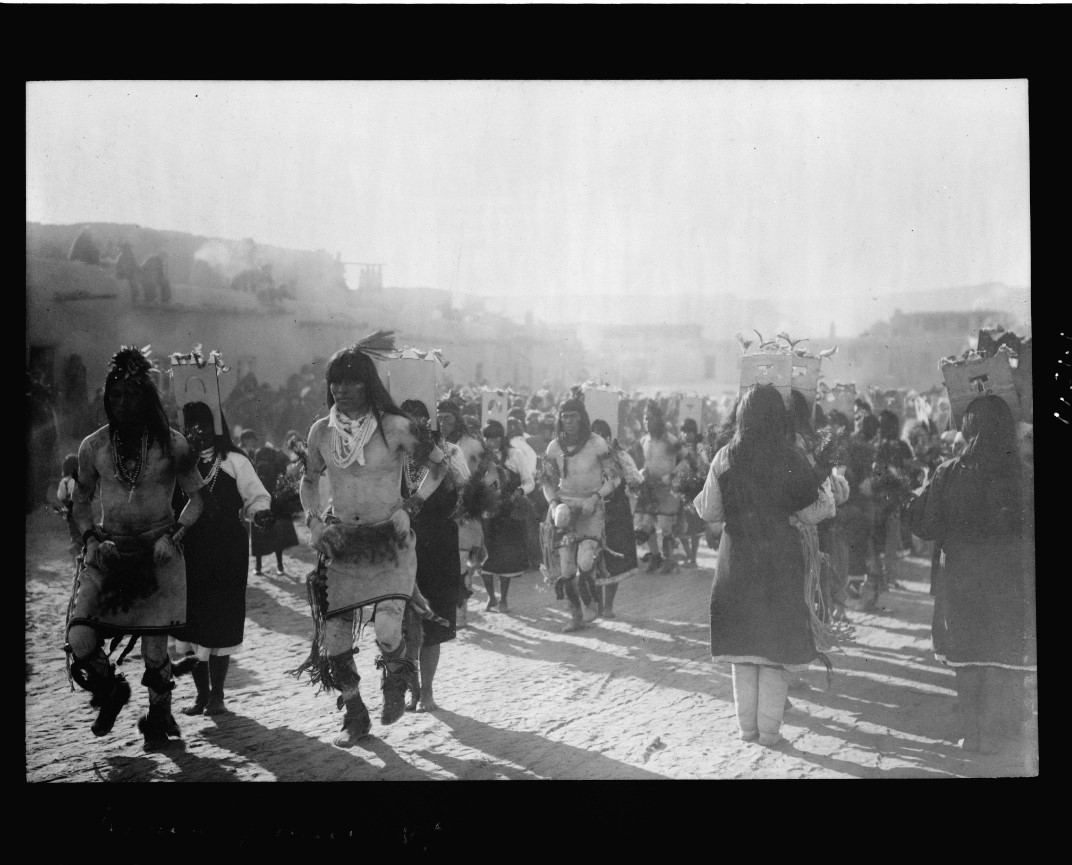
Since time immemorial, the indigenous people of what became the Southwest United States have maintained sustainable, vibrant communities in the harshest of environments; one with generally arid climate, inconsistent precipitation, heat, wind, thin soil and erosion. These communities, on the razor’s edge, survived for eons because resilience and community, within and with the land, were at the center of their life, economy and order. Balance was not always perfect, but it was the target. The possibility of economic surplus and growth is perhaps a latent human instinct, but it until the fluorescence of Chaco Canyon in the eleventh century it remained subordinate. With the fall of Chaco and eventual restoration of decentralizations and the traditional aboriginal practices, balance returned.
The European invasion and the infusion of competitive individualism and economic growth changed all this. The movement west on the wings of the doctrine of discovery and the ensuing extinguishment of both aboriginal title and the stable-state economies proceeded across the Mississippi and the prairies and slammed the capitalistic wrecking ball into the most resilient of the aboriginal survivors – The Pueblo Indians of the Southwest.
The Jemez Pueblo of Central New Mexico has been one of the fiercest defenders of the traditional aboriginal community. Through the intrusion of Spain, Mexico and ultimately the United States, the Pueblo clung to its central land, its claims to aboriginal surroundings and water, and its sustainable orientation, this article traces the prehistoric courses of the Pueblo, and it centuries-long efforts to maintain both the focus and the legal existence of its aboriginal community. It has not been a complete victory in the dominant sovereigns’ courts, but the aboriginal heart of the people and possibilities for collaboration with other Tribes and, perhaps, with a more generous and enlightened dominant sovereign, remain strong.
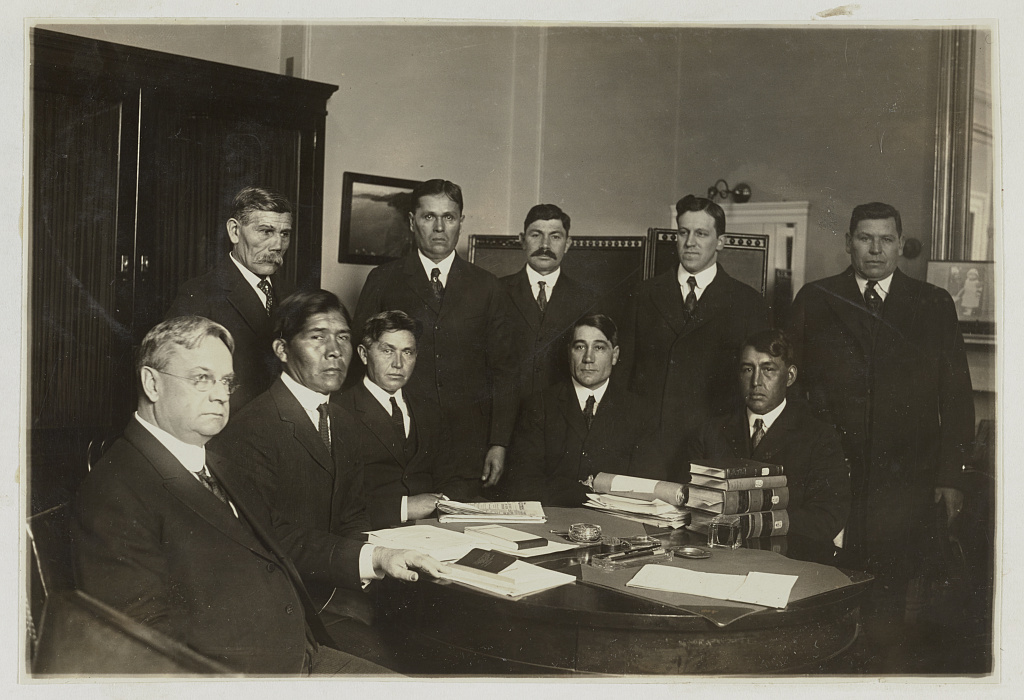
Delegation representing 20,000 Californian Indians meeting with Senator Hiram Johnson: Photograph shows a delegation of eight Native American men from California representing 300 tribes and bands of Californian Indians meeting with Senator Johnson during visit to Congress to petition them to honor the Lost Treaties of 1851 and 1852; delegation members include Alfred C. Gillis (Wintun), Thomas H. Billings (Scotts Valley), Harrison Diaz (Paiute), William Fuller (Me-Wuk), Frank Isles (Klamath), Stephen Night (Ukiah), Albert Wilder (Central Klamath). [LOC]
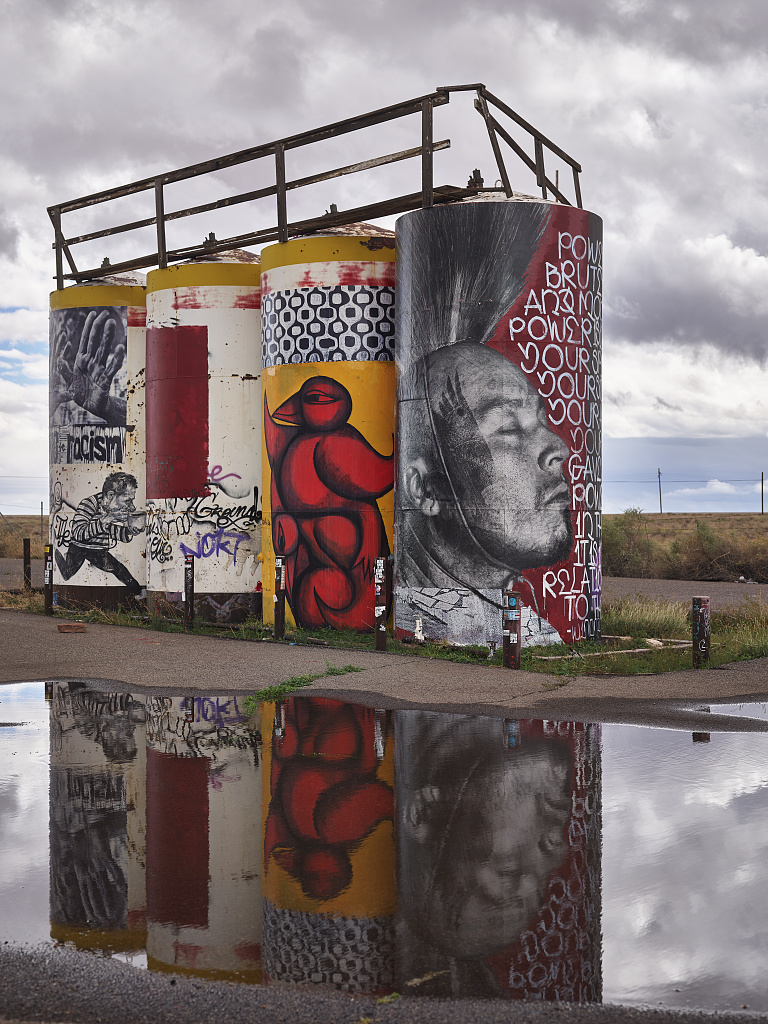
Artwork on water towers along a remote Arizona road leading to Monument Valley Navajo Tribal Park, a red-sand desert region on the Arizona-Utah border known for the towering sandstone buttes [LOC]
Whether Eleventh Amendment sovereign immunity and tribal sovereign immunity deprived the lower courts of subject-matter jurisdiction over the Snoqualmie Indian Tribe’s claim, requiring dismissal on that ground under United States Supreme Court precedent including Steel Co. v. Citizens for a Better Environment, 523 U.S. 83 (1996).
Whether, under United States Supreme Court precedent including Ruhrgas AG v. Marathon Oil Co., 526 U.S. 574 (1999) and Sinochem Int’l Co. v. Malaysia Intern. Shipping Corp., 549 U.S. 422 (2007), an issue preclusion dismissal is a merits dismissal and excluded from the threshold grounds among which a federal court may choose to dismiss a case before establishing its subject-matter jurisdiction.
Whether, under United States Supreme Court precedent including Sinochem Int’l Co. v. Malaysia Intern. Shipping Corp., 549 U.S. 422 (2007), jurisdictional issues in this case were not “arduous” or “difficult to determine” because the lower courts could readily determine that they lacked jurisdiction, such that those courts committed reversible error in bypassing determination of their subject-matter jurisdiction and proceeding to dismiss the case instead with prejudice on issue preclusion grounds.
The disparate impact COVID-19 has had on Indian Country reveals problems centuries in the making from the legacy of colonialism. One of those problems is state encroachment in Indian Country, including attempts to assert taxing authority within Indian Country. The issue of the reaches of state taxing authority in Indian Country has resulted in law that is both uncertain and highly complex, chilling both outside investment and economic development for tribes. As the United States emerges from COVID-19, to focus only on the toll exacted on tribes and their peoples ignores the tremendous opportunities for states to right these historical wrongs. Buoyed by federal COVID-relief funds, state and local governments are in a financial position to reframe their tax policies to promote tribal sovereignty and support economic development in Indian Country. This article argues for states to make diplomatic, responsible state and local tax policies that will create healthier intergovernmental relationships and an environment that in turn creates broader economic growth for tribes and states alike. Through policies requiring state governments to consult with tribes to make joint decisions on tax policy and by refraining from exercising taxing authority in Indian Country, states can move from a zero-sum game. Instead of competing for precious tax revenue, state and local governments can partner with tribes to expand the total amount of available revenue streams. Doing so will not just right the historical wrongs of colonialism—it could also help prevent future crises, such as the COVID-19 pandemic, from having such a disparate impact on tribes again.



 Turtle Talk
You must be logged in to post a comment.