Here are the materials in Sizemore v. State of Oklahoma:
South Dakota NALSA Symposium Link
Here.
Friday Job Announcements
To post an open Indian law or leadership job to Turtle Talk, send the following information to indigenous@law.msu.edu:
- In the email body, a typed brief description of the position which includes
- position title,
- location (city, state),
- main duties,
- closing date,
- and any other pertinent details such as links to application;
- An attached PDF job announcement.
The Tribal Caucus of the EPA Region 10
Legal Intern, Tribal Operation Committee, remote. Duties include drafting comment letters on behalf the Tribal Caucus, legal research, assisting in the development of a Tribal Conference, and presenting to the Tribal Caucus. Position is open until filled. Please provide a copy of a resume and cover letter (please address interest in environmental and Indian law) to rick@region10rtoc.net. Please see the position description for more information.
The Northern Arapaho Tribe of the Wind River Reservation
Legal Intern, summer 2021, Ethete, Wyoming. This position answers directly to the Northern Arapaho in-house counsel. All applicants must have completed their second year of law school with preference given to those that have completed a course in federal Indian law, Tribal law, or have completed a law school clinic program. The student intern will assist the in-house counsel with research, drafting, and other basic legal tasks. The intern will on occasion accompany the in-house counsel to meetings with Tribal Departments, attend Tribal Court cases and hearings, assist in drafting Tribal policies and procedures, and work with the in-house counsel on ICWA cases throughout the United States. The position will remain open until filled. See the position description for more information.
Navajo Nation Department of Justice
2021 Summer Law Clerk – Intern Positions. The Navajo Nation Department of Justice (NNDOJ) provides legal services to the Navajo Nation government, including the Executive, Legislative, and Judicial Branches, and to the 110 local governing chapters. The Navajo Nation Department of Justice (NNDOJ) seeks energetic and motivated candidates for funded summer law clerk positions. Must have completed a law school course on Federal Indian Law. To apply, please submit the following: 1) a letter of interest; 2) resume; 3) law school transcript; and 4) a brief (5-10 page) writing sample to DOJ at general@nndoj.org. Complete applications are due on Friday, April 30, 2021 at 5:00 p.m. Mountain Time.
Native American Rights Fund
Staff Attorney, Boulder, CO (preferred) or Washington, D.C. Practicing attorney to manager a litigation docket in federal Indian law. Closing date is April 16, 2021. Minimum of 3 years of experience as a practicing attorney, experience in or knowledge of federal Indian law. Please see the position description for more information.
Pokégnek Bodéwadmik – Pokagon Band of Potawatomi
Judicial Appointment, Justice Center, Dowagiac, MI. This is a contract position with a three-year term for approximately 3 hours a month. This will be open until filled. See attached for application instructions.
The Confederated Tribes of the Umatilla Indian Reservation
Tribal Attorney, Office of Legal Counsel, near Pendleton, Oregon. This Tribal Attorney position is assigned to represent and advise the CTUIR in its NAHASDA, low-come tax credit and other home ownership, development and advising supported by related funding sources. A majority of the work is prompted by the CTUIR Housing Department, the tribal entity administering its Indian Housing Plan and Affordable Housing Activities pursuant to the Native American Housing and Self Determination Act of 1996. Apply via http://ctuir.org/tribal-attorney-2 and see the job description for more information. Umatilla is a tribal preference employer.
The Tohono O’odham Office
Attorney General, Sells, AZ. The Office of Attorney General represents the interests of the Tohono O’odham Nation in tribal, state, and federal venues. While the posting is for an Assistant Attorney General IV, the Office of Attorney General will consider applicants with less than eight years of experience. Attorneys enjoy a diverse practice, face challenging jurisdictional issues, and protect tribal sovereignty. While attorneys with expertise in all areas of Indian law will be considered, gaming experience is a plus. Please see the position description for more information. Apply here.
Yurok Tribe
Prosecutor, Tribal Prosecutor Office, Klamath, CA. Main duties will be prosecuting tribal criminal matters and working with local counties on diversion programs as well as assist in the tribe’s MMIW project where appropriate. Full job description is on the job posting website along with the application. This position is open until filled. Please see the position description for more information.
Navajo Nation Office of Legislative Counsel
Attorney, Window Rock, AZ. Duties include providing legal advice and legal representation to entities of the Legislative Branch, the Navajo Nation Council, its standing committees, boards and commissions involving various areas of law and policy. For more information please, see the position description at www.dpm.navajo-nsn.gov or to apply, applications are accepted via email (apply@dpm.navajo-nsn.gov). Position is open until filled.
Navajo Nation Department of Justice, Office of the Attorney General
Principal Attorney, Window Rock, AZ. Under general direction of the Assistant Attorney General, Attorney General, and Deputy Attorney General, provides professional legal work and advice to the Navajo Nation Office of the Controller (OOC), Office of Management & Budget (OMB), Office of the Navajo Tax Commission (ONTC), Navajo Tax Commission (NTC), Department of Retirement Services (NDRS), Retirement Plan Administration Committee (RPAC), Budget and Finance Committee (BFC), Investment Committee (IC), and as required, to the Navajo Nation Council, Oversight Committees, the Executive, Legislative and Judicial Branches, and Chapters regarding a wide range of legal issues. This position is open until filled, please see the position description or to apply, visit http://www.dpm.navajo-nsn.gov/jobs.html.
Senior Attorney (2 positions), Window Rock, AZ. Under general direction of Assistant Attorney General or the Attorney General, and Deputy Attorney General. Provides legal direction to Navajo Nation Division, departments, Navajo Nation Council and committees regarding a wide range of legal issues, including statutory and regulatory compliance, contract and procurement issues, and intergovernmental relations; performs professional legal work in research, trial and other legal work; and performs related duties as required. This position is open until filled, please see the position description or to apply, visit http://www.dpm.navajo-nsn.gov/jobs.html.
Navajo Nation Department of Justice, Office of the Chief Prosecutor
Chief Prosecutor, Window Rock, AZ. The Chief Prosecutor performs administrative, managerial, and prosecution work in directing the Office of the Chief Prosecutor and component districts including the Juvenile Justice and White Collar Crime programs. Administers short and long range planning, organizing, directing, strategic planning for annual, external, and supplemental budgets, and related activities of the Office of the Chief Prosecutor. Coordinates and evaluates the overall effectiveness of the assigned program offices and districts. Responsible for adhering to the Plan of Operation and establishing annual goals and objectives, and making necessary amendments. This position serves at the pleasure of the Attorney General. This position is open until filled, please see the position description or to apply, visit http://www.dpm.navajo-nsn.gov/jobs.html.
Barnhouse Keegan Solimon & West LLP
Associate Attorney, Los Ranchos, NM. Seeking associate with 2+ years litigation experience preferably in the areas of federal Indian law and tribal law. For more information, please see the position description.
Miller Nash Graham & Dunn LLP
Director of Diversity, Equity, and Client Relations, Portland, OR. We are adding a senior management team member to lead us in our DEI efforts both internally and as we partner with our clients. For more information about this opportunity and to apply, please visit our Job Board.
ACLU of Nebraska
Immigration Legal Fellow, Lincoln, NE. Seeking applicants with approximately 0-5 years of litigation experience, or experience as a judicial law clerk, for a two-year legal fellowship. The Legal Fellow will collaborate with other team members in administration, development, and communications from time to time. Our 11-person team is complemented by law clerks, interns, volunteer attorneys, and thousands of supporters statewide.
Federal Public Defender
Investigator, District of New Mexico, Albuquerque, NM. Our office represents individuals charged with federal crimes. The investigator position helps research the facts of the case to aid in the defense of the accused. We represent a large population of Native American and Latin American communities. The closing date of the position is May 17, 2021. All applicable information is in the attached job announcement.
Social worker/mitigation specialist, Las Cruces office. Our office represents individuals charged with federal crimes. The social worker helps research the facts of the case to aid in the defense of the accused and find necessary services to help them. We represent a large population of Native American and Latin American communities. The closing date of the position is May 17, 2021. All applicable information is in the attached job announcement.
See posts from March 26, 2021.
Ute Tribe Sanctioned for Abuse of Judicial Process/Acting in Bad Faith
Here are the new materials in the long-running Becker v. Ute Indian Tribe of the Uintah and Ouray Reservation (D. Utah):
205 Becker Notice of Intent to Subpoena
228 Response to Order to Show Cause
234 Becker Memorandum re Tribe’s Documents
235 Becker Response to Order re Sanctions against Tribe
261-1 Arbitration Statement of Claims
269 DCT Order Denying Motion for Reconsideration
270 Tribe Motion to Reconsider 260
Prior post here.
California Tribes With IGRA Good Faith Negotiation Suit against State
Here are the materials in Chicken Ranch Rancheria of Me-Wuk Indians of California v. State of California (E.D. Cal.):
35-1 Tribe Motion for Summary Judgment
38-1 State Motion for Summary Judgment
Prior post here.
Update (5/30/21):
Call for Proposals: 18th Annual Indigenous Law Conference
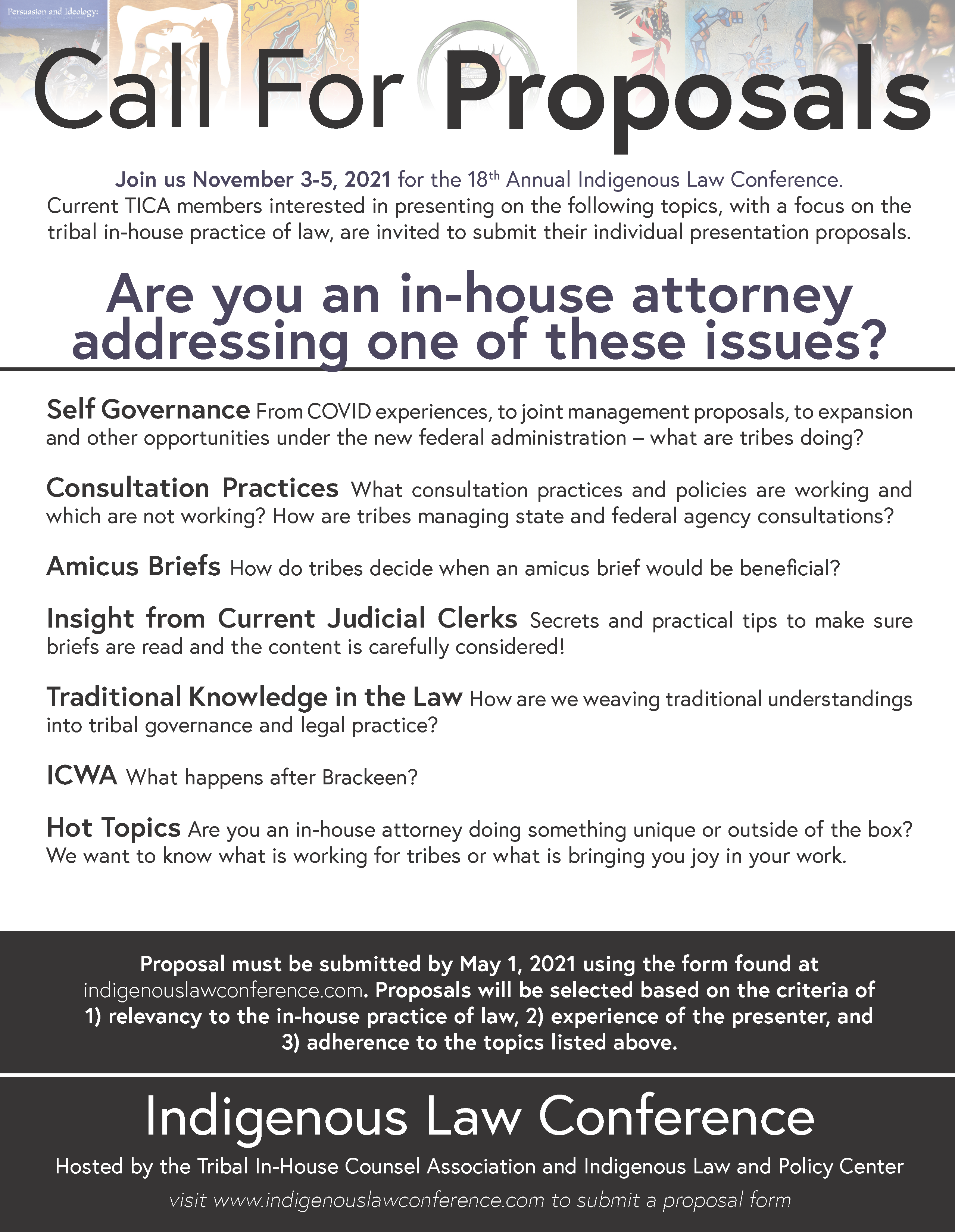
Are you an in-house attorney addressing one of these issues?
-Self Governance
-Consultation Practices
-Amicus Briefs
-Insight from Current Judicial Clerks
-Traditional Knowledge in the Law
-ICWA
-Hot Topics
Each year, the Indigenous Law Conference has 8 panels plus a keynote speaker. Current TICA members interested in presenting on the above topics, with a focus on the tribal in-house practice of law, are invited to submit their individual presentation proposals. ILPC/TICA will form panels. Proposals must be submitted by May 1, 2021. The Conference will be hosted November 4-5, 2021 with pre-conference activities on November 3. For more information, click the buttons below.
DailyNous: “Philosopher Named to White House Environmental Justice Advisory Council”
Our good friend Kyle Whyte from U of M and the Citizen Potawatomi Nation! Congrats!
Here.
Here is the White House announcement.
Respondents’ Briefs and Amicus Briefs in Yellen v. Chehalis
Here (the remainder of the briefs are on the Yellen v. Chehalis backgrounds materials page):
Brief of the Confederated Chehalis Tribes
Final Call for Art, ILPC/TICA Indigenous Law Conference

Call for Art Closes tomorrow, April 1 2021
Since 2007, the Indigenous Law Conference commissions one American Indian, Alaska Native, Native Hawaiian, or Canadian First Nations artist each year. Art is featured on conference materials and the website. For more information and to submit, visit www.indigenouslawconference.com/call-for-art. Deadline to submit is tomorrow April 1, 2021.
Save the date for the 18th Annual Indigenous Law Conference, November 4-5, 2021 with pre-conference activities on November 3!
Visit www.indigenouslawconference.com for 2021 details as they arise.
Call for Proposal announcement coming soon!
Update in Cherokee Nation Trust Breach Suit [Feds Must Comply with Full Discovery]
Here are the materials in Cherokee Nation v. Dept. of the Interior (D.D.C.):
54-1 Motion to Dismiss Common Law Claims
55-1 Federal Motion for Protective Order
68 Magistrate Report Denying 54
Prior materials here.
 Turtle Talk
You must be logged in to post a comment.