Here is the complaint in State of Kansas v. Bernhardt (D. Kan.):
Tribe Sues over Border Wall
Here is the complaint in La Posta Band of Diegueno Mission Indians of the La Posta Reservation v. Trump (S.D. Cal.):
Updated:
With Support of Navajo Nation, Lezmond Mitchell Asks Pres. Trump to Commute His Death Sentence Before August 26 Execution Date
With Support of Navajo Nation, Lezmond Mitchell Asks President Trump to Commute His Death Sentence Before August 26 Execution Date
Navajo President to Appear Before U.S. Pardon Attorney Today, Stating in New Letter that Mitchell’s Commutation Would Honor “Our Religious and Traditional Beliefs”
(Washington, D.C.) Navajo Nation President Jonathan Nez personally appealed to U.S. President Donald Trump to request clemency for Lezmond Mitchell, the only Native American person under a federal death sentence. President Nez is scheduled to appear before the U.S. Pardon Attorney later today to personally advocate on behalf of Mr. Mitchell’s petition for executive clemency.
In a letter [https://tinyurl.com/y59d3a9v], President Nez and Vice President Myron Lizer called on the American president to demonstrate respect for the Navajo Nation’s tribal sovereignty by commuting Mr. Mitchell’s sentence to life imprisonment with no possibility of release. He pointed to the tribe’s steadfast opposition to Mr. Mitchell’s execution in light of the tribe’s long-standing position on the death penalty for Native Americans, and noted,
“The United States Department of Justice sought the death penalty against Mr. Mitchell despite the Navajo Nation’s public opposition, against the express wishes of the victim’s family, and ostensibly against the recommendation of the U.S. Attorney for the District of Arizona. The Navajo Nation is respectfully requesting a commutation of the death sentence and the imposition of a life sentence for Mr. Mitchell. This request honors our religious and traditional beliefs, the Navajo Nation’s long-standing position on the death penalty for Native Americans, and our respect for the decision of the victim’s family…We need to address this issue to move forward in our trust of our federal partners and to continue to work on the importance of protecting our People.”
NBC: “Federal agency to reopen 53 Native American schools despite coronavirus fears”
Here.
NAICJA 51st Annual National Tribal Judicial and Personnel VIRTUAL Conference
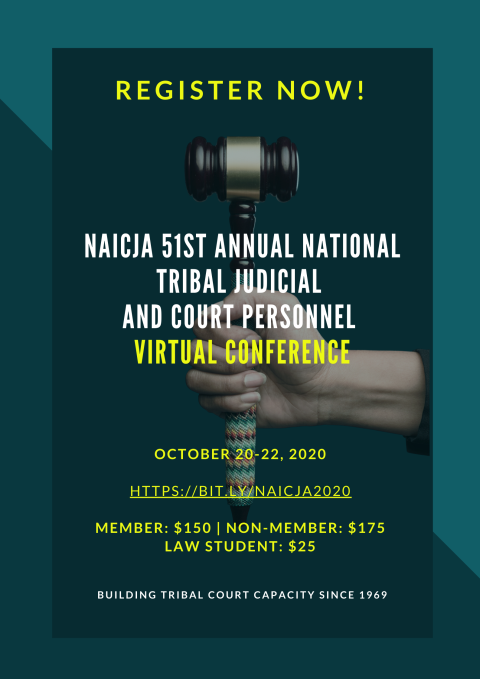
Registration is now open for the NAICJA 51st Annual National Tribal Judicial and Personnel VIRTUAL Conference.
“Tribal Court Justice in 2020: Tribal Court Resiliency, Change and Shaping Law”
Attendees will experience top-notch training in three tracks: Lessons from COVID-19, Resources for Court Clerks and Legal and Judicial Skills.
In process of applying for Continuing Legal Education (CLE) credits.
Wisconsin COA Rejects Claims of Taxpayers Who Didn’t Like That Indians Had Tax Immunity and Therefore Didn’t Want To Pay Taxes, Either
Here are the materials in Klein v. Wisconsin Dept. of Revenue (Wis. Ct. App.):
HCN: “Contested water settlements inflamed the Navajo Nation’s health crisis”
Here.
Eleventh Circuit Affirms Dismissal of Suit by Church Parishioners Against Seminole Tribe
Here is the unpublished opinion in Eglise Baptiste Bethanie De Ft. Lauderdale, Inc. v. Seminole Tribe of Florida. (PDF)
Briefs:
Lower court materials here.
Muscogee (Creek) Nation Announces Appointments to Mvskoke Reservation Protection Commission
Here.
Job Announcements
To post an open Indian law or leadership job to Turtle Talk, send the following information to indigenous@law.msu.edu:
- In the email body, a typed brief description of the position which includes
- position title,
- location (city, state),
- main duties,
- closing date,
- and any other pertinent details such as links to application;
- An attached PDF job announcement.
Tohono O’odham Employment Rights Commission
Contracted Attorney (part-time), Tohono O’odham Nation, Sells, AZ. Most services may be provided virtually by computer, with occasional trips to Sells, Arizona, located one-hour west of Tucson, Arizona. The position is open until filled. Applicants must be licensed in Arizona. Applicants should email their resume, proof of Arizona law license, and letter of interest to Mr. Vernon Smith, Legislative Committee Staffer, at Vernon.Smith@tonation-nsn.gov. Please see the job announcements for more information.
Havasupai Tribal Court
Tribal Public Defender, Supai, AZ. Provide legal representation in the Havasupai Tribal Court for Tribal Member clients in criminal, juvenile, mental health, dependency, and severance of parental rights cases, and perform related duties as required. Application closes August 31, 2020. Please see the job description for more information.
U.S. Attorney District of Alaska
Assistant United States Attorney, Criminal Division, Anchorage, AK. The successful candidate primarily will be responsible for handling the investigation and prosecution of federal crimes. This will include prosecuting cases such as fraud, embezzlement, other white collar crimes, as well as firearms offenses, drug crimes, child exploitation and other violent crimes. In addition, the candidate may also be called upon to assist in the prosecution of a wide variety of other criminal cases as needed to address the district’s priorities. Assistant United States Attorneys work their cases from inception through appeal, and thus, in addition to district court work, the successful candidate will be responsible for drafting appellate briefs and presenting oral arguments. First consideration for applications received by 9/2/20. Closing Date: 11/2/20. More information here and the job description.
Michigan Indian Legal Services
Staff Attorney, SW Michigan. The attorney will provide legal services to members of two tribes and their spouses under contracts with those tribes. Open until filled. Please see the position description for more information.
United South & Eastern Tribes, Inc.
Senior Policy Analyst, Washington, DC (remote work available temporarily). Conduct advocacy on behalf of the collective interests of member Tribal Nations before all branches of the federal government, as well as other partners both within and outside of Indian Country. Develop and maintain an on-going communication between USET SPF and these entities. This position is open until filled. The application link is https://www.usetinc.org/resources/job-opportunities/.
The Kalispel Tribe’s Legal Department
Natural and Trust Resources Attorney, Airway Heights, WA. This position provides legal representation in a broad range of areas concerning Tribal legal rights, obligations, and privileges with an emphasis on matters related to the Kalispel Tribe’s natural and trust resources including land acquisition and development. For the full job description and to apply, please visit the website. Visit our website to learn more about our Legal Team. For any questions, please feel free to reach out to Britaney Francis bfrancis@ktea.com. Open until position is filled.
The Pokagon Band Department of Social Services
RFP. The Pokagon Band Department of Social Services, through the Tribal Victim Services Set-Aside Program grant from the Office of Victims of Crimes (OVC) in the Department of Justice (DOJ), is seeking a vendor for a Community Assessment for the Pokagon Tribal Victim Services Set-Aside Program. The open bidding period is July 31st-August 31st.
Lower Elwha Klallam Tribe
Associate Tribal Attorney, Office of Tribal Attorney (“OTA”), Port Angeles, WA, near Olympic National Park. OTA was established in 2008 and handles most of the Tribe’s legal workload while also supervising outside counsel. This is a new position and will be the third Attorney in OTA. Associate will have a significant caseload spanning the full spectrum of tribal legal work. Open until filled, but desire to fill ASAP. First review of applications on August 24. For details on how to apply, please click on position title to see attached announcement.
Judicial Branch of the Navajo Nation
Staff Attorney, Chinle Judicial District, Chinle AZ. This position provides complex legal advice and guidance, conducts legal research, and drafts legal documents in support of judges and other court staff. For more information, please see the position description or to apply, visit http://www.navajocourts.org/vacancies. This position is open until filled.
Staff Attorney, Aneth Judicial District, Aneth, UT. This position provides complex legal advice and guidance, conducts legal research, and drafts legal documents in support of judges and other court staff. For more information, please see the position description or to apply, visit http://www.navajocourts.org/vacancies. This position is open until filled.
Staff Attorney, Kayenta Judicial District, Kayenta, AZ. This position provides complex legal advice and guidance, conducts legal research, and drafts legal documents in support of judges and other court staff. For more information, please see the position description or to apply, visit http://www.navajocourts.org/vacancies. This position is open until filled.
District Court Judge, Judicial District Court, Navajo Nation Wide. The District Court Judge is responsible in presiding over civil, criminal and family court cases; provides policy direction and guidance in the operation of the Judicial District. For more information, please see the position description or to apply, visit http://www.navajocourts.org. This position is open until filled.
Rosette, LLP
Associate Attorney, Grand Rapids, MI. Advise tribes and tribally owned businesses on all things related to non-gaming economic development, including but not limited to the following: business entity creation and dissolution, corporate governance, contract review, conduct legal diligence necessary for real estate transactions and corporate acquisitions, compliance with tribal law, compliance with federal consumer protection law, and advise on appropriate corporate legal structures for acquisitions and new ventures. September 4, 2020.
See posts from August 1, 2020.
 Turtle Talk
You must be logged in to post a comment.