Here.
EdWeek Video: “From the Pueblo to College: The Journey of Two Rural Students”
Here.
Here.
Here are the materials in Red Cliff Band of Lake Superior Chippewa Indians v. Bayfield County (W.D. Wis.):
Excerpt:
Plaintiff Red Cliff Band of Lake Superior Chippewa Indians seeks a declaratory judgment that enforcement of defendant Bayfield County’s zoning code on fee simple land held by tribal members within the Red Cliff Band Reservation violates federal Indian law. Before the court is plaintiff’s fully briefed motion for summary judgment (dkt. #10), on which the court heard oral argument on November 21, 2019. For the reasons that follow, the court will grant plaintiff’s motion for summary judgment, finding that it is not unmistakably clear that Congress intended to allow application of the County’s zoning regulations on land held by tribal members within the boundary of the reservation.
Any posts for an open Indian law or leadership job received prior to 12pm EST on Friday will appear in that week’s announcement, when the following information is sent to indigenous@law.msu.edu:
Please send all job announcements in this requested format. For examples, see the job announcements below.
Coalition to Stop Violence Against Women
Executive Director, Albuquerque, NM. Lead the organization in building and strengthening social, political, and economic environments in which violence against Native American women no longer exists. Application closes January 15th, 2020. Please see the position description for more information and how to apply.
U.S. District Court for the District of Utah
Law Clerk, St. George, UT. Judge David Nuffer oversees all cases originating out of the southern region of Utah. Main duties include: manage assigned civil and criminal cases, perform legal research as required, and make recommendations and propose solutions. Application closes 1/16/20.
Pueblo of Zuni Tribal Courts
Chief Tribal Judge, Zuni, NM. The Chief Tribal Judge performs judicial work of considerable and varying difficulty in the adjudication of cases. They are responsible for the administration and management of the Tribal Courts. Apply online at http://www.ashiwi.org. For more information please call the Zuni Human Resources Department at (505) 782-7086.
Oglala Sioux Tribe
In-House Counsel Vacancy Announcement, Pine Ridge, SD. The Junior Associate will work for the Oglala Sioux Tribe Council, the Executive Committee and the Health and Human Services and Education Standing Committees. Counsel must attend weekly meetings with Committees and attend Tribal Council meetings as assigned. The application closes January 17, 2020. Please see the position description for more information.
Anishinabe Legal Services
Staff Attorney, Cass Lake, Leech Lake Reservation, MN. Provide civil legal assistance and court representation to program clients before area Tribal Courts, State Courts, and Administrative Forums. This position will be open until filled. Please see the hiring announcement for additional information.
Hopi Tribe
Chief Prosecutor, Kykotsmovi, AZ. This position is responsible for executive and administrative control of the Hopi Office of the Prosecutor (“Office”), as well as the investigation and prosecution of crimes committed by adult and juvenile offenders within the exterior boundaries of the Hopi Reservation, and presentation of minor in need of care matters in the Hopi Children’s Court. Other key duties are indicated on the attached job description.
Deputy Prosecutor, Kykotsmovi, AZ. This position performs professional legal work in the investigation and prosecution of adult and juvenile criminal offenses through conviction and appeal; presentation of certain civil cases in the Hopi Family Court, including Minor In Need of Care cases; legal research and preparation of Court documents; participates as directed in specialty dockets such the Hopi Family Wellness Court and Veterans’ Court; and more. Other key duties are indicated on the attached job description.
Deputy General Counsel, Kykotsmovi, AZ. Provides professional legal counsel and representation to the Hopi Tribal government – including the legislative and executive branches of the Hopi Tribe, the administrative departments, offices and programs. Other key duties are indicated on the attached job description.
Earthjustice
Associate Attorney, Midwest Regional Office, Chicago, IL. Work closely with Staff Attorneys, a Deputy Managing Attorney, the Managing Attorney, and clients to investigate, develop, and prosecute cases; Participate in the full range of tasks involved in complex litigation, including factual investigation, legal research and analysis, discovery, briefing, witness preparation, and oral advocacy; and more. Applications are due by 2/3/2020, and will be reviewed on a rolling basis after the due date. Please see the position description for more information.
Associate Attorney, Northwest, Seattle, WA. Work closely with Staff Attorneys and clients to investigate, develop, and litigate cases. As the attorney gains experience, typically her or his case load will include both cases for which he or she has primary responsibility under the supervision of a Staff Attorney, and cases on which he or she works in a supporting role with Staff Attorneys. Applications are accepted on a rolling basis.
Staff Attorney, Anchorage, AK. Litigate cases from beginning to end, performing all aspects of litigation; Develop litigation and legal advocacy strategies to support program goals; Collaborate and manage relationships with co-counsel, clients, and coalition partners; and more. Rolling deadline until position filled. Please see the position description for more information.
Navajo Nation
COMMISSION ON NAVAJO GOVERNMENT DEVELOPMENT
The Judicial Branch of the Navajo Nation is seeking applicants for nomination of membership on the Commission on Navajo Government Development. The nominee must be a licensed attorney and a member of the Navajo Nation Bar Association. All interested individuals should submit a letter of interest and resume to Chief Justice JoAnn Jayne, P.O. Box 520, Window Rock, AZ, 86515, by December 23, 2019. Nominations to the Commission are subject to confirmation by the Navajo Nation Council.
JUDICIAL BRANCH OF THE NAVAJO NATION
Staff Attorney, Chinle Judicial District, Chinle AZ. This position provides complex legal advice and guidance, conducts legal research, and drafts legal documents in support of judges and other court staff. For more information, please see the position description or to apply, visit http://www.navajocourts.org/vacancies. This position is open until filled.
Staff Attorney, Aneth Judicial District, Aneth, UT. This position provides complex legal advice and guidance, conducts legal research, and drafts legal documents in support of judges and other court staff. For more information, please see the position description or to apply, visit http://www.navajocourts.org/vacancies. This position is open until filled.
Staff Attorney, Dilkon Judicial District, Dilkon, AZ. This position provides complex legal advice and guidance, conducts legal research, and drafts legal documents in support of judges and other court staff. For more information, please see the position description or to apply, visit http://www.navajocourts.org/vacancies. This position is open until filled.
District Court Judge, Judicial District Court, Navajo Nation Wide. The District Court Judge is responsible in presiding over civil, criminal and family court cases; provides policy direction and guidance in the operation of the Judicial District. For more information, please see the position description or to apply, visit http://www.navajocourts.org. This position is open until filled.
Associate Justice, Supreme Court of the Navajo Nation, Window Rock, AZ. This position shall perform work of unusual difficulty, hear arguments, read briefs and conduct research necessary to pass judgment and issue rulings on cases brought before the Navajo Nation Supreme Court. For more information, please see the position description or to apply, visit http://www.navajocourts.org. This position is open until filled.
Morongo Band of Mission Indians
Tribal Attorney, Banning, CA. Provide legal counsel on a range of issues as well as representation in tribal and state court regarding matters affecting the Morongo Tribal Government and its various departments, subject to the direct and oversight of the In-House General Counsel. Posted Until Filled. Please see the position description or website for more information.
Alaska Native Justice Center
Tribal Court Facilitator, Anchorage, AK. Coordinate and manage the Tribal Court Support program which provides technical assistance and training to tribal justice systems. Work closely with ANJC team, rural health care providers, and tribal representatives to identify resources and gaps in victim-centered tribal justice delivery, and develop tools that leverage existing resources to fill those gaps. Position open until filled. Full job description and application available here.
Paralegal, Anchorage, AK. The Paralegal supports ANJC Staff Attorneys and is responsible for maintaining communication and coordination of legal services with Alaska Tribes and tribal entities in Indian Child Welfare cases. The Paralegal also supports work related to providing training and technical assistance to sustain Alaska Tribes’ courts. Position open until filled. Full job description and application available here.
Family Law Attorney, Anchorage, AK. ANJC seeks a Staff Attorney I/II to provide legal services to survivors of domestic violence, sexual assault, human trafficking, dating violence and stalking. Responsible for managing a caseload of state court family law matters, domestic violence protective orders and other matters as assigned. Position open until filled. Full job description and application available here.
The ACLU of Michigan
(2) Staff Attorney, anticipated Detroit, MI. Litigate a wide variety of civil rights and civil liberties cases at the trial and appellate levels in both state and federal courts, acting as lead or co-counsel, and often in partnership with volunteer attorneys, coalition partners, and lawyers from the national ACLU. A significant goal of this position is to enable the ACLU of Michigan to respond quickly when significant civil rights and civil liberties issues present themselves in our communities. For more information please see the position description.
California Indian Legal Services
Staff Attorney, Sacramento, CA. Legal assistance to low-income individuals and tribes on an extensive range of Indian law issues. Duties will include research and writing, counsel and advice, representation in federal, state, and tribal court, and community outreach. Open until filled. See job description for more information.
Intake Advocate/Paralegal, Sacramento, CA. Duties will include conducting client intakes, gathering information on potential Indian law issues, performing follow-up investigation and research, drafting client documents under attorney supervision, providing referrals, and administrative duties. Open until filled. See job description for more information.
Confederated Tribes of the Chehalis Reservation
Staff Attorney, Oakville, WA. Responsible for working with the Office of Tribal Attorney (OTA) representing the Departments of the Tribe and some work with the Tribe’s enterprises. Focus on working with the Tribe’s contract attorney representing and doing work for the Social Services and Behavioral Health Departments of the Tribe and providing other Indian Law and sovereignty services for the Tribe. Ability to maintain a high level of confidentiality is required. Closing Date: January 24, 2020. See the position description or visit the website for more information.
Prairie Island Indian Community
Assistant General Counsel, Welch, MN. Will be responsible for representing the Community in various matters, including those involving: contracts, tribal governance and tribal agencies, employment issues/disputes, land and environment, land assignments and housing, healthcare, litigation, enrollment, ordinance drafting and revision, gaming operations and regulations, and government relations. Closing date: January 31, 2020. Please see the position description for more information.
State of Washington
DSHS Chief Review Judge, Thurston County, WA. The Chief Review Judge leads a group of professional staff including DSHS Review Judges. You’ll have broad decision-making authority delegated by the Secretary and direct the department’s program and policies for administrative hearings, appeals of agency decisions and coordination of agency rules and policies. See job description for more details. Closing Date: 1/29/20.
Tohono O’odham Nation
Attorney General, Sells, AZ. The attorney general provides legal advice and representation to all officials, agencies, departments, divisions and branches of the Tohono O’odham Nation, a federally recognized Indian tribe with 2.8 million acres of reservation land in Southern Arizona. The attorney general represents the Nation in all legal proceedings. For more information see the job description or visit the website.
Mitchell Hamlin School of Law
Mitchell Hamline’s Public Health Law Center, St. Paul, MN. The closing date for all positions is: January 31, 2020.
(there are 4 openings between the HEAL Tobacco and PHLC Staff Attorney)
Fredericks Peebles & Patterson LLP
Associate Attorney, Rapid City, SD. Provide counsel and legal services to new and existing clients as well as represent clients in a professional and expedient manner; Participate in business development functions (conferences, seminars, etc.) as requested to maintain and build client relationships as well as expand business opportunities; and more. Position open until filled.
See post from December 20, 2019.
Here is the complaint in Snoqualmie Indian Tribe v. State of Washington (W.D. Wash.):
Here is the complaint in Navajo Nation v. Dept. of the Interior (D. Ariz.):
Here is the unpublished opinion in Barrett v. Selnek-is Tem-al Corp.:
Here is the opinion. An excerpt:
We recognize that in interpreting federal statutes in Indian affairs we “provide for a broad construction when the issue is whether Indian rights are reserved or established, and for a narrow construction when Indian rights are to be abrogated or limited.” Felter, 752 F.2d at 1512; see also F. Cohen, Handbook of Federal Indian Law 224–25 (1982). In Felter, we determined the hunting and fishing rights of the individuals were not abrogated because the statute did not clearly abrogate them—this is a narrowing construction. But we cannot also conclude that the Termination Act implicitly gave the Uintah Valley Shoshone Tribe authority to exercise Ute tribal rights with respect to hunting and fishing, when the Act plainly established those rights within the Ute Tribe.
Briefs here.
Here:
California Indian Tribes and the Marine Life Protection Act: The Seeds of a Partnership to Preserve Natural Resources
Curtis G. Berkey and Scott W. Williams
Internet Gaming On & Off Tribal Lands
Logan Blackmore
Digging Deeper to Protect Tribal Property Interests: United States v. Osage Wind, LLC
Allison B. Christian
Winner, Best Appellate Brief in the 2019 Native American Law Student Association Moot Court Competition
Chelsea Minuche and Claire Postman
Here:
| We have scoured the web. Here are some of the latest materials related to Indian Law. Find all of the latest updates at narf.org/nill/bulletins/
U.S. Supreme Court Bulletin Federal Courts Bulletin State Courts Bulletin Tribal Courts Bulletin Law Review & Bar Journal Bulletin (contact us if you need help finding a copy of an article)
News Bulletin
|
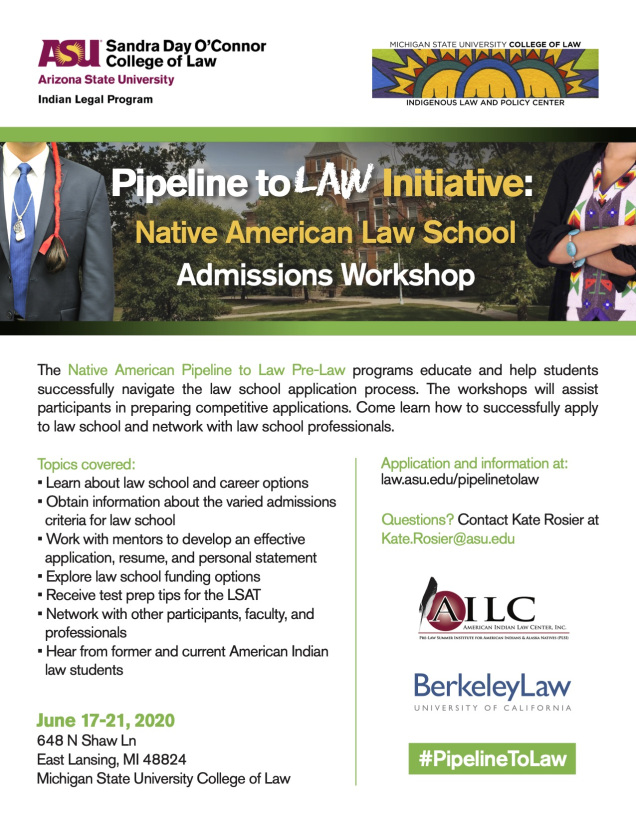
Pre-Law students can apply today for The Native American Pipeline to Law Admissions Workshop to prepare for the law school application process while networking with law school professionals. More information below.
June 17-21, 2020
Hosted at the MSU College of Law in East Lansing, MI
 Turtle Talk
You must be logged in to post a comment.